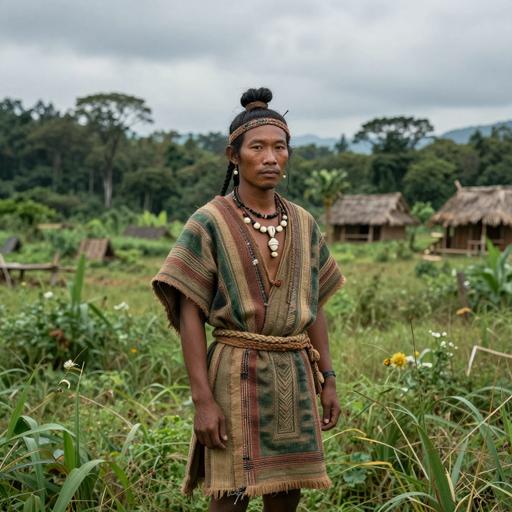
The Story
The journey of mtDNA haplogroup F1C1A1
Origins and Evolution
mtDNA haplogroup F1C1A1 is a downstream subclade of F1C1A, itself a branch of the broader East/Southeast Asian haplogroup F1. Based on its phylogenetic position and molecular clock estimates for closely related lineages, F1C1A1 most likely originated in the early-to-mid Holocene (on the order of ~6–7 kya), probably on the East Asian mainland or the adjacent coastal regions of Southeast Asia. Its emergence fits within the demographic landscape after the end of the Last Glacial Maximum, a period marked by expanding sedentary farming populations, increased regional connectivity, and later maritime dispersals.
Molecular dating for branches of F1 and F1C1 generally places their coalescence in the early Holocene; F1C1A is often dated to around ~8 kya, and F1C1A1 represents a younger diversification within that context. The distribution and age are consistent with a scenario of regional continuity in southern China and mainland Southeast Asia followed by Holocene movements into Island Southeast Asia and coastal East Asia.
Subclades
F1C1A1 itself may contain further internal substructure detectable with high-resolution mitogenome sequencing, though published sampling has been limited. Where internal subclades are reported, they tend to show localized geographic patterns (for example, variants concentrated on particular islands or among specific ethnic groups), which is typical for maternal lineages that experience founder effects during island colonization or coastal expansions. Ancient DNA hits (three documented archaeological samples in the provided database) support its presence in archaeological contexts, but the sparse aDNA record limits fine-scale reconstruction of its subclade branching.
Geographical Distribution
F1C1A1 occurs at low-to-moderate frequencies across a swath of East and Southeast Asia. It is best documented in:
- Mainland East Asia (northern and southern Han Chinese populations, scattered minority groups such as Zhuang and Yao) and neighboring Korea and Japan (including some Ryukyu/Okinawan individuals).
- Mainland Southeast Asia (Vietnamese, Thai, Lao) and Island Southeast Asia (Philippines, parts of Indonesia and Malaysia), where it appears among Austronesian-speaking and other coastal populations.
- Low-frequency occurrences have also been reported in Near Oceania (Austronesian-derived groups in parts of Melanesia and Micronesia), with very rare reports from coastal South Asian groups and sporadic traces in Central Asian or southern Siberian samples, likely reflecting long-distance gene flow or recent historical contacts.
This geographic pattern—concentration in East and Southeast Asia with island and coastal penetrations—aligns with both prehistoric coastal dispersals and the later Austronesian maritime expansion.
Historical and Cultural Significance
While F1C1A1 is not typically a dominant lineage in any single large population, its distribution is informative about regional demographic processes:
- Neolithic continuity in southern China and mainland Southeast Asia: The lineage supports models in which maternal lineages present in the early Holocene persisted locally and contributed to later population mixtures.
- Austronesian-associated dispersals: The presence of F1C1A1 in Island Southeast Asia and parts of Near Oceania at low frequencies is consistent with its transport during Austronesian maritime expansions from Taiwan and coastal Southeast Asia during the mid- to late Holocene. In many source and destination populations it co-occurs with other East/Southeast Asian maternal lineages (e.g., B4, M7), which collectively mark the mixed ancestry of Austronesian-speaking groups.
- Minor footprints in Japan and Korea: Low-frequency occurrences in the Japanese archipelago (including Ryukyu/Okinawa) and Korea likely reflect prehistoric coastal contacts, northeastward movement of people and cultural exchange, and later historical gene flow.
Ancient DNA occurrences (three samples in the referenced database) show that F1C1A1 has been present in archaeological contexts, providing direct temporal anchoring for its Holocene presence in the region, though more aDNA data are needed to trace precise migration events.
Conclusion
F1C1A1 is a regional East/Southeast Asian maternal lineage that exemplifies the combined legacy of Neolithic regional continuity and Holocene coastal and maritime dispersals, including the Austronesian expansion. Its low-to-moderate, patchy distribution across mainland East Asia, Island Southeast Asia, and parts of Near Oceania highlights processes of local persistence, founder effects during island colonization, and later admixture. Continued high-resolution mitogenome sampling and ancient DNA recovery will refine its internal structure and illuminate the timing and routes of its dispersals.
Key Points
- Origins and Evolution
- Subclades
- Geographical Distribution
- Historical and Cultural Significance
- Conclusion