Menu
mtDNA Haplogroup • Maternal Lineage

F1E3

mtDNA Haplogroup F1E3

~4,000 years ago
Southeast Asia
0 subclades
Scroll to explore
Chapter I

The Story

The journey of mtDNA haplogroup F1E3

Origins and Evolution

mtDNA haplogroup F1E3 sits as a subclade of F1E, itself a branch of the broader East/Southeast Asian haplogroup F clade. Based on the parent clade's estimated time depth (~9 kya) and the internal diversity reported for F1E sublineages, F1E3 most plausibly arose in the mid-Holocene (a few thousand years after the initial postglacial expansions of F1) within mainland or island parts of Southeast Asia. Its distribution and low-to-moderate diversity are consistent with a Holocene origin tied to regional demographic processes rather than a deep Pleistocene split.

Because the F1 lineage and its subclades are part of the R9-derived maternal radiation characteristic of East and Southeast Asia, F1E3 represents a localized refinement of this maternal heritage. The emergence of F1E3 likely reflects population structuring that occurred as Neolithic farming practices expanded through southern China and into mainland Southeast Asia, followed by later maritime movements (notably Austronesian dispersals) that redistributed some maternal lineages into island Southeast Asia and Near Oceania.

Subclades (if applicable)

At present, F1E3 appears to be a relatively narrowly represented subclade with limited reported downstream structure in published population surveys. Where larger sample sets exist, F1E3 occasionally shows minor internal branching, but no widely recognized deep subclade series comparable to older mtDNA lineages. Continued sequencing of complete mitochondrial genomes in targeted Southeast Asian and island populations may reveal further substructure and allow better calibration of its internal chronology.

Geographical Distribution

F1E3 is most commonly reported at low-to-moderate frequency across southern China and mainland Southeast Asia (Vietnam, Thailand, Laos), with additional occurrences in island Southeast Asia (Philippines, Indonesia, Malaysia) and sporadic low-frequency reports in Ryukyuan/Okinawan populations, parts of Near Oceania, and among some coastal East Asian communities. Its presence in both continental and island contexts is consistent with a distribution shaped by Neolithic southward/sea-borne expansions of people and later Austronesian movements. Ancient DNA occurrences are rare but have been recorded in a small number of Holocene archaeological samples, confirming a Holocene antiquity in the region.

Historical and Cultural Significance

F1E3 should be viewed as part of the maternal genetic substrate of southern China and Southeast Asia that interacted with incoming agricultural groups and later maritime migrants. It is therefore informative for studies of:

  • Neolithic transitions in southern China and mainland Southeast Asia, where farming-associated demographic shifts redistributed maternal lineages.
  • Austronesian dispersals, which carried a mixture of continental Southeast Asian and island-adapted maternal lineages into the Philippines, eastern Indonesia, and beyond. While not a defining marker of Austronesian expansion by itself, F1E3 can appear among admixed island populations influenced by that movement.
  • Regional continuity and admixture, because its distribution pattern often mirrors locales where Paleolithic/early Holocene substratum persisted and mixed with incoming farmers.

Archaeogenetic detection of F1E3 in Holocene samples, even if infrequent, supports its role as a persistent local lineage through cultural transitions rather than a purely recent introduction.

Conclusion

F1E3 is a mid-Holocene daughter clade of F1E with a principally Southeast Asian provenance. It is best interpreted as a regional maternal lineage that highlights local demographic processes — Neolithic farmer expansion, subsequent local differentiation, and partial redistribution through Austronesian maritime movements. Future full mitogenome sequencing across under-sampled Southeast Asian and island populations will improve resolution of its internal structure, age estimates, and precise migratory episodes associated with its spread.

Key Points

  • Origins and Evolution
  • Subclades (if applicable)
  • Geographical Distribution
  • Historical and Cultural Significance
  • Conclusion

Chapter II

Tree & Relationships

Phylogenetic context and subclades

Evolution Path
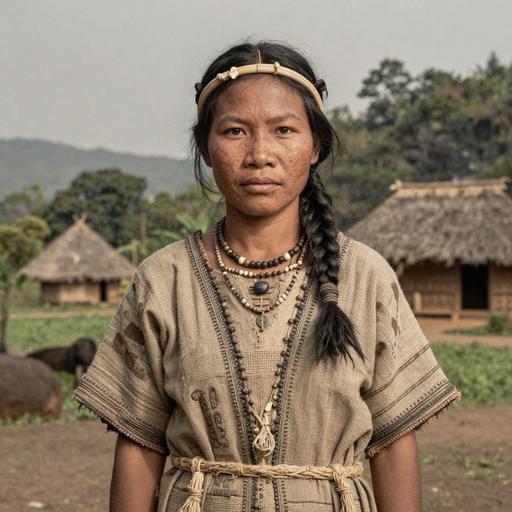
This haplogroup's evolutionary journey from its earliest ancestor to the present.

Steps Haplogroup Age Estimate Archaeology Era Time Passed Immediate Descendants Tested Modern Descendants Ancient Connections
1 F1E3 Current ~4,000 years ago 🔶 Bronze Age 4,500 years 0 2 0
2 F1E ~9,000 years ago 🌾 Neolithic 9,000 years 1 4 2
3 F1 ~25,000 years ago 🦴 Paleolithic 25,000 years 7 115 10
4 N ~60,000 years ago 🦴 Paleolithic 60,000 years 15 15,452 13
5 L3 ~70,000 years ago 🦴 Paleolithic 70,000 years 11 17,621 6
6 L ~160,000 years ago 🦴 Paleolithic 160,000 years 7 18,987 5

Subclades (0)

Terminal branch - no known subclades

Chapter III

Where in the World

Geographic distribution and modern presence


Place of Origin

Southeast Asia

Modern Distribution

The populations where mtDNA haplogroup F1E3 is found include:

  1. Southern Han Chinese and other southern Chinese groups
  2. Vietnamese and other mainland Southeast Asian groups (Thai, Lao)
  3. Filipinos (particularly some island populations)
  4. Indonesians and Malays (island Southeast Asia)
  5. Some Austronesian-derived Near Oceanian populations (low frequency)
  6. Ryukyu/Okinawan groups (occasional reports)
  7. Koreans (rare/low frequency reports)
  8. Tibeto-Burman fringe populations (low frequency)
  9. Scattered occurrences in southern China minority groups (e.g., Tai-Kadai or Hmong-Mien speakers)
  10. Occasional isolated reports in coastal East Asian communities
CHAPTER IV

When in Time

Your haplogroup in the context of human history

~10k years ago

Neolithic Revolution

Agriculture begins, settled communities form

~5k years ago

Bronze Age

Metalworking, writing, and early civilizations

~4k years ago

Haplogroup F1E3

Your mtDNA haplogroup emerged in Southeast Asia

Southeast Asia
~3k years ago

Iron Age

Iron tools, expanded trade networks

~2k years ago

Classical Antiquity

Greek and Roman civilizations flourish

Present

Present Day

Modern era

Your Haplogroup
Historical Era
Chapter IV-B

Linked Cultures

Ancient cultures associated with mtDNA haplogroup F1E3

Cultural Heritage

These ancient cultures have been linked to haplogroup F1E3 based on matching ancient DNA samples from archaeological excavations. The presence of this haplogroup in these cultures provides insights into the migrations and population movements of populations carrying this haplogroup.

Dong Son Kurma Culture Late Medieval Mongolian Upper Yellow River Culture Ust-Belaya Culture Vietnamese Neolithic Yellow River Culture
Culture assignments are based on archaeological context of ancient DNA samples and may represent regional associations during specific time periods.
Chapter V

Sample Catalog

Top 50 ancient DNA samples directly related to haplogroup F1E3 or parent clades

50 / 50 samples
Portrait Sample Country Era Date Culture mtDNA Match
Portrait of ancient individual I3736 from Taiwan, dated 1 CE - 800 CE
I3736
Taiwan Iron Age Taiwan 1 CE - 800 CE Taiwanese Iron F4b1 Direct
Portrait of ancient individual I3731 from Taiwan, dated 1 CE - 800 CE
I3731
Taiwan Iron Age Taiwan 1 CE - 800 CE Taiwanese Iron F3b1 Direct
Portrait of ancient individual I8074 from Taiwan, dated 1 CE - 800 CE
I8074
Taiwan Iron Age Taiwan 1 CE - 800 CE Taiwanese Iron F3b1a-a Direct
Portrait of ancient individual I8080 from Taiwan, dated 1 CE - 800 CE
I8080
Taiwan Iron Age Taiwan 1 CE - 800 CE Taiwanese Iron F3b1a-a Direct
Portrait of ancient individual I14926 from Taiwan, dated 1 CE - 800 CE
I14926
Taiwan Iron Age Taiwan 1 CE - 800 CE Taiwanese Iron F4b1 Direct
Portrait of ancient individual I14933 from Taiwan, dated 1 CE - 800 CE
I14933
Taiwan Iron Age Taiwan 1 CE - 800 CE Taiwanese Iron F3b1a Direct
Portrait of ancient individual I15160 from Taiwan, dated 1 CE - 800 CE
I15160
Taiwan Iron Age Taiwan 1 CE - 800 CE Taiwanese Iron F4b1 Direct
Portrait of ancient individual I15159 from Taiwan, dated 1 CE - 800 CE
I15159
Taiwan Iron Age Taiwan 1 CE - 800 CE Taiwanese Iron F4b1 Direct
Portrait of ancient individual I8079 from Taiwan, dated 1 CE - 800 CE
I8079
Taiwan Iron Age Taiwan 1 CE - 800 CE Taiwanese Iron F3b1 Direct
Portrait of ancient individual DA104 from Kyrgyzstan, dated 1 CE - 700 CE
DA104
Kyrgyzstan The Hun Period in Kyrgyzstan 1 CE - 700 CE Hunnic Period F1b1-a Direct
Chapter VI

Carrier Distribution Map

Geographic distribution of 100 ancient DNA samples carrying haplogroup F1E3

Time Period Filter
All Time Periods
Showing all samples
Each marker represents an ancient individual
Chapter VII

Temporal Distribution

Distribution of carriers across archaeological periods

Chapter VIII

Geographic Distribution

Distribution of carriers by country of origin

Chapter IX

Country × Era Distribution

Cross-tabulation of carrier countries and archaeological periods

Data

Data & Provenance

Source information and data quality

Last Updated 2026-02-16
Confidence Score 50/100
Coverage Low
Data Source

We use the latest phylotree for MTDNA haplogroup classification and data.