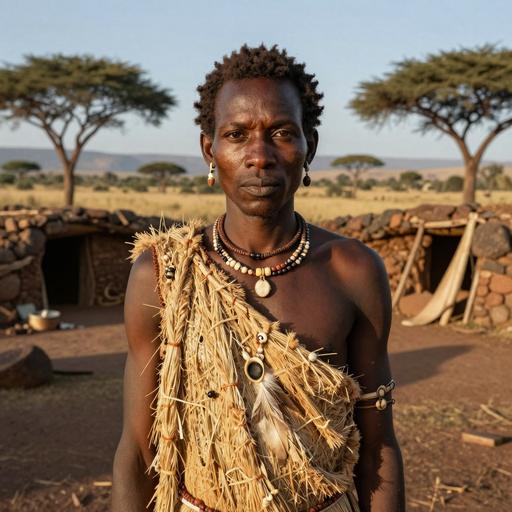
The Story
The journey of mtDNA haplogroup L0A2D
Origins and Evolution
mtDNA haplogroup L0A2D is a subclade of L0A2, which itself derives from the deeply rooted African lineage L0A. L0A2 has a Late Pleistocene origin in eastern Africa (~30 kya), while L0A2D represents a later branching event within that clade, likely arising during the Holocene (several thousand years ago). The timing and pattern of L0A2D's diversification are consistent with regional demographic shifts in the Horn of Africa and adjacent East African regions during the mid- to late-Holocene, including shifts in subsistence, climate-driven population movements, and later cultural expansions.
Genetically, L0A2D carries the diagnostic mutations that place it within the L0A2 sub-tree and distinguishes it from other L0A2 subclades. Its phylogenetic position implies descent from an East African maternal gene pool, with subsequent dispersal into neighboring regions through both ancient and recent gene flow.
Subclades
As a defined subclade of L0A2, L0A2D may itself contain finer branches that have been identified in population screens and sequencing studies, though the internal structure of L0A2D is less extensively sampled than more common global mtDNA clades. Where full mitogenome sequencing has been performed, researchers can resolve internal diversification and coalescence times; as sample coverage increases, additional named sub-branches of L0A2D may be recognized. At present, the lineage is best viewed as a regional Holocene subclade nested within L0A2.
Geographical Distribution
L0A2D is concentrated in eastern Africa and is observed at varying frequencies across the African continent and in populations with African maternal ancestry. Typical distributional patterns include higher frequencies in Horn of Africa and adjacent East African groups, with moderate representation in central and southern African populations via Holocene and historic migrations, and low-frequency occurrences in the African diaspora (Americas) and on Madagascar. A small number of isolates have been reported in North Africa and the Near East, reflecting historical contact and gene flow.
Ancient DNA data for L0A2D are still limited; according to available archaeological datasets this subclade appears in at least one ancient sample, consistent with an established Holocene presence in the region.
Historical and Cultural Significance
The distribution of L0A2D aligns with demographic processes important in Holocene Africa. It likely persisted in maternal lineages of groups engaged in diverse subsistence strategies in East Africa — including pastoralist, agriculturalist, and forager communities — and was carried along routes of migration and admixture. The later spread of Bantu-speaking populations and movements associated with coastal trade (including the peopling of Madagascar) provided mechanisms that transported East African maternal lineages, including L0A2D, into central and southern Africa and to island populations in the western Indian Ocean.
Because mtDNA traces strictly maternal ancestry, L0A2D complements autosomal and Y-chromosome signals used to reconstruct population history. In many present-day contexts its presence can indicate East African maternal ancestry or past admixture with East African groups.
Conclusion
L0A2D is a regionally informative Holocene subclade of L0A2, rooted in eastern Africa and dispersed through a combination of prehistoric and historic movements. While sampling remains incomplete compared with major global haplogroups, available genetic data show L0A2D as part of the maternal legacy of East Africa with measurable contributions to the maternal pools of central and southern Africa, Madagascar, and Afro-diasporic populations. Ongoing mitogenome sequencing and ancient DNA recovery will refine its internal structure and precise timing of expansion.
Key Points
- Origins and Evolution
- Subclades
- Geographical Distribution
- Historical and Cultural Significance
- Conclusion