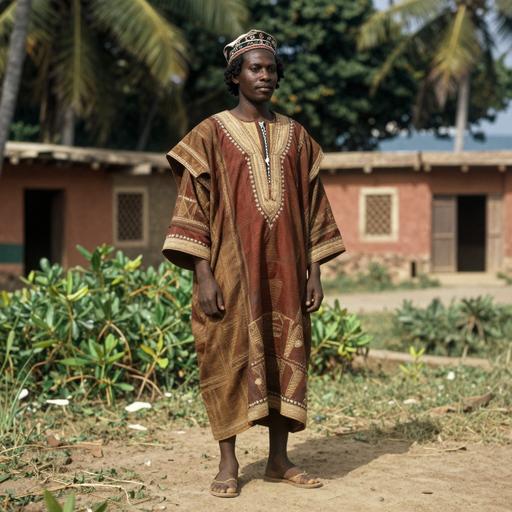
The Story
The journey of mtDNA haplogroup L3E1D
Origins and Evolution
mtDNA haplogroup L3E1D is a downstream lineage of L3E1, itself a branch of the broader African haplogroup L3e. Based on the parent clade's time depth (L3E1 ~15 kya) and typical branching patterns observed in L3e, L3E1D most plausibly arose in the early Holocene, roughly ~8 kya, in West/Central Africa. Like other L3e subclades, L3E1D is defined by a set of coding-region and control-region mutations that distinguish it from sibling and parent lineages; however, precise mutation motifs and the internal topology depend on the density of regional sampling and full mitogenome sequencing.
Divergence of L3E1D likely reflects local population structure and demographic events in the Holocene — including post-glacial environmental changes, localized expansions of foraging communities, and later agriculturalist movements that redistributed maternal lineages across sub-Saharan Africa.
Subclades (if applicable)
As a named subclade (L3E1D), it may have further internal diversity detectable only with high-resolution mitogenome data. Published population surveys often record L3e substructure (L3e1a, L3e1b, etc.), and L3E1D should be treated as an intermediate terminal clade until additional sequences clarify deeper splits. Future sequencing efforts may reveal further sub-branches (e.g., L3E1D1, L3E1D2) or collapse/merge lineages as phylogenies are refined.
Geographical Distribution
L3E1D is principally West/Central African in origin and today is observed at varying frequencies across a geographic corridor that includes coastal and inland West Africa and the Central African rainforest. The lineage is also found among Bantu-speaking populations across Central, Southern and parts of Eastern Africa as a result of Holocene demographic expansions. Due to the transatlantic slave trade and modern migrations, L3E1D appears at low to moderate frequencies in African-descended populations in the Americas and the Caribbean. Sparse occurrences in North Africa and the Near East reflect historical admixture and long-distance contacts but are uncommon.
Patterns of distribution should be interpreted cautiously: the apparent frequency of L3E1D in any one region depends strongly on sampling intensity, the resolution of mtDNA typing, and the degree to which complete mitogenomes (rather than HVR sequences) were used in studies.
Historical and Cultural Significance
While mtDNA lineages do not map one-to-one to archaeological cultures, the demographic events that redistributed L3E1D are clear in population-genetic and historical contexts. The Bantu expansions (beginning ~3–4 kya) transported many West/Central African maternal lineages — including L3e derivatives — far to the south and east, producing the broad presence of such haplogroups in contemporary Bantu-speaking populations. Later historical processes, notably the transatlantic slave trade, dispersed West and Central African maternal lineages, including subclades like L3E1D, into the Americas and Caribbean.
L3E1D may be encountered at higher relative frequencies in populations with strong continuity in the rainforest and coastal West Africa where maternal line continuity persisted through the Holocene, while its presence in other regions often marks later movement or admixture.
Conclusion
mtDNA L3E1D is an early-Holocene maternal lineage rooted in West/Central Africa and nested within the broader L3e radiation. Its distribution today reflects a combination of deep regional ancestry and later demographic processes—particularly the Bantu expansions and historic diasporas—making it a useful marker for reconstructing maternal ancestry and population movements in sub-Saharan Africa and its diaspora. Continued mitogenome sequencing across under-sampled African groups will refine the age estimates, internal structure, and precise geographic origins of L3E1D.
Key Points
- Origins and Evolution
- Subclades (if applicable)
- Geographical Distribution
- Historical and Cultural Significance
- Conclusion