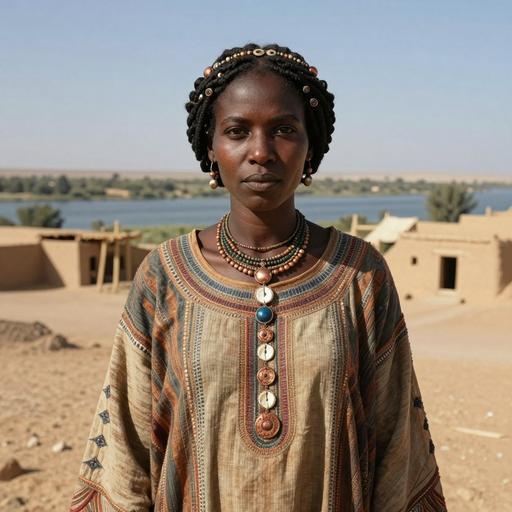
The Story
The journey of mtDNA haplogroup L3F1A
Origins and Evolution
mtDNA haplogroup L3F1A is a downstream subclade of L3F1, itself a branch of the broader L3 macro-haplogroup. Given the established East African/Horn origin of L3F1 in the Late Pleistocene and early Holocene, L3F1A most likely arose locally in the Horn or adjacent East African regions during the early to mid-Holocene (roughly ~7 kya by molecular clock estimates for the subclade). The clade represents a regional diversification of female lineages that followed the initial differentiation of L3-derived lineages across eastern and sub-Saharan Africa.
Phylogenetically, L3F1A sits beneath L3F1 and shares much of the regional distributional pattern of its parent, but shows signatures of a later and more geographically localized expansion. Inference about its timing and spread relies on complete mitochondrial genomes from present-day populations and comparisons with temporally and geographically informative ancient DNA when available; however, ancient samples carrying this exact subclade remain rare, so conclusions combine observed modern frequency patterns with molecular-clock-based age estimates.
Subclades (if applicable)
As a named subclade (L3F1A), this lineage may contain further internal diversity (e.g., downstream branches or private lineages found in specific populations), but many of those downstream splits are rare and often defined only by complete mtDNA sequence studies. Where detailed sequencing has been performed, researchers sometimes identify population-specific branches within L3F1A that reflect localized maternal line continuity (for example, branches concentrated in the Horn versus branches seen in Central African hunter-gatherer groups). Continued mitogenome sampling will refine the internal topology and the timing of daughter clades.
Geographical Distribution
Primary concentrations of L3F1A are in the Horn of Africa and adjacent East African communities (including Oromo, Amhara, Somali and coastal groups). Moderate frequencies appear in Central African populations (including some Pygmy and other equatorial groups), while lower frequencies have been reported in parts of West Africa (e.g., Yoruba and neighboring populations) and southern Africa (among some Khoe-San and Bantu-speaking groups) — patterns consistent with multiple episodes of movement and admixture across sub-Saharan Africa. The haplogroup is also detected at low frequencies in the African diaspora in the Americas and in North Africa and the Middle East as a result of historic trade, migration and the trans-Atlantic slave trade.
The current geographic footprint suggests an origin in the Horn/East Africa with a subsequent spread through gene flow, local expansions (for example connected to pastoralist or agricultural dispersals), and later long-distance movements that carried L3F1A-bearing maternal lines into other regions.
Historical and Cultural Significance
While mtDNA haplogroups do not map neatly onto cultural or linguistic groups, the distribution of L3F1A is consistent with demographic processes known from archaeology and historical linguistics in East Africa. The clade's emergence in the Holocene places it within the time frame of regional cultural transitions such as the spread of pastoralism in eastern Africa (Pastoral Neolithic) and later Iron Age and historical period movements.
- In the Horn and adjacent areas, pastoralist expansions and local population growth could have amplified L3F1A frequencies in some groups.
- The Bantu expansion and other later farmer/forager interactions likely redistributed maternal lineages, creating the low-to-moderate presence of L3F1A observed outside East Africa.
- Historical trade routes across the Red Sea and Indian Ocean and recent historical events (including the trans-Atlantic slave trade) account for occurrences of L3F1A in North Africa, the Middle East and the Americas.
These associations are inferred from concordance between mtDNA geographic patterns and archaeological/historical records rather than direct archaeological assignment of mtDNA to named cultures.
Conclusion
L3F1A is a Holocene-age, East African-derived maternal lineage representing localized diversification inside the broader L3F1 clade. Its modern distribution—strongest in the Horn and East Africa, present at moderate levels in Central Africa, and at low frequencies across West, Southern Africa and the African diaspora—reflects a history of regional continuity, Holocene demographic changes (including pastoralist and farming expansions), and later long-distance dispersals. Ongoing mitogenome sequencing and ancient DNA recovery from East and Central Africa will refine the age estimates and the detailed phylogeographic history of L3F1A.
Key Points
- Origins and Evolution
- Subclades (if applicable)
- Geographical Distribution
- Historical and Cultural Significance
- Conclusion