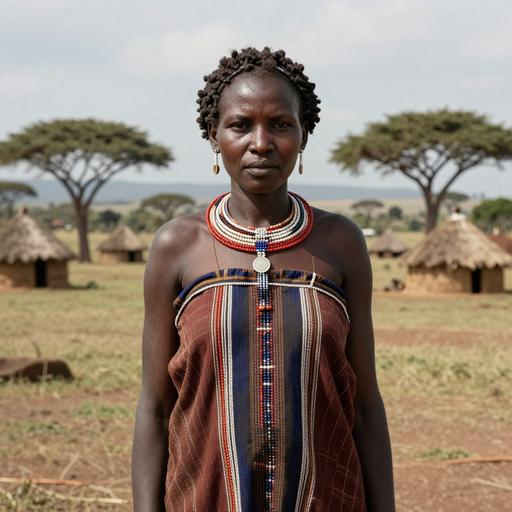
The Story
The journey of mtDNA haplogroup L3F2A
Origins and Evolution
mtDNA haplogroup L3F2A is a downstream subclade of L3F2 (itself a branch of L3f and ultimately of macro-haplogroup L3). Based on the time depth of its parent clade (L3F2 ~12 kya) and phylogenetic branching patterns, L3F2A most likely arose in the Early Holocene within East Africa, particularly the Horn of Africa region. The emergence of L3F2A fits with a broader pattern of maternal lineage diversification in East Africa during the Late Pleistocene–Early Holocene, a period of climatic change and increasing regional population structure.
The mutation profile that defines L3F2A distinguishes it from other L3F2 subclades; however, published sampling for very specific downstream branches like L3F2A is still sparse compared with major African macro-haplogroups. That limited sampling means age and spatial inferences have moderate uncertainty, but the topology within L3F2 supports a relatively recent Holocene origin for L3F2A compared with deeper L3 branches.
Subclades
At present, L3F2A is treated as a defined terminal or near-terminal subclade within L3F2 in many phylogenies. Where additional downstream branches exist, they are typically low-frequency and have been identified only in targeted or small-sample studies. Further whole-mtDNA sequencing of East and adjacent African populations will clarify whether L3F2A contains multiple well-differentiated subclades or is a small, localized lineage.
Geographical Distribution
L3F2A shows its highest representation in the Horn of Africa and adjacent East African populations, with lower-frequency occurrences reported in Central and West African groups and, through historical translocations, among African-descended populations in the Americas. Regional patterns are consistent with an origin in or near the Horn and later spread by localized migration, trade, pastoralist movements, and more recent historical population flows (including the transatlantic slave trade and intra-African migrations).
Observed presence in populations such as Oromo, Amhara, Somali and coastal East African groups (e.g., Swahili-adjacent communities) supports an East African focal area, while occasional detections among West African groups (e.g., Yoruba) and Central African hunter-gatherer groups indicate either older shared ancestry, gene flow, or sampling of lineages that have dispersed more widely.
Historical and Cultural Significance
Because L3F2A is a regional maternal marker rather than one associated with a single large-scale migration event across continents, its significance is primarily local and regional. It likely participated in demographic processes of the Early Holocene and later millennia in East Africa, including the spread of pastoralist lifeways, coastal trading networks, and later expansions (for example, movements associated with Iron Age population dynamics and the Bantu expansion interacting with existing East African maternal lineages).
The haplogroup can therefore be informative in studies of maternal population structure in the Horn and adjacent regions, and in reconstructing fine-scale female-mediated gene flow when combined with broader mtDNA, autosomal and archaeological evidence.
Conclusion
L3F2A is a recognizable, low-to-moderate frequency maternal lineage that reflects Holocene diversification in East Africa / the Horn. Current evidence places its origin in the Early Holocene with localized distribution concentrated in East Africa and peripheral, lower-frequency occurrences across other African regions and the African diaspora. Improved geographic sampling and complete mtDNA sequencing will refine its internal structure, exact age estimates, and the routes by which it dispersed beyond its core area.
Key Points
- Origins and Evolution
- Subclades
- Geographical Distribution
- Historical and Cultural Significance
- Conclusion