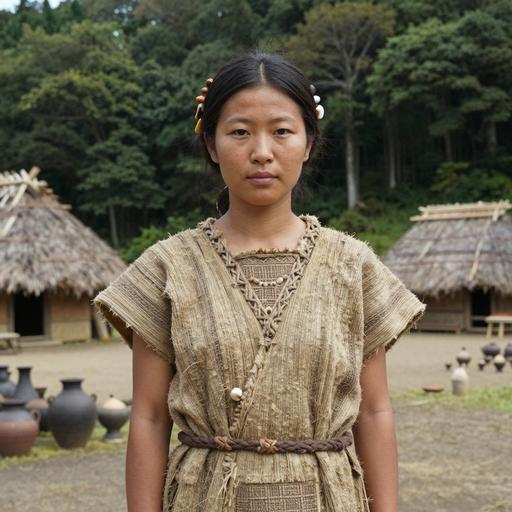
The Story
The journey of mtDNA haplogroup N9B
Origins and Evolution
mtDNA haplogroup N9b is a daughter lineage of macro-haplogroup N9, itself derived from macro-haplogroup N. Based on phylogenetic placement and coalescence estimates for closely related N9 subclades, N9b most likely diversified in Northeast/East Asia during the Late Upper Paleolithic to early Holocene (roughly ~20–15 kya, here approximated as ~18 kya). Its emergence fits the broader pattern of mitochondrial diversification in East Asia following the Last Glacial Maximum, when populations expanded locally and recolonized temperate zones.
Subclades
N9b contains several internal branches (often reported in the literature as N9b1, N9b2, etc.) with different geographic emphases. Some sublineages show strong localization within the Japanese archipelago (including lineages associated with the indigenous Jomon and later Ryukyu populations), while others are found at low frequencies across continental Northeast Asia. The internal structure indicates both deep persistence in island populations and occasional gene flow between islands and the mainland.
Geographical Distribution
N9b is most frequent and characteristic in the Japanese archipelago, especially in populations with greater retention of indigenous maternal lineages (e.g., some Ainu- and Ryukyu-associated groups), and in ancient Jomon samples. It is also present at lower frequencies among mainland East Asian populations (Koreans, some Han Chinese groups), and among some Siberian/Far Eastern groups (e.g., Nivkh, Ulchi) where contact with coastal Northeast Asians occurred. Scattered low-frequency occurrences appear in parts of Southeast Asia and Central Asia, typically interpreted as resulting from prehistoric or historic gene flow.
Historical and Cultural Significance
Because of its concentration in Jomon-associated remains and in modern populations of the Japanese islands, N9b is widely used as a maternal marker for studying prehistoric population continuity and isolation in Japan. The persistence of N9b lineages in island populations through the Holocene supports models where pockets of maternal ancestry survived regional cultural transitions (for example, the transition from Jomon to Yayoi in parts of the archipelago) and contributed to the modern genetic landscape. N9b's distribution also informs reconstructions of coastal and inland contacts between Northeast Asia and the archipelagos.
Conclusion
N9b is a regionally informative mtDNA lineage that reflects a mixture of deep local continuity in the Japanese islands and limited but detectable connections with mainland Northeast Asia and adjacent regions. Its pattern—relatively high frequency in specific island populations and low frequency on the continent—is consistent with a Late Upper Paleolithic origin followed by localized persistence and occasional dispersal during the Holocene.
Key Points
- Origins and Evolution
- Subclades
- Geographical Distribution
- Historical and Cultural Significance
- Conclusion