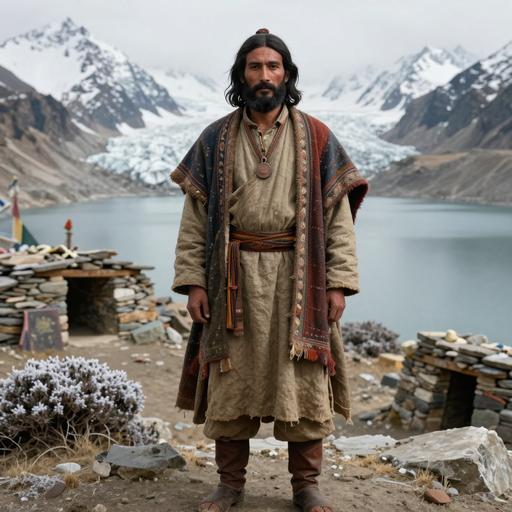
The Story
The journey of mtDNA haplogroup RCR
Origins and Evolution
Haplogroup RCR is a downstream clade of the parent lineage RC, itself a derivative of macro-haplogroup R. Based on the phylogenetic position of RC and typical divergence times within R-derived clades, RCR most plausibly formed in South Asia during the Upper Paleolithic (roughly 30–40 kya) as populations carrying R-derived mitochondrial lineages diversified in the region. Its formation reflects local differentiation of maternal lineages after the initial spread of R-lineages out of West/South Asia.
Genetic evidence for lineages like RCR is consistent with a scenario in which early coastal and inland South Asian groups retained and locally diversified maternal lineages through the Late Pleistocene and early Holocene, with later low-level dispersals radiating into neighboring regions during Holocene population movements.
Subclades (if applicable)
As an intermediate clade, RCR may have one or more downstream subclades (e.g., hypothetical RCRa, RCRb) identifiable by additional diagnostic mutations on the mitochondrial coding region and control region. These subclades, if present, would likely show regional structuring: some confined to the Indian subcontinent, others tracing Holocene dispersals into Southeast Asia and Oceania. Detailed resolution of subclades depends on high-coverage mitogenomes and comprehensive sampling across South and Southeast Asia.
Geographical Distribution
RCR is most frequent and diverse in South Asia, reflecting its origin and long-term persistence there. Moderate frequencies and lower diversity appear in parts of Central Asia and Southeast Asia, consistent with prehistoric and historic contact and gene flow. Low-frequency occurrences in East Asia, Southern Europe, and some parts of Oceania likely reflect rare long-distance dispersal events, maritime movements, or historic migrations (for example, trade and small-scale migrations connecting South Asia with Southeast Asia and beyond).
Regional patterns expected for RCR:
- High diversity/ frequency in South Asia, indicating origin and long-term presence.
- Moderate presence in Central and Southeast Asia, reflecting overland and coastal dispersals.
- Low-level sporadic occurrences in East Asia, Southern Europe and Oceania, representing rare dispersals or admixture.
Historical and Cultural Significance
Haplogroup RCR, as part of the broader R-derived mitochondrial diversity, played a background role in the maternal ancestry of many South Asian populations. It would have been carried by hunter-gatherer and early Holocene groups and persisted through cultural transitions such as the spread of agricultural practices and the formation of Bronze Age societies in South Asia. Secondary dispersals of RCR-type lineages could be associated with:
- Neolithic and post-Neolithic demographic movements within South and Southeast Asia (including coastal migrations and Austroasiatic/Austronesian associated movements in parts of Southeast Asia).
- Historic trade and migration networks linking South Asia with West Asia, East Africa, and island Southeast Asia, facilitating low-frequency long-distance transfers of maternal lineages.
While not diagnostic of a single archaeological culture, RCR would contribute to the composite maternal gene pool found in archaeological skeletal assemblages from the Holocene in South Asia and neighboring regions.
Conclusion
RCR is best understood as a regional South Asian mtDNA clade that emerged during the Upper Paleolithic and survived as a component of maternal diversity through the Holocene. Its principal significance is as a marker of long-term South Asian maternal lineages with measurable but limited dispersal into adjacent regions; resolving its internal substructure requires comprehensive mitogenome sequencing across South, Central and Southeast Asian populations.
Key Points
- Origins and Evolution
- Subclades (if applicable)
- Geographical Distribution
- Historical and Cultural Significance
- Conclusion