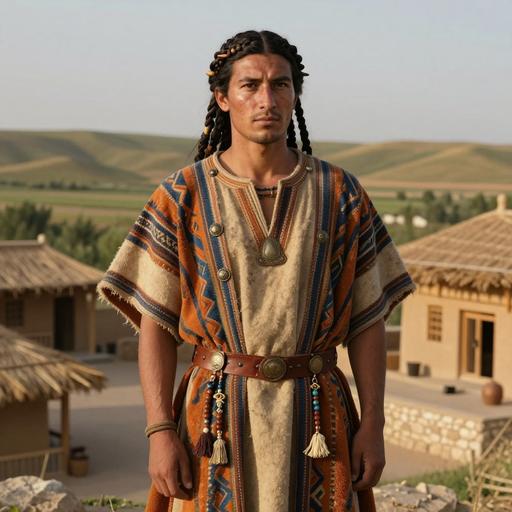
The Story
The journey of mtDNA haplogroup T1A4
Origins and Evolution
mtDNA haplogroup T1A4 is a downstream lineage of T1A, itself a branch of haplogroup T1 that likely arose in the Near East during the early Neolithic period. Based on the phylogenetic position of T1A4 beneath T1A and the observed geographic pattern in modern and ancient samples, T1A4 plausibly arose several millennia after the initial emergence of T1A — a conservative estimate places its origin in the mid-to-late Holocene (around ~6 kya), reflecting diversification within Near Eastern maternal lineages as farming populations expanded and localized lineages developed.
As an mtDNA lineage, T1A4 is defined by derived mitochondrial mutations that distinguish it from other T1A branches. Resolution and precise dating depend on whole-mitochondrial genome data and calibrated molecular clocks; current inferences combine phylogenetic placement with geographic and ancient DNA observations.
Subclades
T1A4 is itself a subclade (i.e., a terminal or near-terminal branch) within the T1A subtree. At present it appears to be a relatively shallow and rare branch with limited documented internal substructure compared with older and more widespread haplogroups. Continued mitogenome sequencing may reveal further sublineages derived from T1A4 in specific regions (for example, localized Mediterranean or Balkan offshoots), but published datasets and the limited number of ancient occurrences suggest low internal diversity so far.
Geographical Distribution
The modern distribution of T1A4 is patchy and generally of low frequency where observed. Confirmed occurrences concentrate around the Eastern Mediterranean and adjacent regions, with scattered reports in:
- The Near East / Levant (reflecting the probable origin and continuity of maternal lineages)
- Southern Europe (Italy, Greece, Iberia) and parts of the Balkans and Black Sea region, where T1A-associated lineages are known to have diffused with Neolithic and later movements
- Coastal North Africa (Mediterranean littoral), likely reflecting historic Mediterranean contacts
- Sporadic instances in Central Asia, consistent with long-distance dispersal or later mediated migration
- Jewish populations, including some Ashkenazi maternal lineages, where T1/T1A derivatives have been reported
Ancient DNA evidence in the database for this subclade (five identified ancient samples) supports its presence in archaeological contexts across the Mediterranean and adjacent regions and underscores a history of persistence at low frequency rather than broad demographic dominance.
Historical and Cultural Significance
T1A4 should be understood in the context of maternal lineages that accompanied the spread of Neolithic farming from the Near East into Europe. As a daughter lineage of T1A, T1A4 likely diversified after the major Neolithic dispersals, becoming localized in pockets of Mediterranean and Balkan populations. Its modern presence in Jewish communities and coastal North Africa points to later historical movements — including trade, population contacts across the Mediterranean, and the mobility of diasporic groups — that redistributed Near Eastern maternal lineages.
Because T1A4 is relatively rare, it has not been strongly associated with a single archaeological culture; instead, its pattern is consistent with localized continuity and sporadic migration events through the Neolithic, Bronze Age and later historical periods (classical, medieval, Ottoman). The lineage provides useful phylogeographic signal for fine-scale maternal ancestry and can help trace micro-histories of population contact when combined with high-resolution mitogenomes and archaeological context.
Conclusion
mtDNA T1A4 is a low-frequency, regionally distributed descendant of T1A whose origin in the Near East fits the broader picture of maternal lineages that diversified during and after the Neolithic. It survives today in scattered populations around the Mediterranean, the Balkans, parts of the Near East, and in some Jewish maternal lineages, and it is detectable in a small number of ancient individuals. Further mitogenome sequencing and ancient DNA sampling will improve resolution of its internal substructure, age estimates, and the specific migratory events that shaped its distribution.
Key Points
- Origins and Evolution
- Subclades
- Geographical Distribution
- Historical and Cultural Significance
- Conclusion