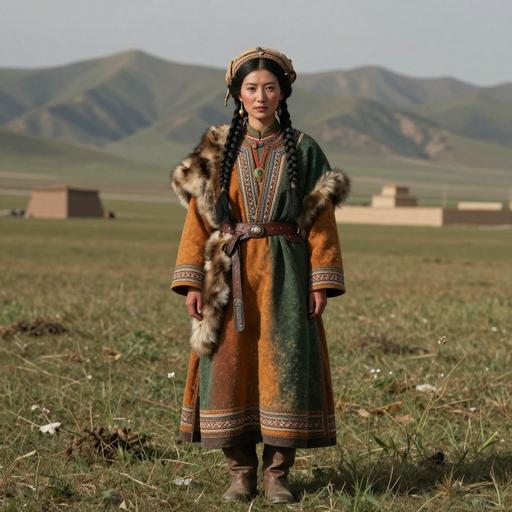
The Story
The journey of mtDNA haplogroup U3A1
Origins and Evolution
mtDNA haplogroup U3A1 is a downstream branch of U3A, itself a subclade of U3. U3A likely formed in the Near East/Caucasus during the early Holocene (around ~12 kya), and U3A1 represents a more derived lineage that probably diversified shortly thereafter (estimated here at ~9 kya). The phylogenetic position of U3A1 within U3 indicates that it is part of the maternal pool associated with post-glacial re-expansions and the spread of Neolithic-type ancestries from the Near East into neighboring regions.
The best resolution for U3A1 — distinguishing it from closely related U3A subclades — comes from whole mitogenome sequencing; control-region or partial HVS data can assign samples to U3A but may be insufficient to robustly resolve U3A1 without coding-region mutations.
Subclades
At present U3A1 appears to have limited downstream diversity in modern and published ancient samples, forming a small number of geographically restricted lineages rather than a broad star-like expansion. Where finer-scale mitogenomes are available, U3A1 shows local microclades that are often specific to the Levant, Caucasus or Anatolia, consistent with localized maternal continuity and drift. Further full-mitogenome sampling in undersampled regions (e.g., rural Anatolia, parts of the Caucasus and North Africa) is likely to reveal additional minor branches.
Geographical Distribution
Modern distribution: U3A1 is most frequently observed in Near Eastern and Caucasus populations (Levantine groups, Armenians, Georgians, and Turks) at low-to-moderate frequencies relative to major European lineages. It is present at lower frequencies in parts of southern Europe (Italy, Greece, Iberia), some North African populations (including Berber groups), and as sporadic occurrences in South and Central Asia. U3A1 is also reported in certain Jewish maternal lineages, reflecting historical Near Eastern connections and diasporic movement.
Ancient DNA: U3A and derived subclades (including U3A1 where resolved) appear in archaeological contexts from the early Holocene onward, especially in sites associated with Near Eastern Neolithic/Chalcolithic populations and later Bronze Age assemblages in the Levant and Anatolia. The lineage's presence in aDNA is consistent with its role in Neolithic and post-Neolithic demographic processes.
Historical and Cultural Significance
U3A1 fits the broader pattern of Near Eastern maternal lineages that accompanied the spread of farming and subsequent cultural interactions across the eastern Mediterranean, Caucasus, and parts of North Africa. Its distribution suggests persistence in local maternal gene pools rather than a pattern of large-scale demographic replacement. In some regions, the haplogroup's presence within Jewish communities and southern European populations reflects historical migrations, trade, and population admixture across the Mediterranean.
Because U3A1 is not a high-frequency lineage in most populations, it is most informative in population-genetic and forensic contexts when used alongside other haplogroups and genome-wide data to reconstruct fine-scale maternal ancestry and migration pathways.
Conclusion
U3A1 is a derived Near Eastern maternal lineage stemming from U3A that highlights early Holocene demographic processes centered in the Near East and Caucasus. Its low-to-moderate frequencies across the Levant, Anatolia, the Caucasus, North Africa and southern Europe, together with occurrences in ancient DNA, indicate a history of localized continuity, small-scale migrations, and integration into diverse regional maternal pools. High-resolution mitogenome data will continue to refine the internal structure and historical movements of U3A1.
Key Points
- Origins and Evolution
- Subclades
- Geographical Distribution
- Historical and Cultural Significance
- Conclusion