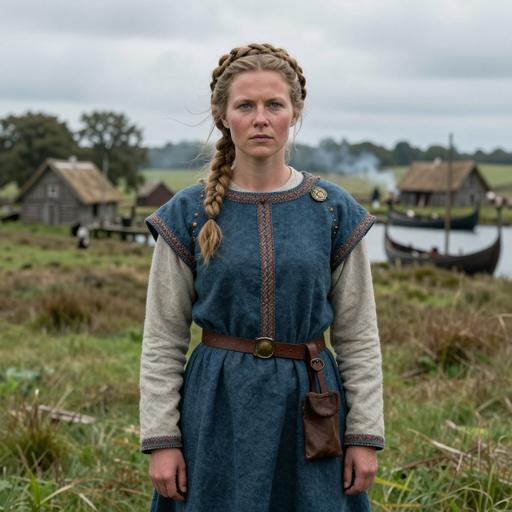
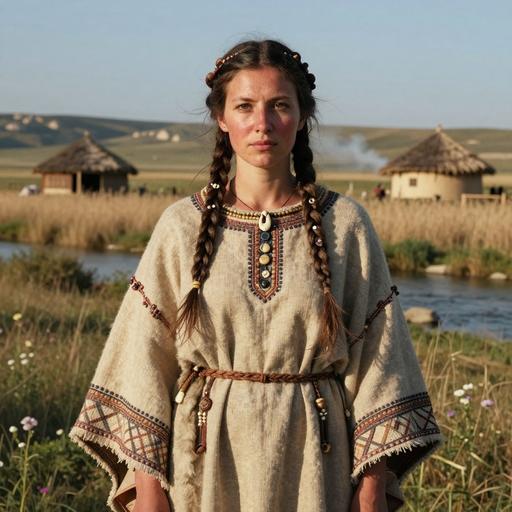
The Story
The journey of mtDNA haplogroup U5A1D2A
Origins and Evolution
Haplogroup U5A1D2A is a derived subclade nested within the U5a1 branch of haplogroup U5, itself one of the principal maternal lineages associated with European Mesolithic hunter-gatherers. Given its position downstream of U5A1D2, U5A1D2A most likely arose in northern or northeastern Europe during the early to mid-Holocene, after the Last Glacial Maximum when relict hunter-gatherer populations repopulated or expanded within Fennoscandia, the Baltic region, and adjacent parts of northwestern Russia. Its estimated time depth (on the order of several thousand years after the origin of U5a1) is consistent with continued diversification of U5 lineages in post-glacial northern refugia and at high latitudes.
Genetic patterns for this lineage suggest a history shaped by small effective population sizes, isolation in high-latitude environments, and occasional admixture with incoming farming or steppe-related groups. These processes produce the characteristic low to moderate modern frequencies and the geographically concentrated distribution seen today.
Subclades
As a specific downstream branch of U5A1D2, U5A1D2A may itself include further micro-subclades identifiable only through high-resolution whole-mitochondrial sequencing; however, its relative rarity means that many downstream splits are currently represented by only a handful of modern or ancient samples. The subclade structure reflects local founder events and drift rather than wide continent-scale expansions. Continued aDNA sampling and dense modern mitogenome sequencing in northern Europe will clarify internal branching and age estimates.
Geographical Distribution
Modern occurrences of U5A1D2A are concentrated in northern Europe (notably among Saami and other indigenous Scandinavian/Finnish groups) and in the Baltic region, with additional presence in northwestern Russia and pockets in Belarus and nearby areas. Lower-frequency occurrences are reported in central and western Europe, and sporadic findings have been recorded in the Caucasus and very rarely in North Africa—likely reflecting secondary gene flow, rare long-distance migration, or sampling noise. The lineage has also been detected in a limited number of ancient DNA contexts (7 samples in the referenced database), confirming its antiquity and continuity in northern Eurasia.
Historical and Cultural Significance
The distribution and phylogenetic placement of U5A1D2A tie it to the legacy of Mesolithic hunter-gatherer maternal ancestry in northern Europe. Its persistence into the Neolithic and later periods indicates maternal-line continuity through major cultural transitions (adoption of agriculture, later Bronze Age mobility), albeit typically at low frequencies that were shaped by local demographic dynamics. In regions where U5A1D2A is relatively enriched—such as among some Saami lineages—its presence may reflect long-term isolation, founder effects, and possible association with pre-Indo-European or Uralic-speaking population substrates. Sporadic occurrences outside the core zone illustrate the complexity of human mobility and contact across Eurasia over millennia.
Conclusion
U5A1D2A is a regionally informative mitochondrial subclade that captures part of the Mesolithic maternal heritage of northern and northeastern Europe. Its limited but persistent distribution highlights processes important to high-latitude population history: survival of ancient lineages, genetic drift and founder events in small or isolated groups, and occasional admixture with neighboring populations. As genome- and mitogenome-scale data increase for both modern and ancient samples, the phylogeny and demographic history of U5A1D2A will become clearer, improving resolution about its age, internal structure, and historical movements.
Key Points
- Origins and Evolution
- Subclades
- Geographical Distribution
- Historical and Cultural Significance
- Conclusion