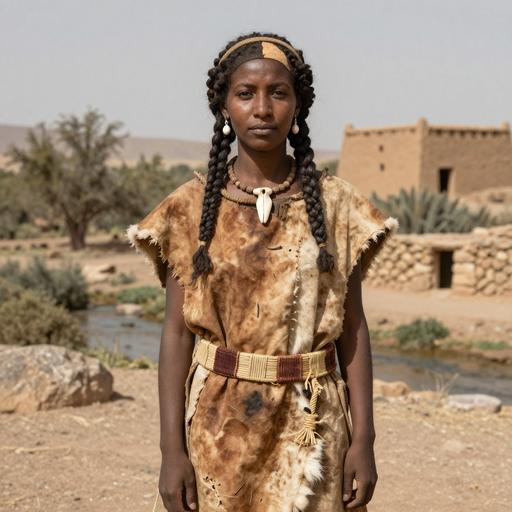
The Story
The journey of mtDNA haplogroup U6C
Origins and Evolution
mtDNA haplogroup U6C is a subclade of U6, a maternal lineage strongly associated with North Africa. Based on the position of U6C within the U6 phylogeny and standard mitochondrial molecular-clock calibrations, U6C most likely arose during the Late Pleistocene to early Holocene (roughly ~15 kya, with uncertainty spanning several thousand years). Its emergence fits a pattern of post-glacial diversification within North Africa that produced multiple U6 sublineages.
Phylogenetic inferences derive from full mitogenome sequencing and population surveys that place U6C as a derived branch of the U6 node. Age estimates are model-dependent (mutation rate, calibration points), so the quoted time should be treated as an approximate central estimate rather than an exact date.
Subclades
U6C itself is a defined sub-branch within U6; compared with larger and more frequent branches such as U6a, U6C is comparatively rare and has fewer well-sampled downstream subclades published to date. When additional whole-mitogenome sequences are obtained, finer substructure (U6C1, U6C2, etc.) may be resolved; at present most population-level references treat U6C as an identifiable terminal or near-terminal branch.
Geographical Distribution
U6C has a geographic distribution that mirrors the broader North African affinity of the U6 haplogroup but at lower frequency and more localized pockets. Reported occurrences and genetic surveys indicate the following pattern:
- Highest relative frequencies in parts of North Africa, especially among some Berber-speaking populations.
- Detectable presence among ancient and some modern inhabitants of the Canary Islands (Guanche samples and descendants), consistent with maritime links between the northwest African mainland and the islands.
- Low-frequency presence in southern Iberia (Spain and Portugal) and the wider western Mediterranean, reflecting prehistoric and historic gene flow across the Gibraltar/Iberian corridor.
- Sporadic occurrences in parts of East Africa and the Near East, likely due to long-term regional connections and later historical movements.
Notably, U6C has been reported in at least one ancient DNA sample from archaeological contexts, demonstrating its antiquity in the region.
Historical and Cultural Significance
Because U6C is nested within a haplogroup that has a strong North African signature, it is frequently discussed in studies of regional demographic history. Associations and implications include:
- Berber populations: U6 lineages (including U6C) contribute to the maternal genetic identity of many indigenous North African groups and are used to trace prehistoric continuity and local expansions.
- Guanche (Canary Islands): The presence of U6C in Guanche remains or modern islanders supports prehistorical and early-historical maritime movements from northwest Africa to the Canary archipelago.
- Mediterranean contacts: Low-level U6C in Iberia and the Near East may reflect multiple episodes of interaction — from Late Pleistocene and Holocene dispersals to historic-era contacts (Phoenician, Roman, Islamic periods) — but the primary signal remains an older North African origin.
In population-genetic studies, U6C (like other U6 subclades) is used as a marker for reconstructing female-mediated migrations, local persistence after climatic changes, and the structure of prehistoric North African populations.
Conclusion
U6C is a geographically informative but relatively uncommon mtDNA subclade of U6 that likely arose in North Africa after the Last Glacial Maximum. Its distribution — concentrated in Berber groups, present in the Canary Islands, and detectable at low frequencies in adjacent regions — supports a model of regional diversification with episodes of limited dispersal into neighboring areas. Continued mitogenome sequencing, especially ancient DNA sampling across North Africa and the western Mediterranean, will refine the phylogeny, age estimates, and historical inferences for U6C.
Key Points
- Origins and Evolution
- Subclades
- Geographical Distribution
- Historical and Cultural Significance
- Conclusion