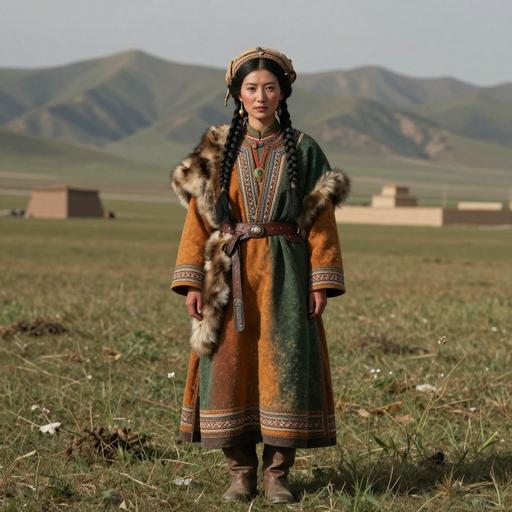
The Story
The journey of mtDNA haplogroup U9
Origins and Evolution
mtDNA haplogroup U9 is a deep branch of macro-haplogroup U, itself one of the oldest and most widespread mitochondrial lineages in Eurasia. U9 appears to have diverged during the Upper Paleolithic, with coalescence estimates commonly placed in the range of roughly 20–30 thousand years ago (we use ~25 kya here as a working estimate). The phylogenetic position of U9 within U indicates it is neither one of the very earliest splits in U nor a recent offshoot, but rather a distinctive regional lineage that persisted in and around the southern Near East and northeastern Africa.
Subclades
U9 is defined by a small set of coding-region mutations and is divided into a few primary branches (often labeled informally as U9a/U9b in the literature, depending on the study and the resolution of sequencing). These subclades show geographic structure: some branches are more common in Arabian Peninsula samples, while others are detected in the Horn of Africa and adjacent Northeast African populations. Phylogeographic work using complete mitogenomes has improved resolution but U9 remains rare in published datasets, so the internal topology and ages of subclades are still refined as more full sequences are gathered.
Geographical Distribution
U9 is geographically focused rather than cosmopolitan. The highest relative frequencies and most consistent detections have been reported from:
- The Arabian Peninsula (Yemen, Oman, parts of Saudi Arabia)
- The Horn of Africa (Ethiopia, Somalia, Eritrea)
- Northeast Africa (Egypt, Sudan) and parts of the Levant where gene flow or historical contacts occurred
Outside these core areas U9 occurs only sporadically at very low frequency (occasional detections in North Africa, the Levant, and rare individuals in Mediterranean or South Asian samples), consistent with localized origin and limited long-range dispersal compared with more common U subclades.
Historical and Cultural Significance
The distribution and age of U9 point to several important population-historical processes:
- Pleistocene and early Holocene continuity: The persistence of U9 in southern Near Eastern and Horn of African populations suggests continuity of maternal lineages in these regions since the late Pleistocene and into the Holocene.
- Trans-Red Sea connections: The occurrence of U9 on both sides of the southern Red Sea fits archaeological and linguistic evidence for long-standing contacts and maritime movements between southern Arabia and the Horn of Africa, including both prehistoric and later Holocene exchanges.
- Neolithic and later movements: While U9 predates the Neolithic, its later distribution may have been shaped by Neolithic demographic changes in Arabia and Northeast Africa, as well as Iron Age and historic-era trade and migration along coastal trade networks.
Conclusion
mtDNA U9 is an informative, low-frequency maternal lineage that highlights ancient connections between the southern Near East/Arabian Peninsula and Northeast Africa. Its moderate Upper Paleolithic age and geographically concentrated distribution make it valuable for studies of regional population continuity, Red Sea crossings, and the maternal legacy of populations in Arabia and the Horn of Africa. Continued sequencing of whole mitogenomes and broader sampling in underrepresented regions will sharpen the picture of U9's internal diversity and demographic history.
Key Points
- Origins and Evolution
- Subclades
- Geographical Distribution
- Historical and Cultural Significance
- Conclusion