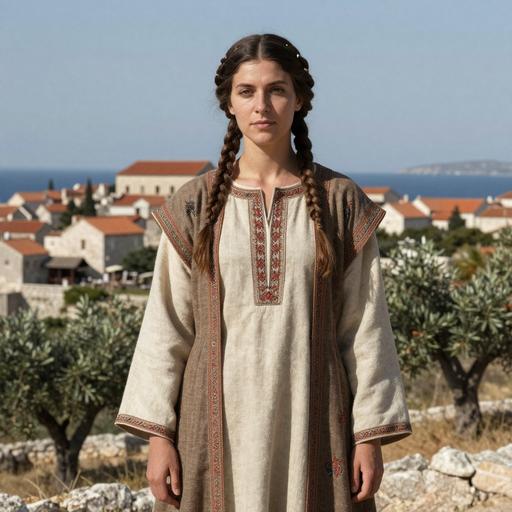
The Story
The journey of mtDNA haplogroup X2E2B
Origins and Evolution
X2E2B is a downstream subclade of mtDNA haplogroup X2E2, itself a branch of the wider X2 lineage. The parent X2E2 has been inferred to have arisen in the Near East/Anatolia in the early to mid‑Holocene (around 7 kya). Given its position in the phylogeny, X2E2B most plausibly originated slightly later, in the mid‑Holocene (we estimate ~5.5 kya) as part of continued regional diversification of maternal lineages associated with Neolithic and post‑Neolithic populations in Anatolia and the Levant. Members of X2 and its subclades are characterized by relatively low overall frequencies but geographically broad distributions, consistent with repeated episodes of localized expansion and long‑distance dispersal.
Subclades (if applicable)
As a specific terminal clade (X2E2B) this lineage currently appears to have limited known downstream diversity in published datasets and ancient DNA catalogs. Diagnostic mutations separating X2E2B from other X2E2 branches have been described in high‑resolution sequencing studies, but the clade remains rare in both modern and ancient samples. The limited number of identified ancient individuals (two in the referenced database) indicates the clade has a detectable archaeological presence but has not been a numerically dominant maternal lineage in sampled contexts. Future deep mtDNA sequencing and broader sampling, especially in Anatolia, the southern Caucasus and the Levant, may reveal additional internal structure or related minor subclades.
Geographical Distribution
Modern occurrences of X2E2B are best described as sparse and regionally patchy. The pattern follows that of its parent X2E2: the highest relative densities are in areas near its inferred origin (Anatolia, the Levant and the southern Caucasus), with lower‑frequency spillover into neighboring regions. Observed modern and ancient occurrences include:
- Southern Europe (coastal and island populations in Italy, Greece and the Balkans) where the clade is present at low frequency, likely reflecting Neolithic farmer dispersals and later historical contacts.
- Near East / Anatolia where the clade likely originated and persists at low to moderate frequency in some populations.
- Caucasus (Armenia, Georgia and adjacent highland groups) showing low to moderate representation, consistent with the region's role as a conduit between Anatolia and the Eurasian steppe.
- North Africa (Maghreb and some Berber groups) where occasional occurrences are consistent with maritime and coastal gene flow across the Mediterranean.
- Central Asia where sporadic instances reflect long‑range movements, trade and historical population dynamics.
Sampling gaps and the overall rarity of the clade mean reported frequencies can be unstable; absence in a regional dataset does not prove historical absence.
Historical and Cultural Significance
The likely origin of X2E2B in Anatolia/Levant at a mid‑Holocene date ties it to the broad demographic phenomena associated with Neolithic agricultural expansions and subsequent post‑Neolithic mobility. While X2E2B itself is not a signature lineage of any single well‑documented archaeological culture, it plausibly traveled with early farming communities and later with culturally and demographically mobile groups across the Mediterranean and into the Caucasus and North Africa.
Later historical processes — including Bronze Age trade networks, classical Mediterranean seafaring (Greek and Roman periods), Byzantine and Ottoman era movements, and overland connections through the Caucasus and Central Asia — provide plausible mechanisms for the clade's scattered presence outside Anatolia. The small number of ancient DNA hits suggests local continuity in a few places rather than large‑scale demographic replacement driven by this specific maternal lineage.
Conclusion
X2E2B is a geographically widespread but low‑frequency maternal lineage whose phylogenetic position and observed distribution are consistent with a Near Eastern/Anatolian origin in the mid‑Holocene and subsequent dispersal with Neolithic and post‑Neolithic movements into Southern Europe, the Caucasus, North Africa and parts of Central Asia. Its rarity and limited ancient DNA representation mean that it is most useful as a marker of localized maternal ancestry and regional contact rather than as an indicator of major population turnovers. Continued sampling and full mitochondrial genome sequencing in undersampled regions will refine its chronology, geographic structure and archaeological associations.
Key Points
- Origins and Evolution
- Subclades (if applicable)
- Geographical Distribution
- Historical and Cultural Significance
- Conclusion