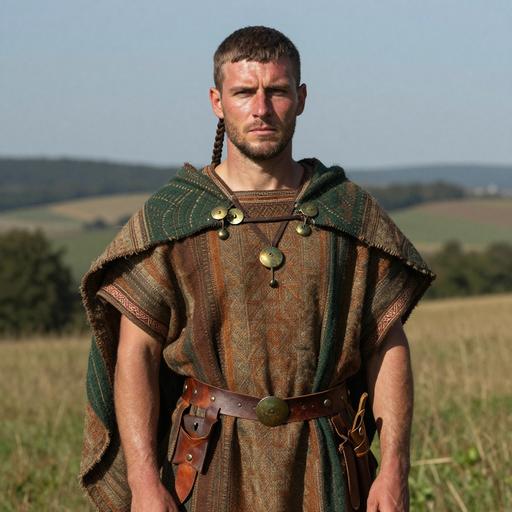
The label "Celtic" bundles a long tapestry of peoples, languages and material traditions rather than a single origin event. Archaeological hallmarks commonly associated with Celtic identity—such as La Tène-style art, fortified hilltop settlements, and complex metalwork—emerge most clearly in Central Europe during the Hallstatt (c. 800–450 BCE) and La Tène (c. 450–1 BCE) periods. Yet the deep-time genetic record included here stretches from Mesolithic–Neolithic ancestry (earliest sample c. 7739 BCE) through Bronze and Iron Age transformations.
Sites cited in this dataset—Driffield Terrace (Yorkshire), Ballynahatty and Annagh (Ireland), Asperg "Grafenbuehl" (Baden-Württemberg), Le Buissonnet (Hauts-de-France) and La Monédière/Bessan (Occitanie)—show overlapping material traditions and long-term regional continuity. Archaeological data indicates that the material culture we call La Tène spread via networks of trade, craft specialists, and mobility across rivers and alpine passes rather than by a single mass migration. Limited evidence suggests local adoption and adaptation were common: in the British Isles, for example, La Tène motifs appear alongside longstanding Bronze Age and Iron Age local traditions.
Where genetics are robust (large sample sizes across regions), we observe admixture patterns consistent with multiple ancestral layers: Mesolithic, Neolithic farming, Bronze Age steppe-related influxes, and Iron Age regional dynamics. These strands together created the demographic substrate on which La Tène cultural forms developed and spread.