Menu
Store
Blog
Gotland_Pre_Viking Sweden, Denmark, Norway, Iceland, UK, Ireland, Faroes, Greenland, Baltic, Russia, Poland

Norse: Seafarers of the North

An archaeological and genetic portrait of Viking-age Scandinavians and their Atlantic world.

4232 BCE - 1750793 CE
1 Ancient Samples
Scroll to begin
Chapter I

The Story

Understanding the Norse: Seafarers of the North culture

Archaeological finds and 1,044 ancient genomes trace Norse origins across Scandinavia and the North Atlantic (c. 4232 BCE–1750 CE). DNA shows dominant R and I Y-lineages and diverse maternal lineages (H, U, J). Regional admixture during Viking expansion reveals complex mobility and cultural exchange.

Time Period

c. 4232 BCE–1750 CE (Viking c. 793–1066 CE)

Region

Sweden, Denmark, Norway, Iceland, UK, Ireland, Faroes, Greenland, Baltic, Russia, Poland

Common Y-DNA

R (334), I (217), N (41), I1 (32), G (8)

Common mtDNA

H (325), U (149), J (138), T (78), K (73)

Chapter II

Timeline

Key moments in the history of this culture

2500 BCE

Bronze Age connectivity in Scandinavia

Bronze Age trade and metallurgy expand maritime networks in southern Scandinavia, laying cultural foundations later visible in Viking Age craft and shipbuilding.

Chapter III

Origins & Emergence

The Norse story unfolds across deep time: human presence in Scandinavia dates back to post-glacial hunter-gatherers, with a long arc through the Bronze and Iron Ages into the Viking centuries. Archaeological sites such as Frösön (Jämtlands län), Enbacken (Örebro), and coastal settlements on Gotland show continuity of craft, shipbuilding and long-distance trade. Material culture — rune-inscribed stones, ship burials, and richly furnished graves — intensifies around the first millennium CE and culminates in the Viking Age (c. 793–1066 CE).

Genomic data from 1,044 ancient individuals (dated c. 4232 BCE to 1750 CE) provide a layered picture. Broadly, genomes reflect a mixture of deep northern European ancestry, steppe-derived components linked to earlier Indo-European expansions, and regional variation from contacts with Baltic, British Isles, and eastern populations. Specific localities sampled — Alsike and Fullero (Uppsala län), Sasta (Täby), Landbogården, and Icelandic sites like Ondverdarnes and Fossvellir — anchor genetic signals to places and time. Archaeological data indicates that Norse identity was not a single biology but a shifting cultural continuum shaped by migration, trade, and assimilation.

Limited evidence suggests pockets of eastern influence (notably haplogroup N) in coastal and eastern Baltic contexts, consistent with interactions across the Baltic Sea and into present-day Russia. While the large sample size strengthens continental-scale conclusions, site-level datasets can remain small, so fine-grained local histories should be treated as provisional.
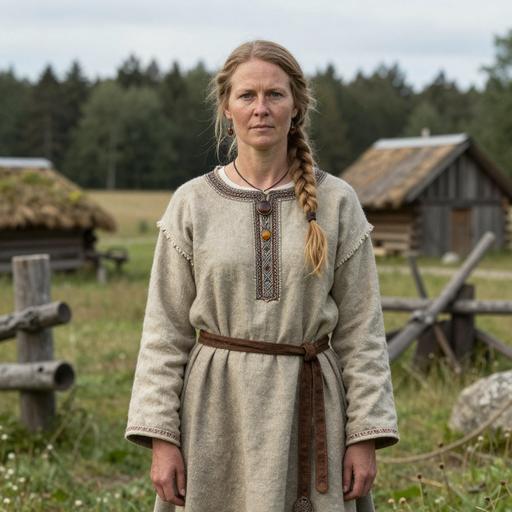
  • Long cultural continuity from Bronze/Iron Ages into Viking Age sites (Frösön, Enbacken).
  • Material culture and inscriptions mark a distinct Norse identity by c. 8th–11th centuries CE.
  • Genomes show layered northern European + steppe ancestry with regional admixture.
Chapter IV

Daily Life & Society

In everyday life the Norse lived in a world of wood, iron and salt-sprayed shorelines. Farmsteads, longhouses and seasonal fishing stations appear at sites such as Landbogården and coastal Faroese settlements; ship remains and harbour installations reveal the maritime economy that powered raids, trade and settlement. Skeletal remains and grave goods convey social gradients: weapon burials, horse gear, and imported luxury items speak to elite networks, while simple cremations and rural assemblages reflect a majority subsistence lifestyle centered on mixed farming, fishing and animal husbandry.

Household craft — weaving, metalwork, boat-building — left durable traces of skill and mobility. Isotopic studies from teeth and bones (where available) indicate diets high in marine protein for some coastal populations and more terrestrial diets inland. Burial practices show regional rituals and evolving religious identities: pre-Christian rites coexist with Christian graveyards in Iceland and Norway by the 11th–12th centuries CE. Archaeological data indicates that gender and age influenced burial symbolism, but genomic and isotopic evidence increasingly reveals a more fluid social landscape, with immigrants, captives and traders integrated into communities across the North Atlantic.

  • Maritime economy: shipbuilding, fishing and trade connected fjords to the Atlantic.
  • Burials and material culture show social hierarchy, craft specialization, and religious change.
Chapter V

Genetic Profile

The genomic portrait of Norse populations is dominated by a mix of northern European ancestries with prominent Y-chromosome and mitochondrial lineages. Among 1,044 analyzed Y-chromosomes, haplogroup R is most frequent (334), followed by I (217), with notable N (41), I1 (32) and smaller counts of G (8). Maternal lineages are led by H (325), U (149), J (138), T (78) and K (73). These profiles mirror patterns expected for northern European populations but also reflect the Norse pan-regional networks.

Steppe-derived ancestry components associated with earlier Indo-European expansions contribute substantially to the Norse genetic makeup, often carried on paternal lineages such as R. Haplogroup I and its subclades (including I1) are typical of Scandinavian male lineages and align with continuity from Iron Age Scandinavia. Haplogroup N, while less common, signals eastern Baltic or Uralic connections in some coastal or eastern samples. Mitochondrial diversity (H, U, J, T, K) shows that maternal ancestry was broadly European and regionally heterogeneous.

Archaeogenetic analyses of Viking-age colonized regions (Iceland, Greenland, British Isles) reveal sex-biased patterns in some contexts: male-mediated Scandinavian Y-lineages frequently appear in settlement zones, while maternal lineages often show local admixture, indicating integration of women from diverse origins. With 1,044 samples the continental trends are robust, but many site-level datasets remain small (<10), so subregional interpretations should be treated as preliminary.

  • Dominant Y-lineages: R and I; N indicates some eastern/Baltic links.
  • Maternal mtDNA diversity (H, U, J, T, K) shows broad European networks and regional admixture.
Chapter VI

Legacy & Modern Connections

The Norse imprint endures in place names, languages and genes. Modern populations of Scandinavia, Iceland, the Faroes and parts of the British Isles carry genetic echoes of Viking mobility: elevated frequencies of Scandinavian Y-haplogroups and mitochondrial continuity in Iceland are visible in contemporary genomes. Archaeological legacies — rune stones, ship burials, and urban trading centers like Hedeby and Birka — map onto routes where genetic admixture and cultural exchange reshaped landscapes.

Genetic studies illuminate migration versus cultural diffusion: in some regions (e.g., parts of the British Isles and Iceland) ancient DNA demonstrates demographic input from Scandinavian males and shared maternal lineages, while in others the cultural adoption of Norse practices occurred with minimal gene flow. These nuanced patterns remind us that identity, like ancestry, is layered: the Norse were voyagers, colonists, traders and neighbors whose biological and cultural fingerprints persist but are interwoven with local histories.

  • Modern Scandinavian and North Atlantic genomes retain Norse signatures in both Y and mtDNA.
  • Archaeology + aDNA show variable demographic impact: migration in some regions, cultural adoption in others.
Chapter VII

Sample Catalog

1 ancient DNA samples associated with the Norse: Seafarers of the North culture

Ancient DNA samples from this era, providing genetic insights into the people who lived during this period.

1 / 1 samples
Portrait Sample Country Era Date Culture Sex Y-DNA mtDNA
Portrait of ancient individual lau001 from Sweden, dated 600 CE
lau001
Sweden Gotland_Pre_Viking 600 CE Norse F - U5a1b1h
AI Powered

AI Assistant

Ask questions about the Norse: Seafarers of the North culture

AI Assistant by DNAGENICS

Unlock this feature
Ask questions about the Norse: Seafarers of the North culture. Our AI assistant can explain genetic findings, historical context, archaeological evidence, and modern connections.
Sample AI Analysis

The Norse: Seafarers of the North culture represents a fascinating chapter in human history...

Genetic analysis reveals connections to earlier populations while showing evidence of unique adaptations and cultural innovations. The ancient DNA samples provide insights into migration patterns, social structures, and the biological relationships between ancient populations.

This is a preview of the AI analysis. Unlock the full AI Assistant to explore detailed insights about:

  • Genetic composition and ancestry
  • Migration patterns and origins
  • Daily life and cultural practices
  • Modern genetic legacy
Use code for 50% off Expires Mar 05