Menu
Store
Blog
France_Rochedane North Africa & Eurasia (Morocco → Siberia)

Shadows of the Paleolithic

A panorama of Late Pleistocene hunter-gatherers from Morocco to Siberia, seen through archaeology and DNA

44169 CE - 10955 BCE
1 Ancient Samples
Scroll to begin
Chapter I

The Story

Understanding the Shadows of the Paleolithic culture

A scientific synthesis of 47 Paleolithic individuals (c. 44,169–10,955 BCE) from sites across Europe, North Africa and Siberia. Connects material culture, key sites (Bacho Kiro, Kostenki, Mal'ta, El Mirón) with Y‑DNA and mtDNA patterns to trace population movements and uncertainty.

Time Period

c. 44,169–10,955 BCE

Region

North Africa & Eurasia (Morocco → Siberia)

Common Y-DNA

E (12), I (5), C (5), P (4), H (2)

Common mtDNA

U (24 predominant), U8a, U2*, K3, M1b

Chapter II

Timeline

Key moments in the history of this culture

44169 BCE

Earliest sample in dataset

The oldest individual in the set dates to c. 44,169 BCE, anchoring the deep Pleistocene span of these Paleolithic genomes.

Chapter III

Origins & Emergence

The Paleolithic horizon represented here spans the deep chill of the Last Glacial Maximum into the warming that preceded the Holocene (c. 44,169–10,955 BCE). Archaeological data indicates a mosaic of regional traditions: the Iberomaurusian in Morocco, the diverse Upper Paleolithic industries of western Europe (El Mirón, Spain; Grotte du Bichon, Switzerland; Rigney and Rochedane, France), and the rich Eastern European and Siberian records at Kostenki and Mal'ta in Russia. Sites such as Bacho Kiro Cave (Bulgaria) and Cioclovina (Romania) preserve human remains in contexts that hint at complex mobility and long‑distance connections.

Genetic evidence from 47 individuals shows repeated population continuity and pulses of movement. Ancient North Eurasian ancestry, documented in Mal'ta (MA1) and Kostenki individuals, contributes to a broad Eurasian genetic substrate; however, regional differentiation is clear — western Europe carries a distinct hunter‑gatherer profile compared with Upper Paleolithic Siberia. Limited evidence from North Africa (Iberomaurusian) includes mtDNA lineages like M1b that suggest links between northern Africa and southwest Asia, but sample representation there remains sparse. Climatic oscillations — stadials and interstadials — likely redirected population routes, concentrating people in refugia such as the Swabian Jura (Brillenhöhle, Burkhardtshöhle) and the Cantabrian zone (El Mirón).

Uncertainties remain: sample density varies by region, and demographic events such as local extinctions or rapid replacements can be difficult to resolve from current data. Ongoing sampling at key sites will refine timing and directionality of Paleolithic dispersals.
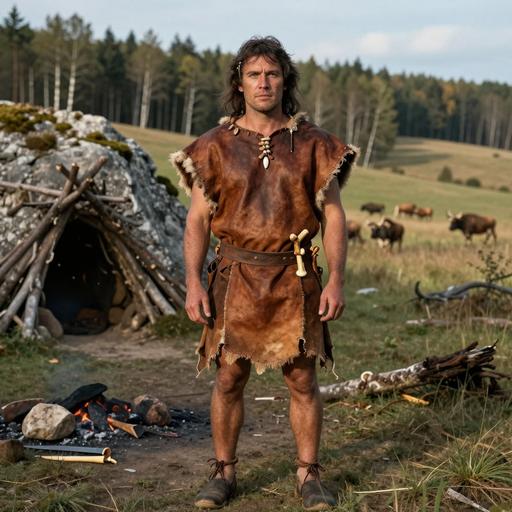
  • Span: c. 44,169–10,955 BCE across Europe, North Africa, Siberia
  • Key sites: Bacho Kiro, Kostenki, Mal'ta, El Mirón, Grotte du Bichon
  • Evidence shows both regional continuity and long‑range genetic links
Chapter IV

Daily Life & Society

Excavations from caves and rock shelters paint an intimate picture of Paleolithic lifeways. Stone tool assemblages — blade and bladelet technologies in western Europe, backed points in some eastern contexts — show high‑skill lithic economies adapted to hunting reindeer, horse and red deer. Sites such as El Mirón Cave (Spain) contain engraved slabs and occupation layers suggesting structured activity areas and symbolic behavior; Grotte du Bichon (Switzerland) preserves a burial with associated fauna that hints at funerary care.

Shelter use was flexible: highland karst systems like the Swabian Jura (Brillenhöhle, Burkhardtshöhle) provided seasonal camps, while open‑air sites in steppe‑tundra landscapes (Kostenki, Russia) indicate rapid exploitation of migrating herds. Organic remains are often fragmentary, but bone tool fragments, personal ornaments and occasional pigment residues suggest ornamentation and social signaling. Social groups were likely small, mobile band levels with dense knowledge of landscapes and seasonal rounds. Climate shifts repeatedly reshaped resource distribution, promoting resilient subsistence strategies and occasional long‑distance contacts reflected archaeologically by similar tool types and raw material sourcing.

Archaeological data indicates cooperative hunting, shared technological repertoires, and symbolic expression, but the scale of social networks and their mechanisms remain partially speculative until broader contextual sampling is available.

  • Mobile hunter‑gatherer bands exploiting caves, upland karsts, and open steppe
  • Evidence for symbolic behavior: burials, engraved slabs, ornaments
Chapter V

Genetic Profile

The genetic snapshot from 47 Paleolithic individuals reveals a complex tapestry of paternal and maternal lineages. Y‑chromosome diversity includes E (n=12), I (n=5), C (n=5), P (n=4) and H (n=2). The relatively high count of haplogroup E is notable for Paleolithic contexts and may reflect specific regional ancestries or later Neolithic/forager mixtures in some sampled contexts; interpretation requires caution because Y counts can be sensitive to sampling bias.

Mitochondrial DNA is dominated by haplogroup U (24 individuals), with sublineages including U8a (4) and U2* (3), consistent with a long‑standing maternal legacy across western Eurasia. Other detected mtDNA lineages include K3 (2) and North African‑associated M1b (2), the latter aligning with Iberomaurusian affinities in Morocco. The presence of Ancient North Eurasian (ANE) ancestry — typified by the Mal'ta (MA1) individual — links Siberian Upper Paleolithic populations to later genetic contributions in Europe and the Americas; Kostenki and Mal'ta samples show varying degrees of this component.

Genetic data indicate both deep continuity (mtDNA U lineages persisting across regions) and admixture episodes (ANE and western hunter‑gatherer mixtures). Because some geographic regions in this dataset have low sample density, regional signals (especially for North Africa and certain Balkan contexts) should be treated as preliminary. Future targeted sampling and higher coverage genomes will refine demographic models and clarify the timing of gene flow between western Eurasia, Siberia, and North Africa.

  • mtDNA dominated by U lineages; U8a and U2* notable in Europe
  • Y‑DNA shows mixed paternal ancestry (E common here; C, I, P also present)
Chapter VI

Legacy & Modern Connections

The Paleolithic populations represented here contributed enduring threads to later Eurasian and North African gene pools. Maternal lineages such as U and paternal lineages observed in this dataset are ancestral to many later European hunter‑gatherer groups and, through complex admixture, to some modern populations. The Ancient North Eurasian signal (evident in Mal'ta and Kostenki‐related ancestry) is particularly consequential: it later enters Bronze Age steppe groups and, indirectly, populations of the Americas.

Connections to North Africa are suggested by Iberomaurusian‑associated mtDNA (M1b) and by the presence of Y‑haplogroup E in Paleolithic contexts, but the directionality and timing of gene flow across the Mediterranean remain areas of active research. Archaeological continuity in symbolic practices and tool organization may reflect traditions transmitted through small, mobile kin networks rather than large migrating populations.

Limited sampling in some regions means that conclusions about direct ancestry to modern groups must remain cautious. Nonetheless, these ancient genomes illuminate the deep, intertwined roots of Eurasian and North African peoples and provide a framework for tracing how Ice Age populations shaped subsequent human diversity.

  • Ancient maternal U lineages feed into later European hunter‑gatherer ancestry
  • ANE (Mal'ta/Kostenki) ancestry impacts later Eurasian and Native American gene pools
Chapter VII

Sample Catalog

1 ancient DNA samples associated with the Shadows of the Paleolithic culture

Ancient DNA samples from this era, providing genetic insights into the people who lived during this period.

1 / 1 samples
Portrait Sample Country Era Date Culture Sex Y-DNA mtDNA
Portrait of ancient individual Rochedane from France, dated 11207 BCE
Rochedane
France France_Rochedane 11207 BCE Paleolithic M I-S21825 U5b2b
AI Powered

AI Assistant

Ask questions about the Shadows of the Paleolithic culture

AI Assistant by DNAGENICS

Unlock this feature
Ask questions about the Shadows of the Paleolithic culture. Our AI assistant can explain genetic findings, historical context, archaeological evidence, and modern connections.
Sample AI Analysis

The Shadows of the Paleolithic culture represents a fascinating chapter in human history...

Genetic analysis reveals connections to earlier populations while showing evidence of unique adaptations and cultural innovations. The ancient DNA samples provide insights into migration patterns, social structures, and the biological relationships between ancient populations.

This is a preview of the AI analysis. Unlock the full AI Assistant to explore detailed insights about:

  • Genetic composition and ancestry
  • Migration patterns and origins
  • Daily life and cultural practices
  • Modern genetic legacy
Use code for 50% off Expires Mar 05