Menu
Store
Blog
Dominican_Ceramic Greater Antilles: DR, Cuba, Puerto Rico, Bahamas, Haiti

Taíno: Echoes of the Greater Antilles

Archaeology and ancient DNA illuminate a seafaring Arawakan world across islands

1400 BCE - 1650 CE
5 Ancient Samples
Scroll to begin
Chapter I

The Story

Understanding the Taíno: Echoes of the Greater Antilles culture

Archaeological and genetic evidence from 268 ancient individuals (1400 BCE–1650 CE) traces Taíno emergence across the Greater Antilles. Sites in the Dominican Republic, Cuba, Puerto Rico, Haiti and the Bahamas show continuity of Ceramic traditions and maternal lineages tied to northern South America, with caution where sample sizes are small.

Time Period

1400 BCE – 1650 CE

Region

Greater Antilles: DR, Cuba, Puerto Rico, Bahamas, Haiti

Common Y-DNA

Q (predominant), CT, Q1b, P, BT

Common mtDNA

C, A2, D1, A2e, A

Chapter II

Timeline

Key moments in the history of this culture

2500 BCE

Early Archaic Occupations

Cave sites in western Cuba (Canimar Abajo, Cueva Calero) record Archaic hunter-gatherer occupations that provide deep-time context for later arrivals.

500 BCE

Ceramic Expansion Begins

Pottery-making, Arawakan language spreads and horticulture appear in the Antilles, setting foundations for later Taíno societies.

1000 CE

Taíno Cultural Flourishing

Regional variants of Taíno society and material culture are well-established across Hispaniola, Puerto Rico, Cuba and the Bahamas.

1492 CE

First European Contact

Columbian contact initiates rapid social, demographic, and genetic change across the islands.

1650 CE

Colonial Transformations

Intensified colonialism, disease, and migration reshape island populations and complicate genetic continuity.

Chapter III

Origins & Emergence

The archaeological record for Taíno-speaking peoples unfolds like a chain of coral-lit islands: older Archaic occupations in cave sites such as Canimar Abajo and Cueva Calero (western Cuba) provide deep time context, while later Ceramic-phase villages—La Caleta (Dominican Republic), Juan Dolio (DR), and Paso del Indio (Puerto Rico)—show the hallmarks of an Arawakan-derived, pottery-making lifeway. Radiocarbon and stylistic sequences indicate a major Ceramic expansion into the Antilles by the first millennium BCE to the early centuries CE, bringing new pottery styles, horticulture (manioc/cassava), and social practices.

Archaeological data indicate both continuity and influx: shell middens, communal plazas, and burial patterns show long-term island occupation, while shifts in material culture reflect connections to the Orinoco/upper Amazonian corridors. Limited evidence suggests multiple pulses of migration rather than a single event, and localized adaptations produced regional variants across Cuba, Hispaniola, Puerto Rico and the Bahamas. Genetic samples from cave and coastal burial sites help anchor these patterns in biological ancestry, linking the archaeological signature to populations with northern South American affinities. Uncertainties remain about the precise timing and number of migration events; new ancient genomes continue to refine the story.
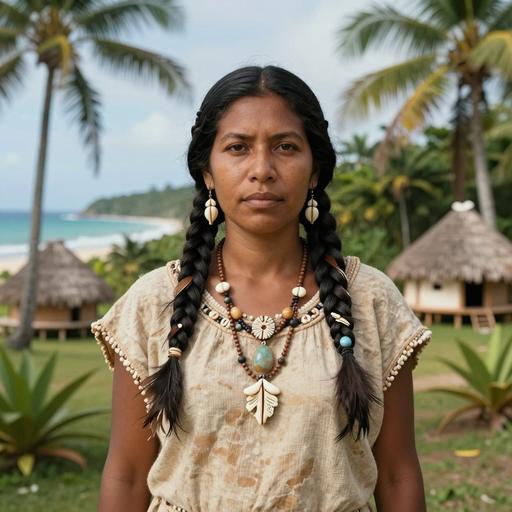
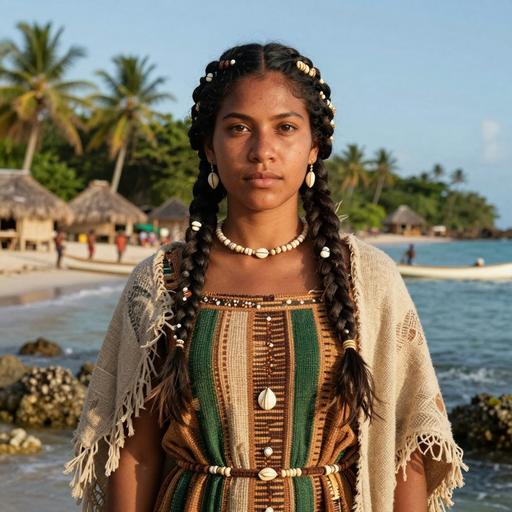
  • Archaic cave sites (Canimar Abajo, Cueva Calero) predate Ceramic expansions
  • Ceramic villages (La Caleta, Juan Dolio, Paso del Indio) reflect Arawakan lifeways
  • Evidence supports multiple migration pulses and local diversification
Chapter IV

Daily Life & Society

Material traces paint a vivid picture of coastal life: plazas for public ritual, raised conical houses, carved zemis (spiritual objects), and middens rich in fish bone and shell. Pottery styles—thin-stemmed and decorated vessels—accompanied new horticultural practices, including cassava cultivation, sweet potatoes, and the management of coastal fisheries. Archaeological excavations at La Caleta, El Soco (Dominican Republic), and Matanzas-area caves in Cuba reveal household assemblages with grinding stones, net sinkers, and worked shell, attesting to a mixed economy of farming, fishing and trade.

Social structure appears to have been ranked but flexible: burials from Cueva Roja and El Soco include both simple interments and richly furnished graves, suggesting emerging elites alongside broadly shared material culture. Craft specialization included pottery and stone-tool production; marine navigation—dugout canoes inferred from ethnographic analogy and artifact dispersal—enabled inter-island exchange. Palimpsests of ritual and daily debris at sites such as Juan Dolio and Diale (Haiti) show vibrant community life up to the early colonial encounters.

Archaeological interpretations must remain cautious: preservation biases favor coastal and cave sites, and many island contexts have been disturbed by later activity.

  • Mixed economy: horticulture (cassava), coastal fishing, shellfish gathering
  • Communal plazas, zemis, and ranked burials indicate complex social life
Chapter V

Genetic Profile

The genetic dataset for Taíno-associated burials includes 268 ancient individuals sampled across the Dominican Republic, Cuba, Puerto Rico, Haiti and the Bahamas. Y-chromosome diversity is dominated by haplogroup Q (132 of 268 Y calls), consistent with an Indigenous American paternal ancestry common in northern South America and the Antilles; minor counts of CT, Q1b, P and BT occur but are rare. Mitochondrial DNA is strikingly dominated by haplogroup C (93), followed by A2 (32), D1 (31), A2e (22) and A (18), a maternal profile that coheres with migrations from the Orinoco–Amazonia region and with patterns seen in other Ceramic-period Caribbean samples.

These genetic patterns align with archaeological models of Arawakan-speaking people dispersing from northern South America into the islands. Genome-wide data, where available, show continuity across many island sites but also hints of regional structure—subtle genetic differentiation linked to island geography and site clusters (e.g., La Caleta vs. Matanzas-area caves). The dataset is substantial overall, but geographic sampling is uneven (many samples from Dominican sites and Cuban caves); where per-site sample counts are low (<10) conclusions are preliminary. Finally, post-contact admixture with Europeans and Africans during the 16th–17th centuries complicates late-period genomes, so ancient pre-contact samples are crucial for isolating Indigenous ancestry.

  • Y-DNA dominated by Q — consistent with Indigenous American paternal lineages
  • MtDNA dominated by C and A2/D1 — links to northern South American sources
Chapter VI

Legacy & Modern Connections

The Taíno world did not vanish; cultural and genetic threads persist in contemporary Caribbean communities and in place names, crafts, and oral traditions. Ancient mtDNA lineages (C, A2, D1) detected in archaeological remains are also present at low but meaningful frequencies among modern island populations, supporting biological continuity despite colonial disruption. Genetic studies, combined with archaeology, help reclaim Indigenous histories suppressed in historical narratives, but they must be framed with community engagement and respect for descendant peoples.

Uncertainties remain about the scale of demographic collapse, survival of lineages in rural vs. coastal populations, and the role of later migrations. Where ancient sample sizes per site are small, inferences about local continuity should be treated as provisional. Nevertheless, the convergence of artifacts, settlement patterns, and ancient DNA offers a powerful, evidence-based path to restoring the Taíno past and its living legacy.

  • Ancient maternal lineages persist in modern Caribbean gene pools
  • Archaeology + DNA support cultural continuity; community collaboration is essential
Chapter VII

Sample Catalog

5 ancient DNA samples associated with the Taíno: Echoes of the Greater Antilles culture

Ancient DNA samples from this era, providing genetic insights into the people who lived during this period.

5 / 5 samples
Portrait Sample Country Era Date Culture Sex Y-DNA mtDNA
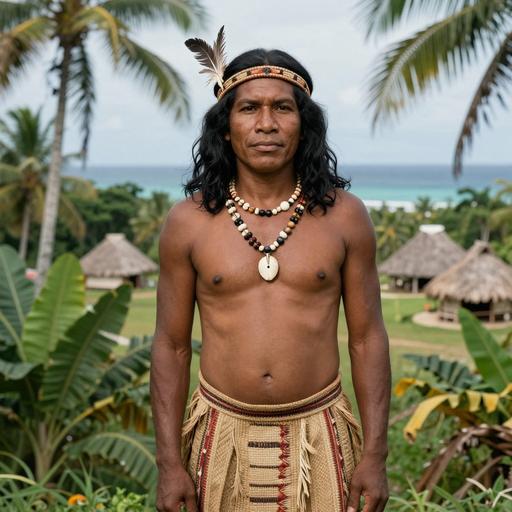
Portrait of ancient individual I8113 from Dominican Republic, dated 850 CE
I8113
Dominican Republic Dominican_Ceramic 850 CE Taino F - -
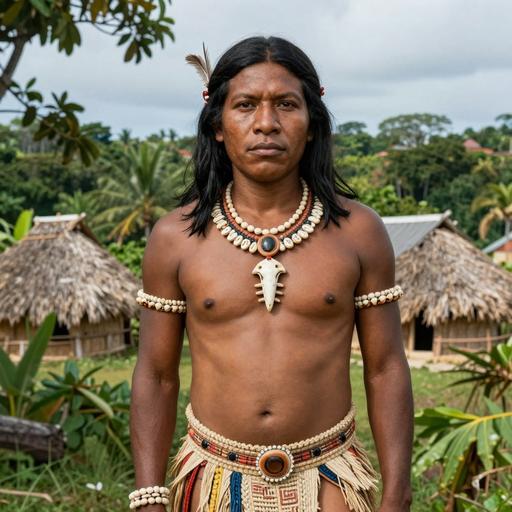
Portrait of ancient individual I13197 from Dominican Republic, dated 850 CE
I13197
Dominican Republic Dominican_Ceramic 850 CE Taino F - A2+(64)+16129
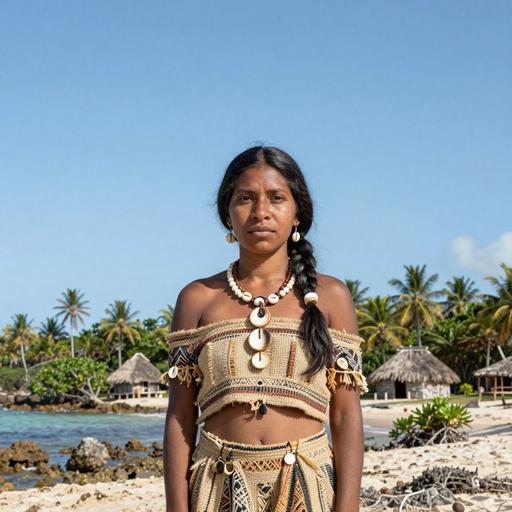
Portrait of ancient individual I13200 from Dominican Republic, dated 850 CE
I13200
Dominican Republic Dominican_Ceramic 850 CE Taino M BT A2+(64)+@16111
Portrait of ancient individual I15229 from Dominican Republic, dated 650 CE
I15229
Dominican Republic Dominican_Ceramic 650 CE Taino M CT -
Portrait of ancient individual I16177 from Dominican Republic, dated 600 CE
I16177
Dominican Republic Dominican_Ceramic 600 CE Taino F - C1b2
AI Powered

AI Assistant

Ask questions about the Taíno: Echoes of the Greater Antilles culture

AI Assistant by DNAGENICS

Unlock this feature
Ask questions about the Taíno: Echoes of the Greater Antilles culture. Our AI assistant can explain genetic findings, historical context, archaeological evidence, and modern connections.
Sample AI Analysis

The Taíno: Echoes of the Greater Antilles culture represents a fascinating chapter in human history...

Genetic analysis reveals connections to earlier populations while showing evidence of unique adaptations and cultural innovations. The ancient DNA samples provide insights into migration patterns, social structures, and the biological relationships between ancient populations.

This is a preview of the AI analysis. Unlock the full AI Assistant to explore detailed insights about:

  • Genetic composition and ancestry
  • Migration patterns and origins
  • Daily life and cultural practices
  • Modern genetic legacy
Use code for 50% off Expires Mar 03