Menu
Store
Blog
Japan_Jomon Japan, South Korea, China (coastal & southern sites)

Threads of the East Asian Shoreline

A deep-time portrait linking coastal archaeology from Japan, Korea and China to ancient DNA

9798 BCE - 1950 CE
3 Ancient Samples
Scroll to begin
Chapter I

The Story

Understanding the Threads of the East Asian Shoreline culture

Archaeological and ancient-DNA evidence from 59 samples (9798 BCE–1950 CE) across Japan, South Korea and China reveals layered coastal societies — from Mesolithic caverns and shell middens to Three Kingdoms polities — with genetic signals of both deep hunter-gatherer lineages and later farming-associated ancestries.

Time Period

9798 BCE – 1950 CE

Region

Japan, South Korea, China (coastal & southern sites)

Common Y-DNA

D(4), O(2), C(2), F(1), DE(1)

Common mtDNA

N9b(9), D(8), M(6), N(5), B(3)

Chapter II

Timeline

Key moments in the history of this culture

9798 BCE

Earliest sampled occupation

Human remains from the earliest sampled contexts (c. 9798 BCE) attest to post-glacial coastal foraging in Guangxi and southern Korea.

4000 BCE

Early pottery and settled coasts

Shell midden accumulation and cord-marked pottery in Honshu and Shikoku indicate intensified coastal residence and craft specialization.

1000 BCE

Bronze and social complexity in Korea

Bronze-age material culture appears in Korean contexts, foreshadowing later hierarchical burial practices.

300 CE

Three Kingdoms transformations

Burial architecture and grave goods at Daeseong-dong reflect regional state formation and increased long-distance exchange.

1600 CE

Historical continuity into the early modern era

Archaeological continuity and episodic gene flow leave a composite heritage evident in later historical-period samples.

Chapter III

Origins & Emergence

Across nearly eleven millennia the coastal margins of East Asia served as both crucible and corridor. Archaeological deposits from sites such as Gaofeng Cave (Nandan County, Guangxi, China) and shell midden sequences at Funagura (Kurashiki, Honshu) and Hijaro (Ainan, Shikoku) show long-term maritime adaptation: persistent exploitation of fish, shellfish and estuarine resources, and early ceramic technologies in local hunter-gatherer contexts. In the Korean peninsula, cave burials and early settlement traces at Daeseong-dong and Yuha-ri (Gyeongsangnam-do) mark continuity from Late Pleistocene foragers through Neolithic and Bronze Age transitions.

The material record indicates multiple cultural phases referenced locally as the Layi and Qinchang periods in China, the Early to Late Jomon in Japan, and Changhang through the Three Kingdoms in Korea. These cultural labels reflect changing subsistence, craft and social complexity rather than single, homogeneous peoples. Archaeological data indicates pulses of innovation — pottery, metallurgy, and rice agriculture — arriving at different times along the coast, producing mosaic societies.

Genetically, persistent maternal lineages (notably mtDNA N9b and D) and deep-rooted paternal markers (haplogroup D and C) point to a long-standing hunter-gatherer foundation in the region, later admixed with lineages commonly associated with expansion of agriculture (haplogroup O). Limited chronological and geographic sampling across the 59 individuals means models of population movement remain provisional; archaeological context is essential to interpret genome-scale signals.
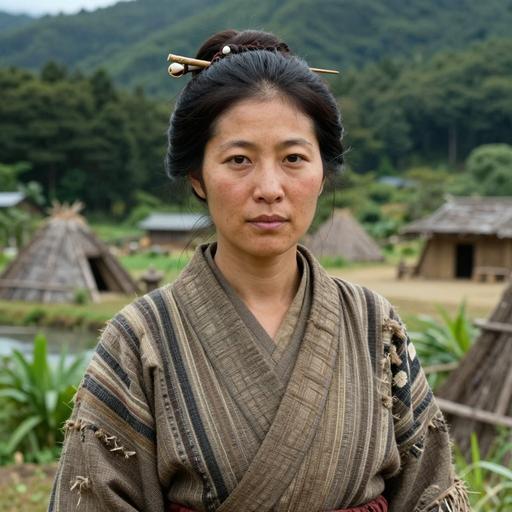
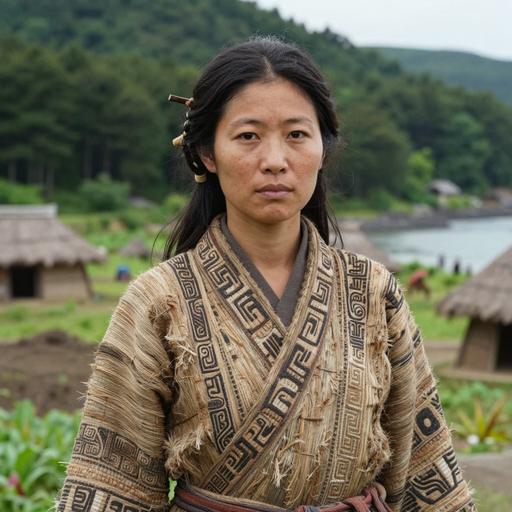
  • Coastal foraging and early pottery at shell middens and caves
  • Layered cultural phases: Mesolithic/Epipaleolithic to Three Kingdoms
  • Archaeology and genetics together suggest deep hunter-gatherer roots with later farmer admixture
Chapter IV

Daily Life & Society

Daily life along East Asian shores was shaped by tides and the rich estuaries that bound human activity to the sea. Shell middens such as Funagura and Hijaro accumulate as palimpsests of meals and craft: discarded shells, fish bones, charred plant remains and fragments of cord-marked pottery. Inhabited caves (e.g., Gaofeng Cave) preserve hearths, worked stone tools and human burials arranged with personal items — a cinematic record of seasonal rounds and household practice.

As time progressed, many coastal communities incorporated domestic rice agriculture and metallurgy. In the Korean archaeological sequence, the Changhang cultural horizon shows increasingly complex settlement patterns and craft specialization, culminating in the Three Kingdoms period burials at Daeseong-dong and nearby Changhang contexts where grave goods and horizontal cave tombs reflect social ranking and interregional exchange. Japanese sequences show continuity of hunter-gatherer technologies into the Early Jomon and then material changes associated with Yayoi rice farming in some regions, producing diverse local responses.

Material culture—pottery types, bronze and iron tools, and burial architecture—provides the contextual scaffolding that allows genetic signals to be placed in time and social setting. Archaeological data indicates local variability: some coastal communities remained maritime-oriented for millennia while others adopted farming or new craft forms at different rates.

  • Shell middens and cave deposits record diet, craft and seasonality
  • Transition to agriculture and metallurgy varied regionally, shaping social inequality
Chapter V

Genetic Profile

The genetic assemblage of 59 ancient individuals from sites across Japan, South Korea and southern China provides a multi-layered picture. Mitochondrial haplogroups show a strong presence of N9b (9 samples) and D (8 samples), lineages often associated with longstanding coastal and insular hunter-gatherer populations in the region. These maternal signatures are consistent with archaeological continuity in shell-midden and cave contexts and align with broader research that links N9b and certain D subclades to pre-agricultural populations of the Japanese archipelago and neighboring coasts.

On the paternal side, haplogroup D appears in 4 individuals — a lineage frequently observed in ancient and some modern populations of East Asia and Japan — while haplogroups O (2) and C (2) suggest contributions from later northern or agricultural-adapted populations. The presence of O, in particular, is often correlated with expansions tied to millet and rice farming across East Asia in the Holocene, though direct attribution requires autosomal evidence and careful temporal control.

Genome-wide patterns (where available) typically reveal admixture between deep local hunter-gatherer ancestry and incoming farmer-related ancestries. However, the temporal span of these samples (9798 BCE–1950 CE) and uneven geographic sampling mean that regional continuity and episodic migration both shaped present-day genetic landscapes. Archaeogenetic interpretations should therefore be treated as evolving hypotheses, refined as more temporally and spatially targeted samples are analyzed.

  • mtDNA emphasis on N9b and D points to maternal continuity from ancient coastal foragers
  • Y-DNA mix of D, O and C indicates layered paternal inputs: deep Paleolithic lineages and later farmer-related lineages
Chapter VI

Legacy & Modern Connections

Modern populations of Japan, Korea and parts of southern China retain echoes of these deep coastal histories. Archaeogenetic studies show that elements of ancient maternal lineages (notably N9b and certain D lineages) persist in modern groups, suggesting long-term continuity of maternal ancestry in some regions, especially islands and isolated coastal communities. At the same time, autosomal ancestry reflects multiple admixture events: enduring hunter-gatherer ancestry blended with later Northeast and mainland East Asian farmer-related gene flow.

Culturally, the long record of maritime exploitation, pottery traditions, and the variable adoption of rice agriculture shaped trajectories that led to complex state formations like the Three Kingdoms of Korea and the distinctive prehistoric sequences of the Jomon and Yayoi in Japan. For users of DNA ancestry platforms, these results highlight that genetic signals are best interpreted alongside archaeological context: lineage frequencies alone cannot capture the rhythms of cultural change, trade, and migration that produced modern East Asian diversity.

  • Maternal lineages suggest pockets of long-term continuity in coastal communities
  • Genetic admixture mirrors archaeological evidence of migration, farming adoption and cultural exchange
Chapter VII

Sample Catalog

3 ancient DNA samples associated with the Threads of the East Asian Shoreline culture

Ancient DNA samples from this era, providing genetic insights into the people who lived during this period.

3 / 3 samples
Portrait Sample Country Era Date Culture Sex Y-DNA mtDNA
Portrait of ancient individual IK002 from Japan, dated 897 BCE
IK002
Japan Japan_Jomon 897 BCE East Asian F - N9b1
Portrait of ancient individual Sanganji131464 from Japan, dated 1404 BCE
Sanganji131464
Japan Japan_Jomon 1404 BCE East Asian F - N9b
Portrait of ancient individual Sanganji131421-3 from Japan, dated 1370 BCE
Sanganji131421-3
Japan Japan_Jomon 1370 BCE East Asian M D-M64 N9b
AI Powered

AI Assistant

Ask questions about the Threads of the East Asian Shoreline culture

AI Assistant by DNAGENICS

Unlock this feature
Ask questions about the Threads of the East Asian Shoreline culture. Our AI assistant can explain genetic findings, historical context, archaeological evidence, and modern connections.
Sample AI Analysis

The Threads of the East Asian Shoreline culture represents a fascinating chapter in human history...

Genetic analysis reveals connections to earlier populations while showing evidence of unique adaptations and cultural innovations. The ancient DNA samples provide insights into migration patterns, social structures, and the biological relationships between ancient populations.

This is a preview of the AI analysis. Unlock the full AI Assistant to explore detailed insights about:

  • Genetic composition and ancestry
  • Migration patterns and origins
  • Daily life and cultural practices
  • Modern genetic legacy
Use code for 50% off Expires Mar 05