Menu
Store
Blog
Russia_HG_Tyumen Siberia (Angara & Lake Baikal basin, Trans‑Baikal)

Voices of the Angara: Siberian Hunter-Gatherers

A genetic and archaeological portrait of hunter-gatherer groups around Lake Baikal and the Angara River.

43980 BCE - 1390 CE
2 Ancient Samples
Scroll to begin
Chapter I

The Story

Understanding the Voices of the Angara: Siberian Hunter-Gatherers culture

Ancient foragers spanning 43,980 BCE–1390 CE in the Angara and Lake Baikal region. 89 genomes show Y haplogroups N, Q, K and mtDNA D, C, A, G, F. Archaeological and genetic evidence points to long-term regional persistence, seasonal mobility, and later East Asian admixture.

Time Period

c. 43980 BCE–1390 CE

Region

Siberia (Angara & Lake Baikal basin, Trans‑Baikal)

Common Y-DNA

N (24), Q (14), K (3), BT (1)

Common mtDNA

D (21), C (15), A (8), G (8), F (7)

Chapter II

Timeline

Key moments in the history of this culture

2500 BCE

Late Neolithic–Pre‑Bronze persistence

Hunter-gatherer communities around Lake Baikal show continued occupation and material continuity, with growing evidence of regional interaction.

Chapter III

Origins & Emergence

The Siberian_Hunter_Gatherers represent a deep, millennia-spanning presence along the Angara River and across the Lake Baikal and Trans‑Baikal landscapes. The dataset ranges from very early Upper Palaeolithic individuals (as early as ~43,980 BCE) through Late Holocene and medieval contexts (to c. 1390 CE). Key archaeological loci include Shamanka II (Lake Baikal), Izvestkovaja-1 and Kuenga River sites, Fofonovo, the Nozhyj Lake burial complex, and riverine localities at the mouth of the Belaya and along the Argun.

Archaeological data indicate persistent human use of river corridors and lakeshores for millennia — places rich in fish, waterfowl and seasonal game. Climatic oscillations after the Last Glacial Maximum reconfigured steppe and taiga ecotones; people adapted with flexible mobility and localized specializations. The cultural sequence recorded in site stratigraphy and material remains links these hunter-gatherers to regional Neolithic and Eneolithic horizons (for example, the Ust-Belaya Angara tradition and the Eneolithic layers at Shamanka), but not to a single homogenous culture.

Limited evidence suggests early continuity in some genetic lineages across millennia, while later periods show additional inputs from neighboring East Asian groups. Spatial and temporal sampling is uneven: some early and very late dates are represented by few samples, so broader regional sampling is needed to refine emergence models.
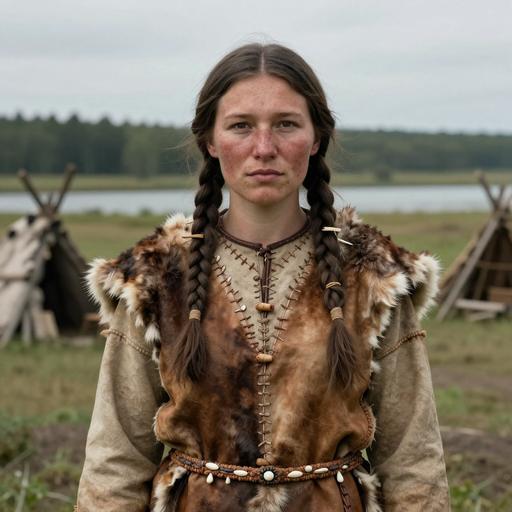
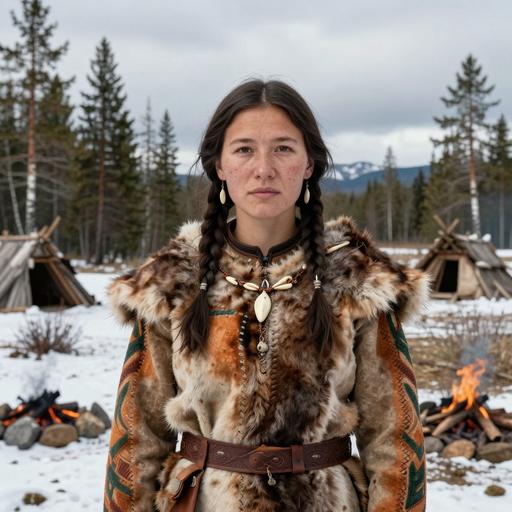
  • Presence from c. 43,980 BCE to 1390 CE around Angara and Baikal
  • Sites: Shamanka II, Izvestkovaja-1, Fofonovo, Nozhyj Lake, Kuenga River, Dvorcy-Dacha
  • Flexible adaptation to post-glacial taiga–steppe shifts
Chapter IV

Daily Life & Society

Archaeological traces across Angara basin and Trans‑Baikal sites paint a picture of mobile, lake- and river-oriented lifeways. Hearths, habitation floors and lithic scatters indicate recurring seasonal camps rather than large, permanent settlements. Fishing and exploitation of lacustrine resources were likely central: the Angara and Lake Baikal form a corridor rich in fish and waterfowl, and burials concentrated near lakeshores suggest the social importance of these places.

Tool industries recorded at multiple sites include locally produced stone and bone implements adapted for hunting, fishing and hide processing. Organic preservation in some Baikal contexts preserves evidence for bone and antler work, though preservation varies by site. Burial practices show variability: some interments are isolated inhumations while others, notably at Shamanka II and Nozhyj Lake sites, indicate more complex mortuary behavior and possible ritual emphasis. Social organization was likely organized in small bands with flexible alliances tied to seasonal rounds; grave assemblages and spatial patterns hint at differentiated roles but do not resolve firm social hierarchies.

Archaeological data indicate long-term continuity of knowledge and place use, punctuated by episodes of contact and movement. Ethnoarchaeological analogy with historic Siberian foragers helps interpret material remains, but direct continuity to any single modern group should be inferred cautiously.

  • Seasonal camps focused on fishing and riverine resources
  • Stone, bone and antler tool traditions; varied burial practices
Chapter V

Genetic Profile

Genetic data from 89 individuals provide a substantial view of population dynamics in the Angara–Baikal region. Y-chromosome lineages are dominated by haplogroup N (24 samples) with substantial representation of Q (14), smaller counts of K (3) and one BT. Mitochondrial diversity is typical of Northeastern Eurasia: haplogroups D (21), C (15), A (8), G (8) and F (7) are common. These maternal lineages point to deep Siberian continuity and shared maternal ancestry with other Northeast Asian and Beringian-linked groups.

Y-haplogroup N is broadly associated with later northern Eurasian expansions and is frequent today among Uralic- and Tungusic-speaking populations; its presence here suggests a long-standing northern Eurasian paternal component. Haplogroup Q, while less numerous, highlights an older Siberian substratum that is also ancestral to Native American lineages outside Eurasia. The mix of maternal and paternal markers indicates repeated episodes of local continuity and male- and female-mediated gene flow.

Temporal resolution shows persistence of core Siberian lineages through Neolithic and Eneolithic horizons and evidence for additional East Asian-related admixture in some Medieval-period individuals. Because sampling density varies across the 44,000-year span, interpretations about frequency changes over time should be treated cautiously. Overall, the genetic profile aligns with archaeological patterns of long-term regional occupation combined with episodic contact and admixture.

  • Y: N dominant (24), Q present (14); mtDNA dominated by D, C, A, G, F
  • Genetic continuity with later East Asian admixture, especially by the Medieval period
Chapter VI

Legacy & Modern Connections

The genetic and archaeological record of the Angara–Baikal hunter-gatherers forms a foundational strand in the ancestry of northern Eurasia. Modern populations across Siberia and parts of northeastern Eurasia retain elements of the same mitochondrial and paternal lineages seen in the ancient dataset—haplogroup N in particular remains common among many northern groups, while Q persists in some Indigenous Siberian and Beringian-descended lineages. These continuities illustrate how deep-time regional persistence can shape later population structure.

At the same time, the record shows clear signs of interaction: new genetic inputs and shifting material cultures in the later Holocene reflect contacts with expanding East Asian, pastoral and later medieval movements. For ancestry platforms and museums, these findings emphasize that individual ancestry is often a palimpsest of long-term regional continuity and episodic migration. Continued, careful sampling—especially from underrepresented time slices and locations—will refine links between ancient hunter-gatherer lifeways and present-day populations.

  • Modern Siberian lineages retain elements of ancient mtDNA and Y-DNA diversity
  • Later admixture layers reflect East Asian and regional contacts over millennia
Chapter VII

Sample Catalog

2 ancient DNA samples associated with the Voices of the Angara: Siberian Hunter-Gatherers culture

Ancient DNA samples from this era, providing genetic insights into the people who lived during this period.

2 / 2 samples
Portrait Sample Country Era Date Culture Sex Y-DNA mtDNA
Portrait of ancient individual I1960 from Russia, dated 6329 BCE
I1960
Russia Russia_HG_Tyumen 6329 BCE Siberian Hunter-Gatherers F - U2e3b1
Portrait of ancient individual I1958 from Russia, dated 4723 BCE
I1958
Russia Russia_HG_Tyumen 4723 BCE Siberian Hunter-Gatherers F - U
AI Powered

AI Assistant

Ask questions about the Voices of the Angara: Siberian Hunter-Gatherers culture

AI Assistant by DNAGENICS

Unlock this feature
Ask questions about the Voices of the Angara: Siberian Hunter-Gatherers culture. Our AI assistant can explain genetic findings, historical context, archaeological evidence, and modern connections.
Sample AI Analysis

The Voices of the Angara: Siberian Hunter-Gatherers culture represents a fascinating chapter in human history...

Genetic analysis reveals connections to earlier populations while showing evidence of unique adaptations and cultural innovations. The ancient DNA samples provide insights into migration patterns, social structures, and the biological relationships between ancient populations.

This is a preview of the AI analysis. Unlock the full AI Assistant to explore detailed insights about:

  • Genetic composition and ancestry
  • Migration patterns and origins
  • Daily life and cultural practices
  • Modern genetic legacy
Use code for 50% off Expires Mar 05