Menu
Store
Blog
Kyrgyzstan_Saka_IA Kyrgyzstan, Kazakhstan, Xinjiang (China), Russia

Whispers of the Steppe

Horseborn nomads of the Scythian–Saka world across Central Asia

1499 BCE - 884 CE
8 Ancient Samples
Scroll to begin
Chapter I

The Story

Understanding the Whispers of the Steppe culture

Archaeological and genetic evidence from 92 Steppe_Nomads (1499 BCE–884 CE) reveals a mobile Scythian–Saka horizon across Xinjiang, Kazakhstan, Kyrgyzstan and Russia, showing west-east admixture and long-distance cultural networks.

Time Period

1499 BCE – 884 CE

Region

Kyrgyzstan, Kazakhstan, Xinjiang (China), Russia

Common Y-DNA

R (26), Q (10), J (10), E (2)

Common mtDNA

U (20), T (7), D (6), H (5), C (5)

Chapter II

Timeline

Key moments in the history of this culture

700 BCE

Scythian–Saka cultural florescence

Material and genetic evidence point to a peak in Scythian/Saka social complexity and long-distance interactions across the steppe, reflected in rich kurgan burials and wide-ranging trade links.

Chapter III

Origins & Emergence

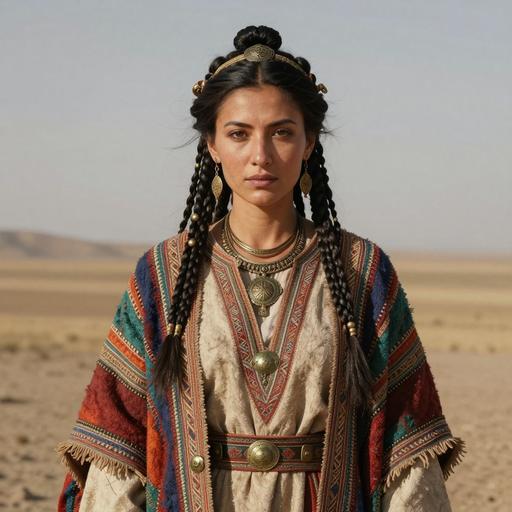
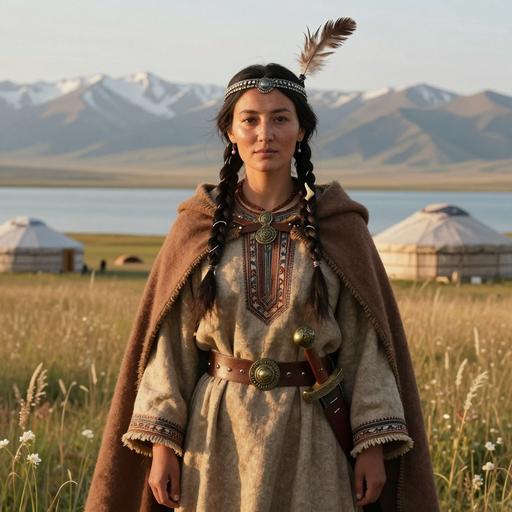
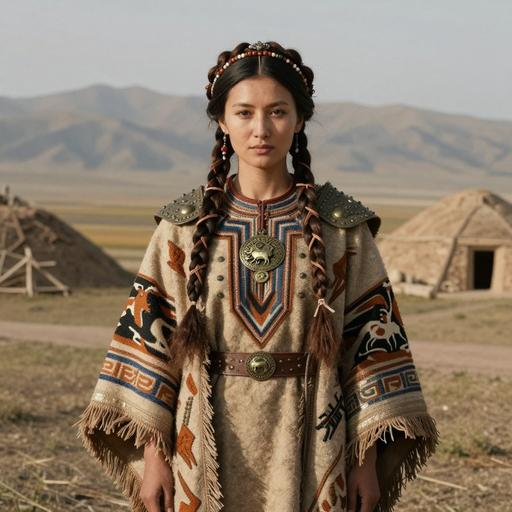
Across the wide, wind-carved grasslands, archaeological signals coalesce into the image of mobile mounted communities commonly grouped under Scythian and Saka labels. Beginning in the first millennium BCE and visible here between 1499 BCE and 884 CE, funerary mounds, weapon caches and horse gear from sites such as Bolati, Axile, Wutulan and the Chilpek burial mounds (Issyk‑Kul, Kyrgyzstan) map a network of pastoral nomadism and cultural exchange. Material culture — composite bows, bronze plaques, animal-style art — hints at shared identities that were flexible and regional.

Archaeological data indicates many of these communities practiced seasonal mobility with elite burial rites (kurgans) preserving rich grave goods. The geographic spread from the Yili and Aletai regions of Xinjiang into Kazakhstan and the southern Urals reflects sustained contact zones where steppe pastoralists, agro-pastoral communities and Silk Road caravans intersected. Limited evidence suggests local variation: some loci show stronger eastern material influences (Xinjiang sites), others more western steppe traits (Tasmola, Central Saka contexts in Kazakhstan). The archaeological record is uneven; many interpretations remain provisional where excavation or radiocarbon coverage is sparse.
  • Material culture unites wide geographic zone (kurgans, horse trappings, animal style art)
  • Key sites: Bolati, Axile, Wutulan (Xinjiang); Chilpek burial mounds (Issyk‑Kul)
  • Evidence shows regional variation and long-distance contacts along early Silk Road corridors
Chapter IV

Daily Life & Society

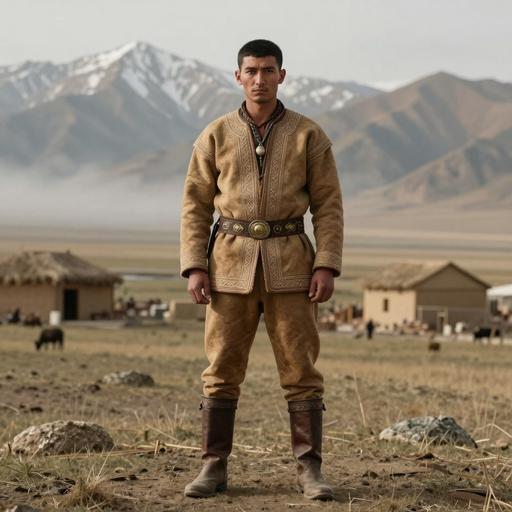
Life on the steppe was rhythm and motion: herds, hooves and seasonal camps. Archaeological remains — hearths, lightweight portable gear, and faunal assemblages — indicate economies based primarily on pastoralism (horses, sheep, goats, cattle), supplemented by hunting and traded cereals. Horse harness fragments and bit wear on horse teeth at multiple sites point to the centrality of mounted mobility for transport, raiding and status display.

Social organization appears hierarchical but flexible. Elaborate kurgan burials with weaponry and imported goods suggest warrior elites with far-reaching connections; simpler burials attest to lower-status pastoral households. Women’s graves often include distinctive ornamentation and craft tools, showing gendered roles that combined household, craft and possibly political functions. Archaeobotanical traces and trade items at Xinjiang sites indicate contact with oasis economies and Silk Road exchange, highlighting how these nomads both shaped and were shaped by sedentary neighbors. Preservation biases (funerary elites survive best) mean everyday household archaeology is less visible, so reconstructions rely on combining burial assemblages with sparse camp-site evidence.

  • Economy focused on mounted pastoralism with complementary hunting and trade
  • Kurgan burials reveal elite status differentiation; everyday life less archaeologically visible
Chapter V

Genetic Profile

Genetic data from 92 individuals spanning 1499 BCE to 884 CE provides a clearer picture of ancestry and mobility across the steppe. Y-chromosome markers are diverse: R is most common (26 instances), accompanied by Q (10), J (10) and a small number of E (2). Mitochondrial diversity likewise spans west and east Eurasian lineages: U (20), T (7), D (6), H (5) and C (5). This mix indicates repeated admixture between western steppe-associated males (R lineages often associated with broader Indo-European steppe ancestry) and eastern/Inner Asian maternal contributions (D, C), consistent with archaeological evidence for interaction zones.

The genetic pattern suggests a core West Eurasian steppe ancestry blended over time with eastern or Siberian components, particularly in Xinjiang sites (Bolati, Axile, Wutulan, Qiafuqihaishuiku) where eastern mtDNAs are more frequent. Haplogroup J and E occurrences point to gene flow from more southerly or Near Eastern sources, perhaps via trade networks or incorporation of diverse groups. While 92 samples give substantial resolution, geographic sampling is uneven—many specimens come from Xinjiang and Chilpek mounds—so regional conclusions should be treated cautiously. Where sample counts are low (<10) for particular sites or subperiods, interpretations remain preliminary and require more data.

  • Mixed west–east ancestry: predominant R Y-lineages with notable eastern mtDNA (D, C)
  • Presence of J and E hints at southern/Near Eastern contacts via trade or migration
Chapter VI

Legacy & Modern Connections

The Scythian–Saka horizon left a deep cultural and genetic imprint across Central Asia. Modern populations in Kazakhstan, Kyrgyzstan and Xinjiang carry echoes of this blended ancestry: traces of steppe-associated Y-lineages and a mosaic of mitochondrial types persist in varying frequencies. Artistic motifs, horse culture and burial practices influenced later nomadic polities such as the Sarmatians and contributed to the cultural repertoire of medieval Eurasian steppe societies.

Genetically, the steppe nomads exemplify how mobility knits populations together: repeated admixture events produced regional mosaics rather than uniform populations. Contemporary genetic links are complex and region-specific; archaeological continuity in ritual and horse pastoralism is clearer than direct one-to-one ancestry claims. Continued sampling from underrepresented sites and better temporal coverage will refine how these ancient threads connect to present-day genomes.

  • Modern Central Asian populations retain mixed signals reflecting steppe ancestry and regional admixture
  • Cultural traditions (horse culture, artistic motifs) influenced successive nomadic empires
Chapter VII

Sample Catalog

8 ancient DNA samples associated with the Whispers of the Steppe culture

Ancient DNA samples from this era, providing genetic insights into the people who lived during this period.

8 / 8 samples
Portrait Sample Country Era Date Culture Sex Y-DNA mtDNA
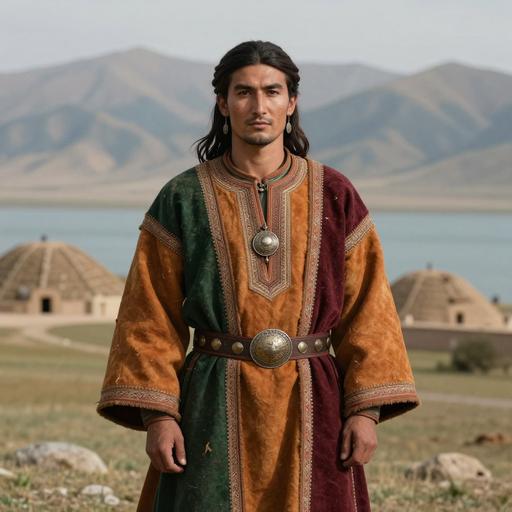
Portrait of ancient individual KEN001 from Kyrgyzstan, dated 356 BCE
KEN001
Kyrgyzstan Kyrgyzstan_Saka_IA 356 BCE Steppe Nomads M J-Z7449 A16
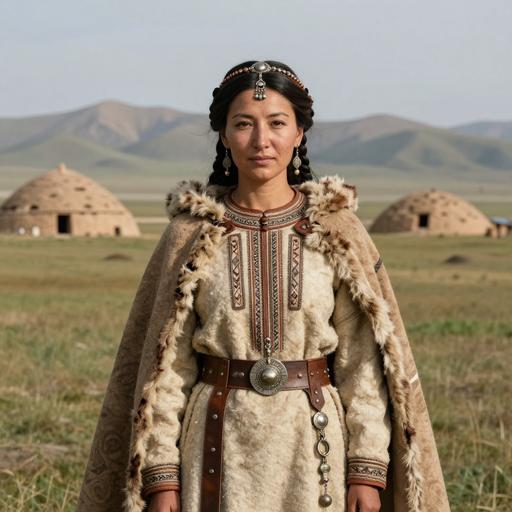
Portrait of ancient individual CHK005 from Kyrgyzstan, dated 300 BCE
CHK005
Kyrgyzstan Kyrgyzstan_Saka_IA 300 BCE Steppe Nomads F - U1a
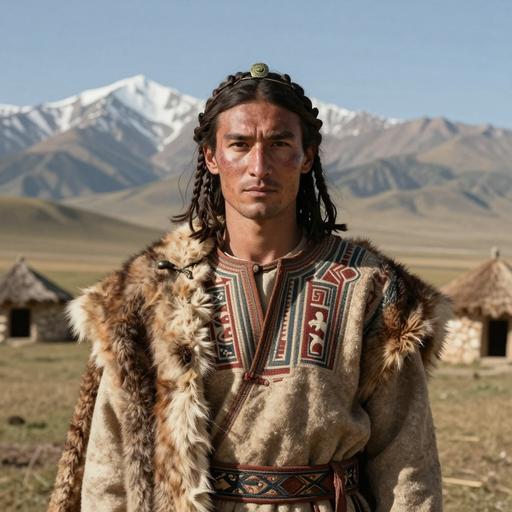
Portrait of ancient individual CHK004 from Kyrgyzstan, dated 709 CE
CHK004
Kyrgyzstan Kyrgyzstan_Saka_IA 709 CE Steppe Nomads M J-PH358 F1b1f
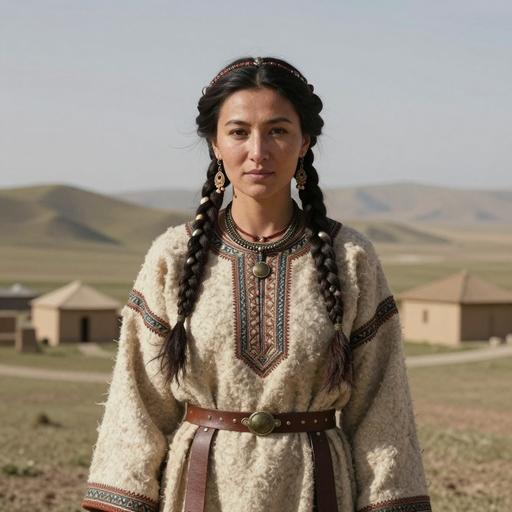
Portrait of ancient individual CHK003 from Kyrgyzstan, dated 751 BCE
CHK003
Kyrgyzstan Kyrgyzstan_Saka_IA 751 BCE Steppe Nomads F - -
Portrait of ancient individual KEN003 from Kyrgyzstan, dated 400 BCE
KEN003
Kyrgyzstan Kyrgyzstan_Saka_IA 400 BCE Steppe Nomads M R-Z2124 G2a3
Portrait of ancient individual KEN002 from Kyrgyzstan, dated 540 BCE
KEN002
Kyrgyzstan Kyrgyzstan_Saka_IA 540 BCE Steppe Nomads F - U4a1a
Portrait of ancient individual CHK002 from Kyrgyzstan, dated 750 BCE
CHK002
Kyrgyzstan Kyrgyzstan_Saka_IA 750 BCE Steppe Nomads F - U4a2
Portrait of ancient individual CHK001 from Kyrgyzstan, dated 514 BCE
CHK001
Kyrgyzstan Kyrgyzstan_Saka_IA 514 BCE Steppe Nomads F - H1
AI Powered

AI Assistant

Ask questions about the Whispers of the Steppe culture

AI Assistant by DNAGENICS

Unlock this feature
Ask questions about the Whispers of the Steppe culture. Our AI assistant can explain genetic findings, historical context, archaeological evidence, and modern connections.
Sample AI Analysis

The Whispers of the Steppe culture represents a fascinating chapter in human history...

Genetic analysis reveals connections to earlier populations while showing evidence of unique adaptations and cultural innovations. The ancient DNA samples provide insights into migration patterns, social structures, and the biological relationships between ancient populations.

This is a preview of the AI analysis. Unlock the full AI Assistant to explore detailed insights about:

  • Genetic composition and ancestry
  • Migration patterns and origins
  • Daily life and cultural practices
  • Modern genetic legacy
Use code for 50% off Expires Mar 05