Menu
Store
Blog
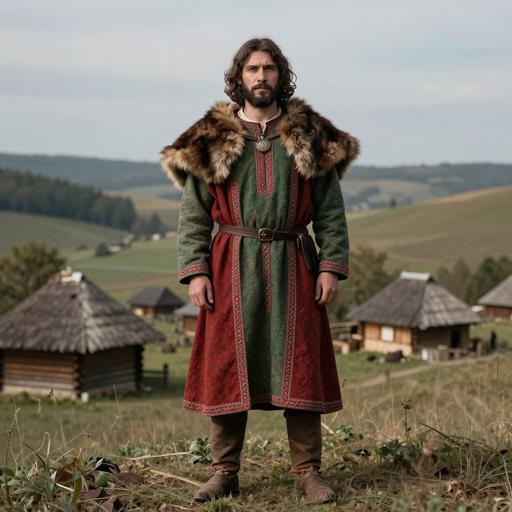
Portrait reconstruction of I17642
Ancient Individual

A man buried in Romania in the Middle Ages era

I17642
901 CE - 1029 CE
Male
Medieval Brailita, Romania
Romania
Scroll to begin
Chapter I

Identity

The biological and cultural markers that define this ancient individual

Sample ID

I17642

Date Range

901 CE - 1029 CE

Biological Sex

Male

mtDNA Haplogroup

G3a1'2

Y-DNA Haplogroup

Not available

Cultural Period

Medieval Brailita, Romania

Chapter II

Place

Where this individual was discovered

Country Romania
Locality Brăiliţa
Coordinates 45.3018, 27.9668
Chapter III

Time

When this individual lived in the broader context of human history

I17642 901 CE - 1029 CE
Chapter IV

Story

The narrative of this ancient life

Medieval Brăilița, a region in what is now Romania, is not extensively documented in historical records, partly due to its transitional position between various empires and cultures, including the Byzantine Empire. However, its location and influence can be pieced together through a composite understanding of the broader medieval context in the region and insights from archaeological findings, historical texts, and regional studies of medieval Eastern Europe.

Geographical and Historical Context:

Brăilița is situated near the modern-day city of Brăila in Romania, close to the River Danube. During the medieval period, this area was a significant crossroads of trade and cultural exchange, influenced by various dominant powers, including the Byzantine Empire to the south, the Bulgarian Empire, and later, the Ottoman Empire. The region's proximity to the Danube gave it strategic importance for trade and military movements, serving as a conduit between Central Europe, the Black Sea, and the Byzantine Empire.

Cultural Influences:

The cultural milieu of medieval Brăilița, in the shadow of the Byzantine Empire, would have been a tapestry of influences. Byzantine control, or at least influence, brought with it the Orthodox Christian faith, which was a unifying cultural and religious force in the region. Byzantine art, characterized by its religious iconography, mosaics, and architectural styles, likely permeated local practices.

Brăilița, as part of the larger area known historically as Wallachia, would have been influenced by Slavic cultures as well. The Slavic migrations and interactions with native Dacian-Roman populations contributed to a unique cultural synthesis. This convergence of cultures is reflected in language development, religious practices, and artistic traditions.

Society and Economy:

The society of medieval Brăilița was predominantly agrarian, but its position on trade routes fostered some degree of mercantile activity. The fertile lands near the Danube were conducive to agriculture, and trade goods flowing through the region included grain, wine, honey, wax, and furs.

Feudalism, as a socio-economic system, was less rigidly structured here than in Western Europe, but there were local variations. Land was often controlled by local rulers or boyars (noblemen), and a complex hierarchy of vassalage existed, supported by serf-based labor on agricultural estates. Towns like Brăila began developing in the late medieval period as trade hubs, gradually gaining prominence and contributing to the region’s economic tapestry.

Political Structure:

Medieval Romanian lands, including Brăilița, were influenced by and sometimes under the suzerainty of powerful neighbors. The Byzantine influence reached its zenith before the encroaching force of the Bulgarian Empire and later Hungary, culminating in Wallachia's semi-independent voivodate under local dynasties. These rulers navigated the complex web of allegiances and tributary relationships with surrounding empires.

Religion and Art:

The Orthodox Church played a central role in everyday life, with monastic centers acting as cultural and educational hubs. Byzantine liturgical traditions, church architecture, and iconography deeply influenced local artistic expressions.

Churches were typically adorned with frescoes and icons, depicting religious themes that were integral to Byzantine art. The cross-in-square plan predominated in church architecture, sometimes adapted with local building materials and styles.

Conclusion:

While specifics about medieval Brăilița are sparse, understanding its interaction with the Byzantine Empire, regional powers, and the local cultural synthesis gives us insight into this fascinating historical period. The area's history is marked by the blending of cultures, economic transition from purely agrarian to mercantile, and the complex feudal and political dynamics influenced by the perennial push and pull of greater empires. This era set the stage for the region's evolution through subsequent Ottoman influence and the eventual emergence of the modern Romanian state.

Chapter V

Genetics

The genetic ancestry of this ancient individual

Ancient Genetic Admixture

This analysis compares the DNA profile of I17642 with ancient reference populations, showing the genetic composition in terms of prehistoric ancestral groups.

Ancient Asians 48.0%
Western Steppe Pastoralists 19.5%
European Hunter-Gatherers 18.5%
Neolithic Farmers 14.0%

Modern Genetic Admixture

This analysis compares the DNA profile with present-day reference populations, showing what percentage of genetic makeup resembles modern populations from different regions.

Asia 75.1%
Northern Asian 22.2%
Siberian 12.7%
Mongolian 9.5%
Northern West Asian 21.2%
Anatolian 12.3%
Caucasian 8.9%
Chinese & Southeast Asian 16.3%
Chinese 16.3%
Central Asian, Northern Indian & Pakistani 15.4%
Central Asian 15.4%
Europe 20.9%
Northwestern European 20.9%
Scandinavian 20.9%
America 3.2%
America 3.2%
Native American 3.2%
Africa 0.8%
Northern East African 0.8%
Eastern African 0.8%

Closest Modern Populations

These are the modern populations showing the closest statistical alignment to A man buried in Romania in the Middle Ages era, ranked by genetic distance. Lower distance values indicate closer statistical similarity.

1
Bashkir
6.5446
2
Tatar Crimean Steppe
6.7571
3
Tatar Lipka
7.5770
4
Khanty O1
8.3778
5
Tatar Siberian
9.0973
6
Besermyan
9.4375
7
Uzbek
9.5212
8
Udmurt
9.6824
9
Turkmen Uzbekistan
9.7125
10
Turkmen
10.0458
Chapter VI

Context

Other ancient individuals connected to this sample

Sources

References

Scientific publications and genetic data

Scientific Publication

The genetic history of the Southern Arc: A bridge between West Asia and Europe | Science

Authors Lazaridis I, Alpaslan-Roodenberg S, Acar A
Abstract

The period from the Copper Age to the Bronze Age marked major social and economic transformations in West Eurasia. To better understand these changes and their genetic impacts, we generated genome-wide data from 727 individuals who lived between 5000 and 1000 BCE in southeastern Europe and southwestern Asia.

G25 Coordinates

The G25 coordinates for sample I17642 can be used for detailed admixture analysis in our G25 Studio tool.

I17642,0.09051544,-0.07194348,0.05241344,0.01996686,0.00499966,0.00070442,0.00203806,0.00771886,0.00021438,-0.0059469,0.01933624,-0.0039221,0.00594728,-0.02831906,-0.00438028,-0.00425816,-0.00546474,0.000908,0.00126786,-0.0011607,-0.00300758,0.01722702,0.01570074,-0.00643492,-0.00503433
Analyze in G25 Studio
Use code for 50% off Expires Mar 05