Menu
Store
Blog
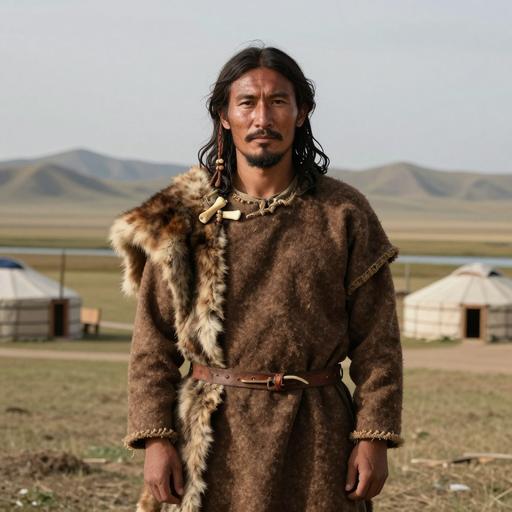
Portrait reconstruction of IAG001
Ancient Individual

A man buried in Mongolia in the Early Bronze Age era

IAG001
2570 BCE - 2465 BCE
Male
Early Bronze Age Khovd, Mongolia
Mongolia
Scroll to begin
Chapter I

Identity

The biological and cultural markers that define this ancient individual

Sample ID

IAG001

Date Range

2570 BCE - 2465 BCE

Biological Sex

Male

mtDNA Haplogroup

Not available

Y-DNA Haplogroup

Not available

Cultural Period

Early Bronze Age Khovd, Mongolia

Chapter II

Place

Where this individual was discovered

Country Mongolia
Locality Khovd. Yagshiin Khuduu
Coordinates 46.1211, 91.5718
Chapter III

Time

When this individual lived in the broader context of human history

IAG001 2570 BCE - 2465 BCE
Chapter IV

Story

The narrative of this ancient life

The Early Bronze Age (EBA) in the Khovd region of Mongolia is a fascinating period characterized by significant cultural and technological transitions among the communities inhabiting the Eurasian Steppe. This era, roughly spanning from the late 3rd millennium to early 2nd millennium BCE, marks the evolution of nomadic pastoral societies that were instrumental in shaping the dynamics of Eurasia.

Environmental and Geographical Context

The Khovd region is positioned in western Mongolia, prominently situated within the greater expanse of the Eurasian Steppe. This vast grassland region provided a unique environment that supported the development of pastoralism due to its open landscapes, which were ideal for grazing livestock. The climate during the Early Bronze Age was likely similar to today—characterized by harsh winters and dry summers, necessitating a mobile lifestyle to access resources efficiently.

Cultural Characteristics

Subsistence and Economy

The Early Bronze Age communities in Khovd were primarily pastoral, relying heavily on the herding of animals such as sheep, goats, cattle, and horses. This form of subsistence was well-suited to the region's ecological conditions and allowed these groups to exploit different pastures seasonally. Animal husbandry led to a highly mobile lifestyle, which was reflected in their material culture and settlement patterns.

The adoption and domestication of the horse, evident in this period, played a crucial role in the economic and social life of these communities, ushering in new means for transportation, trade, and warfare.

Social Structure and Organization

The social organization of Early Bronze Age Khovd was likely based on kinship ties, with clans or extended family groups forming the fundamental social units. Hierarchies perhaps existed, likely determined by wealth in livestock, martial prowess, or spiritual roles. Evidence suggests the presence of social stratification, as indicated by variations in burial practices and grave goods.

Material Culture

Material culture from this era reflects a blend of local traditions and interactions with neighboring cultures. Pottery from this period, typically handmade and fired at low temperatures, exhibits simple geometric decorations. The emergence of metalwork, though limited, marks significant technological progress. Tools and ornaments made from bronze and other metals indicate connections with broader Eurasian metallurgical traditions.

Stone tools and weapons, such as knives and arrowheads, were prevalent, highlighting the continued importance of hunting and warfare alongside pastoral activities. Textile remnants suggest knowledge of weaving, although evidence is sparse due to the perishable nature of materials.

Mortuary Practices

Burial practices were complex and varied, indicating a rich spiritual and ritual life. Graves often contain goods reflective of the deceased's status or occupation, including tools, weapons, and ornaments. The presence of kurgans, or burial mounds, is widespread, suggesting a practice of venerating individuals of high social or spiritual importance.

Artistic and Religious Expressions

Artistic expressions are observed in petroglyphs and carvings, depicting animals, hunting scenes, and abstract designs, offering insights into the symbolic and aesthetic values of these communities. Religious beliefs likely involved shamanistic elements, emphasizing the interconnectedness between humans, animals, and the spiritual world, although detailed evidence is limited.

Interactions and Influence

The Early Bronze Age in Khovd was a dynamic period of cross-cultural interaction facilitated by the region's position along the ancient trade routes of the Eurasian Steppe. This connectivity allowed for the exchange of goods, ideas, and technologies with neighboring cultures, such as those in Central Asia, Siberia, and further west.

In conclusion, the Early Bronze Age in Khovd, Mongolia, reflects a critical period of cultural development in the Eurasian Steppe, with significant advancements in pastoralism, metallurgy, and social organization. The communities of this era laid foundational aspects for the later, more complex societies that would emerge in Mongolia and across the steppes, influencing the region's historical trajectory for millennia to come.

Chapter V

Genetics

The genetic ancestry of this ancient individual

Ancient Genetic Admixture

This analysis compares the DNA profile of IAG001 with ancient reference populations, showing the genetic composition in terms of prehistoric ancestral groups.

Western Steppe Pastoralists 47.2%
Ancient Asians 16.7%
European Hunter-Gatherers 14.5%
Neolithic Farmers 13.6%
Ancient Native Americans 7.9%

Modern Genetic Admixture

This analysis compares the DNA profile with present-day reference populations, showing what percentage of genetic makeup resembles modern populations from different regions.

Europe 53.0%
Northwestern European 53.0%
English 41.2%
Finnish 11.8%
Asia 35.9%
Central Asian, Northern Indian & Pakistani 35.4%
Pakistan 17.6%
Indian 9.3%
Central Asian 8.5%
Northern West Asian 0.5%
Caucasian 0.5%
America 9.0%
America 9.0%
Native American 9.0%
Africa 2.1%
West African 2.1%
Ghanaian, Liberian, Sierra Leonean 1.2%
Senegambian & Guinean 0.9%

Closest Modern Populations

These are the modern populations showing the closest statistical alignment to A man buried in Mongolia in the Early Bronze Age era, ranked by genetic distance. Lower distance values indicate closer statistical similarity.

1
Tatar Kazan
4.6352
2
Besermyan
4.7534
3
Udmurt
6.2464
4
Tatar Mishar
6.4368
5
Komi A
6.8579
6
Chuvash
6.9451
7
Tatar Lipka
7.6552
8
Russian Leshukonsky
8.4279
9
Saami Kola
8.6793
10
Tajik Tajikistan Hisor
9.6182
Chapter VI

Context

Other ancient individuals connected to this sample

Sources

References

Scientific publications and genetic data

Scientific Publication

A Dynamic 6,000-Year Genetic History of Eurasia's Eastern Steppe

Authors Jeong C, Wang K, Wilkin S
Abstract

The Eastern Eurasian Steppe was home to historic empires of nomadic pastoralists, including the Xiongnu and the Mongols. However, little is known about the region's population history. Here, we reveal its dynamic genetic history by analyzing new genome-wide data for 214 ancient individuals spanning 6,000 years. We identify a pastoralist expansion into Mongolia ca. 3000 BCE, and by the Late Bronze Age, Mongolian populations were biogeographically structured into three distinct groups, all practicing dairy pastoralism regardless of ancestry. The Xiongnu emerged from the mixing of these populations and those from surrounding regions. By comparison, the Mongols exhibit much higher eastern Eurasian ancestry, resembling present-day Mongolic-speaking populations. Our results illuminate the complex interplay between genetic, sociopolitical, and cultural changes on the Eastern Steppe.

G25 Coordinates

The G25 coordinates for sample IAG001 can be used for detailed admixture analysis in our G25 Studio tool.

IAG001,0.10548406,0.0115291,0.03949484,0.0632958,-0.02235076,0.01679664,-0.0014915,-0.00017064,-0.00843614,-0.0261177,0.0093621,-0.00663688,0.01002106,-0.0147399,-0.00580964,-0.0098522,-0.01270352,-0.00310444,-0.01404308,-0.01610396,-3.366E-05,0.00415894,-0.01732902,0.00568298,-0.00385202
Analyze in G25 Studio
Use code for 50% off Expires Mar 05