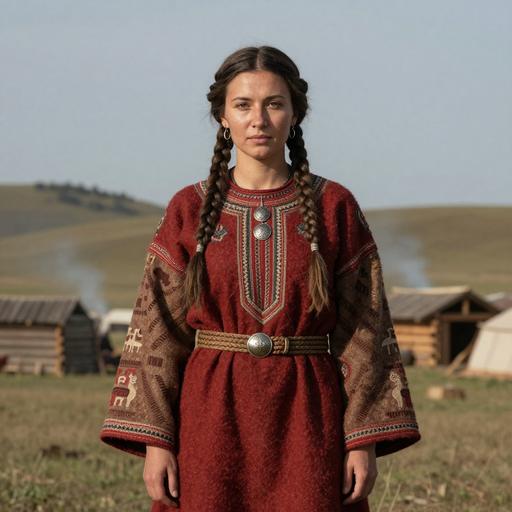
The Story
The journey of mtDNA haplogroup HV0H
Origins and Evolution
mtDNA haplogroup HV0H is a downstream subclade of HV0, itself a West Eurasian branch derived from HV. HV0 lineages likely originated during the Late Glacial (around ~17 kya) in or near the Near East/Caucasus and played a role in the postglacial recolonization of parts of Europe. HV0H appears to have differentiated shortly after the main HV0 node, in the terminal Pleistocene or early Holocene (~14 kya), consistent with patterns of diversification that follow climatic amelioration and human range expansions.
Phylogenetic placement of HV0H within the HV/HV0 cluster means it shares deeper ancestry with haplogroups such as V, and its structure is inferred from both control-region and coding-region variants in modern and ancient mitogenomes. Because HV0H has been identified only at low frequencies in modern populations and in a small number of ancient samples, the branch is considered rare but informative about localized maternal histories connecting the Near East, Mediterranean and parts of Europe.
Subclades (if applicable)
HV0H is a relatively localised, low-diversity branch. Where thorough mitogenome sequencing has been performed, HV0H can resolve into minor internal sublineages with geographically restricted distributions (for example lineages found mainly in Anatolia or the western Mediterranean). However, compared with larger clades such as H or U, HV0H shows limited subclade richness, reflecting either a small original founder population or later drift and bottlenecks.
Geographical Distribution
The modern distribution of HV0H is patchy and generally at low to moderate frequency where detected. Its highest relative concentrations tend to be found in parts of the Near East/Caucasus and in western and southern Europe (notably the Mediterranean and Iberia), consistent with a history of postglacial movements and repeated gene flow across the Anatolia–Europe corridor. Lesser occurrences are reported in northern Europe (often as rare lineages), North Africa (likely reflecting prehistoric and historic contacts across the Mediterranean), and sporadically in Central and South Asia, where long-distance contacts and population movements occasionally introduce West Eurasian maternal lineages.
Ancient DNA recovery of HV0/HV0H-class lineages from late Pleistocene to Holocene contexts supports an interpretation of HV0H as part of a broader Late Glacial/early Holocene maternal gene pool that contributed to European and Near Eastern maternal diversity.
Historical and Cultural Significance
HV0H is not associated with any single archaeological culture at high frequency. Instead, its biogeographic signal connects multiple phases of prehistory:
- Late Glacial / Epipaleolithic: Origin and early diversification during postglacial expansions from refugia in southern Europe and the Near East.
- Neolithic: Some HV0H lineages probably moved with or admixed into early farming communities, particularly around the Mediterranean where maritime and inland Neolithic dispersals redistributed maternal lineages.
- Later prehistoric and historic periods: Low-level mobility (e.g., Bronze Age and later demographic shifts across Europe and the Near East) redistributed HV0H in a patchy fashion; limited presence in Bell Beaker or other steppe-associated contexts is possible but not dominant.
Because HV0H occurs at low frequency, it is most valuable for fine-scale regional studies of maternal ancestry and for tracing localized continuity or replacement in archaeological contexts rather than for explaining continent-wide demographic transformations.
Conclusion
HV0H is a minor but informative West Eurasian mtDNA lineage that likely arose in the Near East/Western Asia during the Late Glacial and contributed to the postglacial and later Holocene maternal gene pool of Europe and neighboring regions. Its scarcity and restricted substructure make it useful for regional population-history questions linking the Near East, the Mediterranean, and parts of Europe, and its presence in a small number of ancient samples underscores a long-term, if limited, continuity through the Holocene.
Key Points
- Origins and Evolution
- Subclades (if applicable)
- Geographical Distribution
- Historical and Cultural Significance
- Conclusion