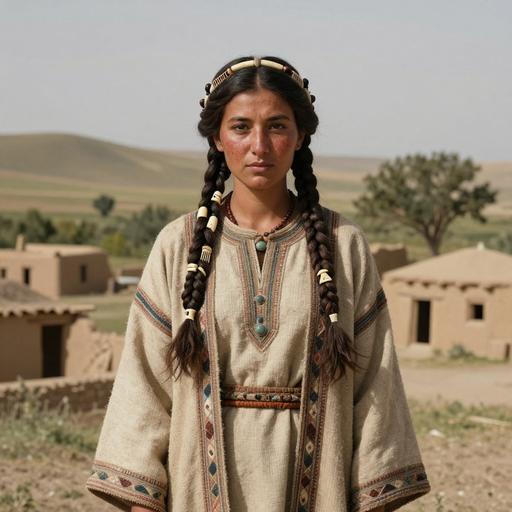
The Story
The journey of mtDNA haplogroup J1B3B1
Origins and Evolution
mtDNA haplogroup J1b3b1 is a low-frequency, downstream branch of J1b3b (itself under J1b3). Based on phylogenetic position and available coalescent estimates for J1 lineages, J1b3b1 most likely diversified in the Near East or eastern Mediterranean during the early to mid-Holocene (roughly ~6–8 kya). This time depth is consistent with expansions of farming populations and maritime Neolithic dispersals that carried many West Eurasian maternal lineages into Southern Europe, the Mediterranean islands, coastal North Africa and neighboring regions.
The lineage is defined by a small number of diagnostic mutations downstream of J1b3b; because it is rare, its internal diversity is limited in modern population samples and in current ancient DNA datasets.
Subclades (if applicable)
At present, J1b3b1 shows little well-differentiated downstream structure in published datasets — its diversity is mainly represented by single-lineage branches and a few private mutations seen in modern and archaeological samples. This limited branching is expected for a low-frequency haplogroup and may reflect either a relatively recent origin within J1b3b, demographic bottlenecks, or undersampling in regions where it occurs. As more whole-mitochondrial genomes are sequenced from the Near East, Mediterranean and North Africa, additional substructure could be discovered that clarifies migration routes and timing.
Geographical Distribution
J1b3b1 is concentrated at low to moderate frequencies in the eastern Mediterranean and shows sporadic occurrences across the circum‑Mediterranean and adjacent regions. Modern occurrences are reported in Anatolia and the Levant, coastal southern Europe (especially Mediterranean littoral populations), parts of the Maghreb and other North African coastal zones, the Caucasus and scattered instances in Central Asia. The haplogroup has also been observed at low frequency in some Jewish communities (both Ashkenazi and Sephardi), consistent with shared maternal lineages moving with Near Eastern populations and diasporic events.
In archaeogenetic contexts, J1b3b / J1b3b1 has been identified in a small number (for example, two) of ancient individuals in current databases; these findings support continuity of certain J1-related lineages from Neolithic and later periods into modern Mediterranean populations.
Historical and Cultural Significance
Because of its timing and geographic pattern, J1b3b1 is best interpreted as part of the maternal substrate associated with Neolithic farmer dispersals from the Near East and subsequent maritime and coastal movements. The distribution along Mediterranean coasts suggests roles in coastal colonization and trade networks — including the Cardial/Impressa Neolithic expansion into the western Mediterranean, and later historical connectivity through Phoenician, Greek, Roman and medieval Mediterranean maritime contacts.
Its presence in North Africa and the Caucasus can reflect both early Holocene movements and later gene flow during historical periods (Bronze Age trade, Iron Age and classical era contacts, and historic population movements). Low-frequency presence in Jewish groups is consistent with Near Eastern ancestry components retained through founder events and diaspora dynamics.
Conclusion
J1b3b1 is a rare but informative maternal lineage that reflects Near Eastern Holocene demographic processes and the complex web of Neolithic and post-Neolithic movements around the Mediterranean, North Africa and adjacent regions. Ongoing high-resolution mitogenome sampling and ancient DNA recovery in understudied areas will be key to refining the chronology, routes and substructure of this lineage.
Key Points
- Origins and Evolution
- Subclades (if applicable)
- Geographical Distribution
- Historical and Cultural Significance
- Conclusion