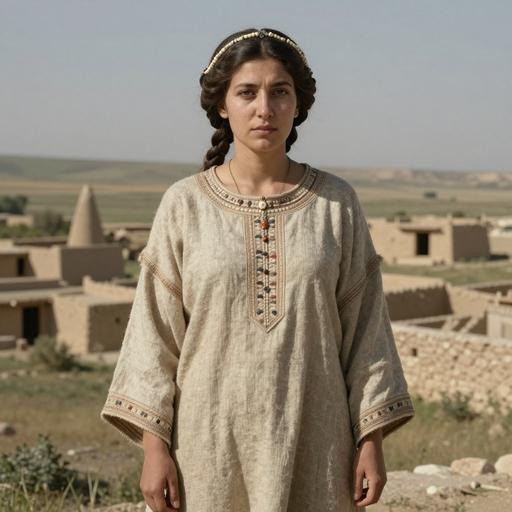
The Story
The journey of mtDNA haplogroup J1C10A
Origins and Evolution
mtDNA haplogroup J1C10A is a terminal subclade nested within J1C10 (itself a branch of J1C1/J). Based on the phylogenetic position of J1C10 and its known time depth, J1C10A most plausibly arose after the parent clade's early Holocene establishment in the Near East/Caucasus, with a likely origin in the Bronze Age (around 3.5 kya). Its emergence reflects continued diversification of Near Eastern maternal lineages that were involved in both Neolithic farmer expansions and later Bronze Age and historic population movements across the Mediterranean and adjacent regions.
Subclades
At present J1C10A is treated as a relatively terminal or narrowly defined subclade derived from J1C10; published data and available phylogenies show limited further branching under J1C10A in public databases. This limited internal diversity is consistent with a more recent origin relative to deeper J1/J branches, or with under-sampling in published and public mtDNA datasets. As more complete mitogenomes are sequenced, additional downstream substructure may be revealed.
Geographical Distribution
J1C10A is observed at low-to-moderate frequencies across coastal and island regions of the Mediterranean, with presence also recorded in the Near East, the Caucasus and parts of North Africa and Central Asia. Its distribution matches the broader footprint of J1C10 but is typically rarer and more focal, often concentrated in coastal trade corridors and long-settled agricultural zones. The clade has also been reported in select Jewish maternal lineages (both Ashkenazi and Sephardi contexts), reflecting historic diasporic movements.
The clade appears in a small number of ancient DNA samples in public and research databases, which supports a Bronze Age or later presence in archaeological contexts; however, the ancient sampling is sparse and limits high-resolution inference about precise migratory events.
Historical and Cultural Significance
Because J1C10A sits within a maternal lineage that expanded with Near Eastern farmers and later Mediterranean networks, its historical significance is most plausibly tied to post-Neolithic demographic processes: Bronze Age cultural interactions (maritime trade, colonization and population movements), Iron Age connectivity across the Mediterranean and Near East, and historic diasporas (including Jewish population movements and later classical-era mobility). The focal occurrences in coastal regions suggest that maritime trade and colonization (e.g., Phoenician, Greek, Roman-era movements) likely contributed to its spread, alongside local continuity and assimilation.
Conclusion
J1C10A represents a recently diversified maternal lineage derived from a Near Eastern/Caucasus-rooted clade. It is relatively uncommon but geographically informative: its presence in the Mediterranean, Near East, Caucasus and North Africa points to a history of regional continuity combined with Bronze Age and later maritime and historical mobility. Improved geographic sampling and additional ancient mitogenomes will clarify finer-scale origins, timing and migration routes for this subclade.
Key Points
- Origins and Evolution
- Subclades
- Geographical Distribution
- Historical and Cultural Significance
- Conclusion