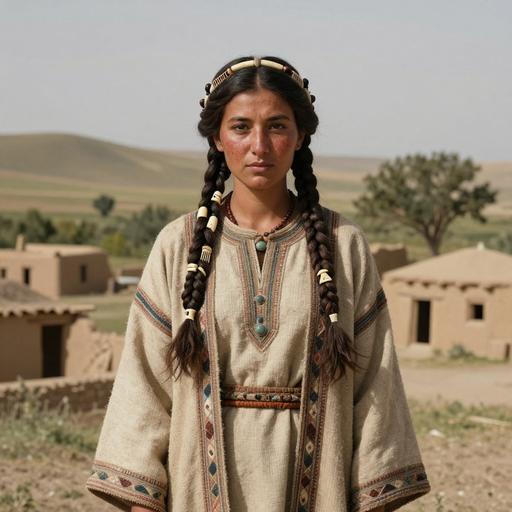
The Story
The journey of mtDNA haplogroup J2B1B1
Origins and Evolution
mtDNA haplogroup J2B1B1 is a downstream subclade of J2B1B within the broader J2 branch of mitochondrial DNA. J2 lineages are broadly associated with Holocene expansions originating in the Near East and eastern Mediterranean; as a subclade of J2B1B, J2B1B1 most likely formed during the mid- to late-Holocene (several thousand years after the Last Glacial Maximum) and reflects maternal lineages that participated in post-glacial re-expansions and early agricultural dispersals along Mediterranean coastal and island corridors. Its low-to-moderate modern frequencies and limited deep branching are consistent with a relatively recent origin followed by localized spread and drift.
Subclades
J2B1B1 is itself a downstream lineage of J2B1B; if further downstream diversity exists, it tends to be extremely sparse in modern databases. Because this clade is rare, documented downstream subclades are few and often represented by singletons or small family clusters in population surveys. Where additional private mutations are observed they frequently reflect local founder events (for example on islands or in small coastal communities) rather than broad, deep phylogeographic substructure.
Geographical Distribution
This haplogroup shows a coastal and island-biased distribution consistent with maritime and littoral dispersal routes from the eastern Mediterranean. Modern and ancient DNA surveys report J2B1B1 at low-to-moderate frequencies principally in:
- Southern Europe and Mediterranean islands (including parts of Italy, Greece, Cyprus, and nearby islands)
- Anatolia and the Levant
- Coastal North Africa (maghrebine littoral samples)
- The Caucasus region in isolated occurrences
- Scattered low-frequency occurrences in parts of Central Asia
- Low-frequency observations within some Jewish communities (both Ashkenazi and Sephardi samples in some studies)
Two identified ancient DNA instances attributed to this clade (or immediately upstream lineages) indicate it has been present in archaeological contexts consistent with Holocene coastal/maritime populations.
Historical and Cultural Significance
Because J2B1B1 descends from a Near Eastern-rooted branch, its presence in Mediterranean and adjacent regions aligns with Neolithic farmer dispersals, subsequent Bronze Age maritime networks, and later historical movements (including Phoenician, Greek, Roman and other Mediterranean interactions). Its rarity and patchy distribution suggest it was never a dominant maternal lineage but likely contributed to the genetic makeup of local coastal communities and island populations via founder effects, small-scale migrations, and sustained regional continuity. The occurrence in some Jewish samples reflects historical Near Eastern connections and later diaspora mixing rather than a uniquely Jewish origin.
Conclusion
J2B1B1 is a geographically informative, low-frequency maternal marker of Holocene Near Eastern origin whose modern pattern reflects localized persistence, maritime and coastal spread, and the effects of genetic drift and founder events. While not a major lineage in terms of frequency, it is useful for fine-scale phylogeographic studies that aim to reconstruct maternal movements around the eastern Mediterranean and adjacent regions during the Neolithic and later periods.
Key Points
- Origins and Evolution
- Subclades
- Geographical Distribution
- Historical and Cultural Significance
- Conclusion