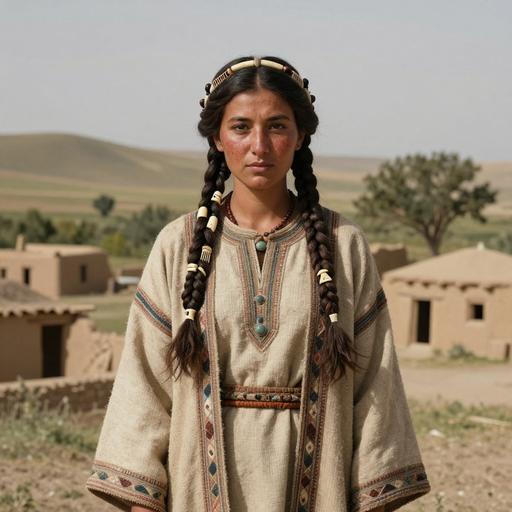
The Story
The journey of mtDNA haplogroup J2B2
Origins and Evolution
mtDNA haplogroup J2B2 is a downstream subclade within haplogroup J, itself a well-known maternal lineage that expanded from the Near East during the Late Glacial and early Holocene. J2B2 likely coalesced in the early Holocene (on the order of ~8–10 kya), derived from the broader J2B lineage that is associated with post-glacial re-expansions and the later Neolithic dispersal of farming populations out of Anatolia and the Levant. As a relatively deep but low-frequency branch, J2B2 represents a lineage that survived regional demographic events and was carried during both inland and maritime movements across the Mediterranean basin.
Subclades (if applicable)
J2B2 is a nested subclade of J2B; published phylogenies and large-scale mtDNA trees show it as one of several limited-frequency branches within the J2 complex. Compared with more common J subclades (for example J1 and some J2 sublineages), J2B2 remains relatively rare and has few well-documented downstream branches in public databases. The scarcity of reported sub-branches and the limited number of ancient occurrences suggest a modest effective population size and geographically patchy distribution through prehistory.
Geographical Distribution
Modern distribution: J2B2 is observed at low-to-moderate frequencies in southern European populations (particularly Mediterranean coastal areas and islands), parts of the Near East (Anatolia, the Levant), the Caucasus, and coastal North Africa; lower-frequency occurrences are reported in parts of Central Asia and among some Jewish communities (both Ashkenazi and Sephardi) at low frequencies. The pattern is consistent with an origin in the Near East followed by Neolithic farmer expansions and later historical movements across the Mediterranean and adjacent regions.
Ancient DNA: The haplogroup has been detected in a small number of ancient samples (three in the reporting database referenced here), providing direct evidence of its presence in archaeological contexts and supporting continuity of the lineage in the broader Near Eastern–Mediterranean realm during the Holocene.
Historical and Cultural Significance
Because of its Near Eastern origin and Mediterranean distribution, J2B2 is most plausibly tied to Neolithic demic diffusion—that is, the spread of early farming populations from Anatolia and the Levant into Europe and the Mediterranean during the early Holocene. Later historical processes (maritime trade networks, Phoenician and Greek colonization, Roman-era mobility, Byzantine and Islamic connections, and medieval diaspora movements including Jewish migrations) offer plausible mechanisms for localized increases or the establishment of J2B2 lineages in coastal and island contexts. However, the haplogroup's relatively low frequency means it rarely defines large-scale population transformations on its own; rather, it contributes to the mosaic of maternal lineages reflecting many overlapping migrations.
Conclusion
mtDNA J2B2 is a geographically informative but low-frequency maternal lineage that highlights Near Eastern roots and Holocene dispersals into the Mediterranean, Caucasus, North Africa, and parts of Central Asia. Its presence in both modern and a small number of ancient samples supports a model of early Holocene origin followed by persistence through Neolithic farmer expansions and subsequent historic movements, making it a useful marker for regional maternal ancestry studies when it is encountered in modern or archaeological remains.
Key Points
- Origins and Evolution
- Subclades (if applicable)
- Geographical Distribution
- Historical and Cultural Significance
- Conclusion