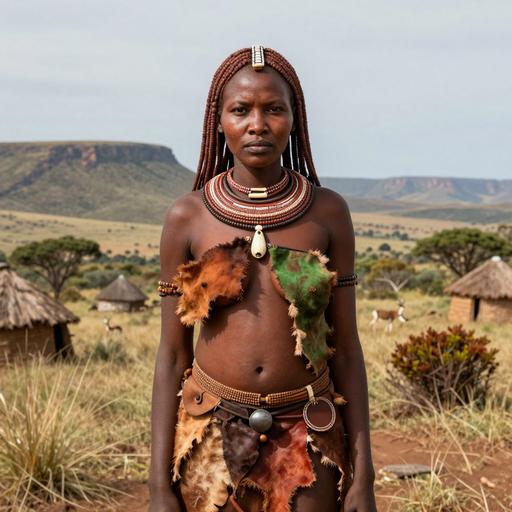
The Story
The journey of mtDNA haplogroup L0D1A1A
Origins and Evolution
L0d1A1A is a subclade nested within mtDNA haplogroup L0d1A1, itself a branch of the deeply rooted African lineage L0d. The broader L0d/L0k complex represents some of the oldest maternal diversity in modern humans and is strongly associated with Khoe‑San forager communities of southern Africa. Based on the position of L0d1A1A beneath L0d1A1 (the parent estimated around ~12 kya) and observed diversity in modern samples, L0d1A1A most likely arose in southern Africa during the Holocene, with a reasonable coalescence estimate on the order of a few thousand years ago (~6 kya). This timing places its origin after the Last Glacial Maximum and within the period of substantial regional continuity and local population differentiation in the Kalahari and adjacent regions.
Genetic patterns for L0d sublineages reflect long-term local persistence combined with episodic gene flow: high within-group continuity among Khoe‑San populations and low-level spread into neighboring populations through admixture events associated with later demographic processes (for example pastoralist and Bantu‑speaking expansions, and historic contacts).
Subclades
As a terminal or near-terminal subclade (L0d1A1A), published data are limited and few additional downstream branches have been widely reported. Where higher-resolution sequencing exists, L0d1A1A can sometimes be subdivided by private mutations found in specific Khoe‑San groups, but the substructure remains modest compared with deeper L0d diversity. Continued mitogenome sequencing of southern African populations may reveal further internal structure.
Geographical Distribution
L0d1A1A is geographically concentrated in southern Africa, especially among Khoe‑San groups. It occurs at high to moderate frequency in some Khoe‑San communities and at low frequencies in neighboring Bantu-speaking populations and historically admixed groups (for example the Cape ‘Coloured’ population in South Africa). Scattered low-frequency occurrences reported in East and Central Africa likely reflect ancient back-and-forth contacts or more recent gene flow. Rare detections in African-descended populations in the Americas trace to the transatlantic slave trade but are uncommon for this lineage.
Two ancient DNA (aDNA) samples in available databases have been assigned to L0d1A1/L0d lineages that are consistent with continuity of L0d maternal lineages in southern Africa through the Holocene, supporting the regional antiquity of L0d1A1A-type diversity.
Historical and Cultural Significance
The distribution and age of L0d1A1A tie it to long-standing hunter‑gatherer lifeways in southern Africa (Later Stone Age traditions) and the genetic continuity of Khoe‑San maternal lineages. The haplogroup's low-frequency presence in Bantu-speaking populations and admixed communities documents historical admixture events following the arrival of Bantu-speaking agriculturalists and later pastoralist movements; it therefore serves as a maternal marker of deep local ancestry that persists despite subsequent demographic shifts. In population-genetic studies, L0d1A1A and related L0d subclades are frequently used to trace ancient population structure, maternal continuity, and the demographic impact of Holocene-era migrations in southern Africa.
Conclusion
L0d1A1A is a regionally concentrated, scientifically informative mtDNA lineage that exemplifies the deep maternal ancestry of Khoe‑San populations and the persistence of ancient southern African lineages into the Holocene. Although currently undersampled compared with some other global haplogroups, available modern and ancient data indicate an origin in southern Africa several thousand years ago, strong association with forager groups, and limited spread into neighboring and admixed populations via historic and prehistoric admixture. Additional full mitogenome sequencing from diverse southern African groups will refine its internal structure and age estimate further.
Key Points
- Origins and Evolution
- Subclades
- Geographical Distribution
- Historical and Cultural Significance
- Conclusion