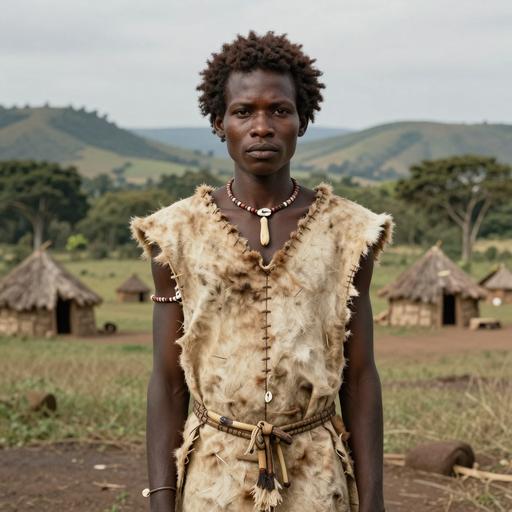
The Story
The journey of mtDNA haplogroup L0D1C
Origins and Evolution
L0d1C is a subclade of the deep southern African lineage L0d1, itself part of the broader L0 clade that represents some of the oldest maternal diversity in anatomically modern humans. Based on its phylogenetic position beneath L0d1 (parent node estimated at ~70 kya), L0d1C is inferred to have arisen later during the Late Pleistocene to early Holocene (here estimated around ~30 ka), consistent with a history of lineage diversification within southern Africa among hunter‑gatherer populations. Its emergence reflects localized maternal diversification in populations ancestral to the modern Khoe‑San and other southern African groups.
Subclades (if applicable)
Within L0d1C, population-level sequencing and phylogenetic studies have revealed internal branches of varying depth; however, fine-scale internal nomenclature and robust subclade definitions depend on broad mitogenome sampling of Khoe‑San and neighboring groups. Some research identifies geographically restricted internal branches that indicate long-term regional continuity, but exact subclade names and ages vary with expanding datasets. Overall, L0d1C behaves like a relatively old, regionally structured cluster with limited long‑distance dispersal.
Geographical Distribution
L0d1C is concentrated in southern Africa, where it attains its highest frequencies among Khoe‑San (forager) populations. It also appears at lower frequencies in nearby Bantu-speaking groups and has occasional occurrences in central and eastern African forager populations, which is consistent with historic and prehistoric gene flow across southern and eastern Africa. Due to the transatlantic slave trade, rare instances of L0d lineages (including deep southern African clades) have been detected at very low frequency in African-descended populations in the Americas, although such occurrences for L0d1C specifically are uncommon. Ancient DNA studies have identified L0d clades in archaeological contexts from southern Africa, supporting long-term regional continuity; L0d1C itself has limited representation in published ancient datasets but is consistent with a deep, local presence.
Historical and Cultural Significance
L0d1C is culturally informative because it tracks maternal continuity among Khoe‑San forager groups, who preserve some of the most deeply divergent human mitochondrial lineages. The distribution and diversity of L0d1C and related L0d branches provide genetic evidence for long-term population structure in southern Africa prior to the Bantu expansion and subsequent historical movements. The presence of L0d1C at low levels in Bantu-speaking populations reflects admixture and local incorporation of forager maternal lineages into expanding farmer populations, illuminating interactions between subsistence groups over the last several thousand years.
Conclusion
As a regional, deep-rooted maternal lineage, L0d1C is best understood as part of the unique mitochondrial heritage of southern African forager populations. Its time depth and restricted primary distribution make it a useful marker for studies of Late Pleistocene and Holocene population structure in southern Africa, forager–farmer interactions, and the regional continuity documented by ancient DNA. Continued full mitogenome sequencing in Khoe‑San and neighboring groups will refine internal substructure and the detailed demographic history of L0d1C.
Key Points
- Origins and Evolution
- Subclades (if applicable)
- Geographical Distribution
- Historical and Cultural Significance
- Conclusion