The Story
The journey of mtDNA haplogroup M
Origins and Evolution
mtDNA haplogroup M is a primary non-African maternal lineage that branches from African-derived haplogroup L3 shortly after the Out-of-Africa dispersal. Most population-genetic and phylogenetic analyses place the origin of M roughly between 50–70 kya, with many estimates clustering around ~55–65 kya, consistent with an early Upper Paleolithic coastal or near-coastal expansion into South and Southeast Asia. M diversified rapidly into numerous regional sublineages as modern humans spread across Asia and into Oceania.
Subclades
Haplogroup M contains many major downstream clades that have distinct geographic and historical signatures. Important descendant lineages include (but are not limited to): C, D, E, G, Z, M1, F-derived clusters, and numerous South and Southeast Asian-specific M branches. Some of these (e.g., C and D) are prominent in northern Eurasia and the Americas, whereas M1 is notable for its presence in North Africa and is generally interpreted as a Paleolithic back-migration into Africa. Other M subclades are highly diverse and endemic to South Asia, the Andaman Islands, Island Southeast Asia, and Near Oceania.
Geographical Distribution
Haplogroup M and its derivatives are widespread across Asia and Oceania with varying frequencies: very high diversity and frequency in South Asia and parts of Southeast Asia, high frequencies in many indigenous populations of Oceania (including Papuans and Aboriginal Australians), substantial representation across East Asia (through certain M subclades), and presence in the Americas through descendant clades (notably C and D). A localized presence of M1 in North Africa reflects prehistoric back-migration events. In western Eurasia M is generally rare except for specific regional introductions and recent gene flow.
Historical and Cultural Significance
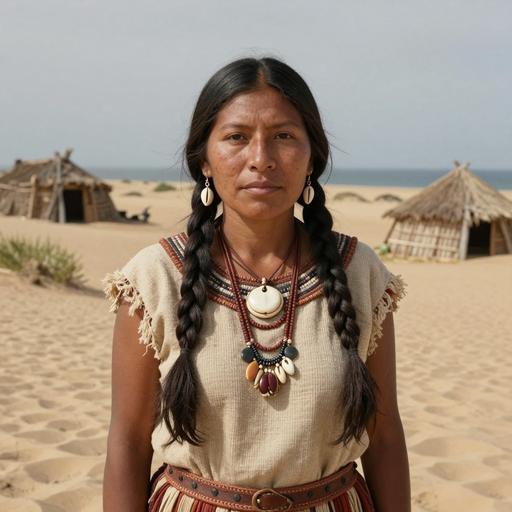
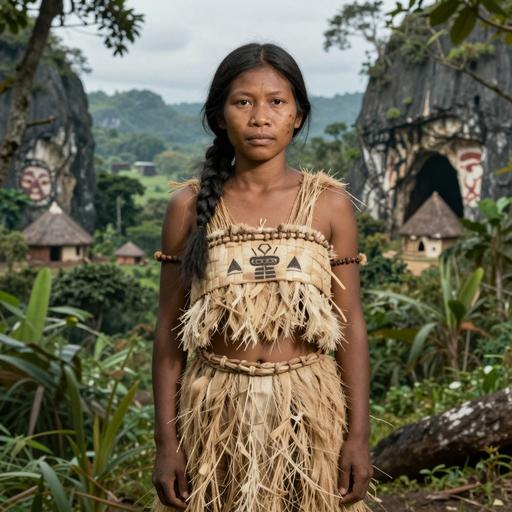
Because M diversified early after the Out-of-Africa dispersal, it marks some of the earliest human expansions into South and Southeast Asia and the colonization of Near Oceania and Australia. Several M subclades trace migrations associated with the coastal dispersal model, and later M lineages were carried during the Austronesian expansion into Island Southeast Asia and Oceania. The presence of M-derived lineages (C and D) among Native American populations also links M to the founding maternal ancestry of many indigenous peoples of the Americas.
Conclusion
mtDNA haplogroup M is a foundational non-African maternal lineage whose deep time depth and widespread diversification make it central to reconstructing early modern human migrations across Asia, Oceania, and into the Americas. Its many regional subclades record both Pleistocene dispersals and later Holocene demographic events, and continued sampling and ancient DNA studies keep refining its internal phylogeny and geographic history.
Key Points
- Origins and Evolution
- Subclades
- Geographical Distribution
- Historical and Cultural Significance
- Conclusion