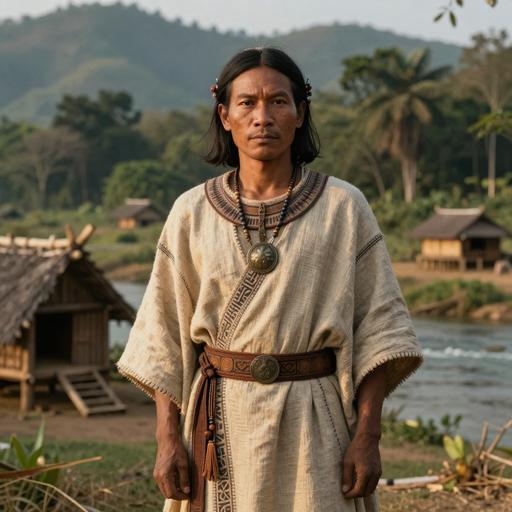
The Story
The journey of mtDNA haplogroup M24B
Origins and Evolution
mtDNA haplogroup M24B is a downstream subclade of haplogroup M24, itself nested within the deep-rooting South Asian M2-derived lineages. Given the parent M24 has an estimated time-depth of roughly 30 kya in the subcontinent, M24B is best interpreted as a later local diversification that likely formed in the Late Glacial to early Holocene (roughly ~12 kya by phylogenetic inference). This timing is consistent with post–Last Glacial Maximum demographic shifts, regional population structure, and local continuity among hunter-gatherer and early Holocene communities in South Asia.
Subclades (if applicable)
As a specific branch labelled M24B, this clade may include further minor derived lineages detectable only with high-resolution complete mitogenome sequencing. Published population surveys and targeted sequencing often report M24* (unresolved) and named subclades like M24A/M24B when sufficient resolution exists; the presence of M24B in modern and a small number of ancient samples suggests limited but persistent diversification. Additional sub-branches are expected to be geographically structured across tribal and regional groups in the subcontinent.
Geographical Distribution
M24B is concentrated in South Asia, with the highest frequencies and diversity observed among indigenous Adivasi/tribal populations and some Dravidian-speaking groups in southern India. Lower-frequency occurrences appear in North and Central Indian Indo-Aryan populations, Bangladesh, Sri Lanka (including occasional Veddah samples), and sporadic detections in Pakistan, Nepal lowlands/foothills, and coastal Southeast Asia reflecting limited gene flow. Modern diaspora communities can carry rare instances of M24B outside South Asia.
Historical and Cultural Significance
The distribution of M24B—favoring tribal and some regional caste groups—indicates long-term maternal continuity in the subcontinent rather than a signature of recent large-scale migration. Its persistence from the Late Pleistocene/Holocene boundary through the Mesolithic and into later agricultural and complex-society periods suggests continuity of maternal lineages through cultural transitions (foragers to early farmers to Bronze Age societies). While M24B is not strongly associated with transcontinental migration events (e.g., Steppe-associated Bronze Age expansions), it contributes to the genetic signature of local South Asian populations and appears in a small number of archaeological (ancient DNA) contexts, supporting its antiquity.
Conclusion
M24B is a regionally informative maternal lineage within the broader South Asian M2–M24 phylogeny. Its patterns—concentrated among indigenous and some regional populations, late-Pleistocene/early-Holocene time depth, and occasional appearance in neighboring regions—make it useful for reconstructing maternal continuity and micro-scale demographic history within South Asia. Further high-coverage mitogenome sequencing and expanded ancient DNA sampling will refine the internal structure and precise time depth of M24B subclades.
Key Points
- Origins and Evolution
- Subclades (if applicable)
- Geographical Distribution
- Historical and Cultural Significance
- Conclusion