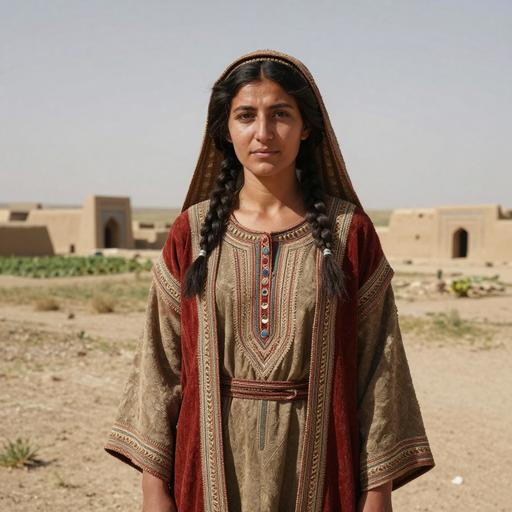
The Story
The journey of mtDNA haplogroup N1B1A
Origins and Evolution
mtDNA haplogroup N1B1A is a subclade of N1B1, itself derived from macro-haplogroup N. Based on the phylogenetic position of N1B1 and available coalescence estimates for its downstream branches, N1B1A most plausibly arose in the Near East or adjacent Caucasus region during the Early Holocene (roughly within the last ~10,000 years). As a downstream branch, N1B1A inherits the broader Near Eastern/Late Pleistocene–Early Holocene signature of N1B1 but shows further regionalization consistent with Holocene demographic processes such as the spread of farming, local expansions, and later historical migrations.
Subclades (if applicable)
N1B1A is characterized by derived mutations nested within N1B1. Published sampling and phylogenies indicate limited deep sub-structure in N1B1A compared with some more widespread haplogroups — many observed lineages fall into small, regionally restricted clusters. Ancient DNA (aDNA) detections (the database referenced contains ~19 aDNA occurrences for N1B1-level lineages) suggest N1B1A and its nearest relatives persisted through the Neolithic and into later periods in the same regions, but high-resolution, well-sampled mitogenomes are required to resolve fine-scale subclades and recent branching events.
Geographical Distribution
Modern distribution: N1B1A occurs at low-to-moderate frequencies across the Near East and adjacent regions. The highest relative frequencies and diversity are observed in the Levant, Anatolia, and the southern Caucasus, with additional low-moderate presence in parts of the North African littoral and the Horn of Africa, consistent with historical and prehistoric gene flow along coastal and trade routes. Small occurrences are recorded in southern Europe (Mediterranean Italy, Greece, Sardinia) and among certain Jewish communities, reflecting both ancient connectivity and later migratory episodes.
Ancient DNA evidence: The presence of N1B1-level lineages in multiple archaeological contexts (the referenced set of ~19 aDNA samples) supports continuity of this maternal lineage in the eastern Mediterranean and Near East from the Neolithic through the Bronze Age and into historical times, although sample sizes remain modest and geographically biased.
Historical and Cultural Significance
Because of its Near Eastern origin and Holocene age, N1B1A likely participated in several key demographic processes:
- Neolithic spread and local continuity: N1B1A sits in the time frame of the Neolithic transition in the Near East; some of its distribution is plausibly explained by local expansion of early farming groups or by assimilation between incoming farmers and indigenous hunter-gatherers.
- Regional maintenance and founder events: The haplogroup's patchy, low-to-moderate presence in coastal North Africa, the Horn of Africa, and Mediterranean Europe is consistent with episodic maritime or overland contacts (trade, migration, or small founder events) rather than mass replacements.
- Historic dispersals and diaspora communities: Occasional occurrences in Jewish and Mediterranean populations likely reflect a combination of ancient Near Eastern ancestry and later population movements, trade networks and community-specific founder effects.
Conclusion
N1B1A is best understood as a regional maternal lineage of the Near East/Caucasus that diversified in the Early Holocene and persisted at low-to-moderate frequencies across adjacent regions. It provides a window onto localized maternal ancestry and micro-demographic events in the Levant, Anatolia, and the Caucasus, and its sporadic presence in North Africa, the Horn of Africa, and parts of the Mediterranean reflects the long history of connectivity in these regions. Increased mitogenomic sampling, especially of ancient remains, will improve resolution of its substructure and demographic history.
Key Points
- Origins and Evolution
- Subclades (if applicable)
- Geographical Distribution
- Historical and Cultural Significance
- Conclusion