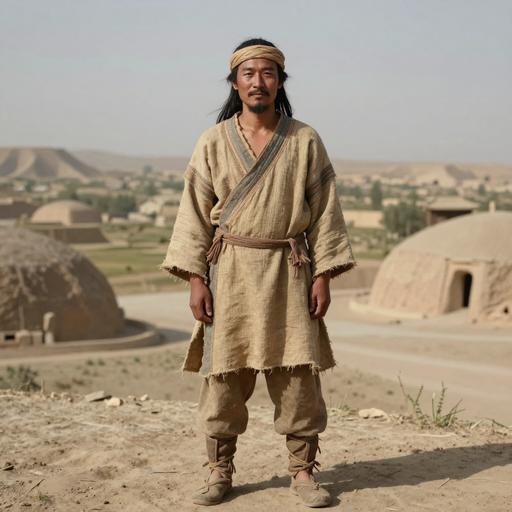
The Story
The journey of mtDNA haplogroup R11A
Origins and Evolution
mtDNA haplogroup R11A is a subclade of R11, itself a branch of macro-haplogroup R (descended from N). Based on its phylogenetic position and the age estimates for the parent clade, R11A most likely diversified during the early Holocene (roughly ~12 kya), after the Last Glacial Maximum and contemporaneous with regional hunter-gatherer to early farming transitions. Molecular clock estimates for many regional R-derived lineages and the geographic distribution of basal R11 lineages suggest R11A arose on or near the South Asia–Southeast Asia margin and expanded in a series of localized dispersals rather than a single continent-wide migration.
Subclades
As a named subclade (R11A), this lineage may itself contain additional downstream diversity in high-resolution datasets, but published sampling remains limited. Where deeper sequencing has been done, R11A splits into rare local branches confined to island and coastal populations, consistent with founder effects and drift in small, often insular communities. Continued mitogenome sequencing in understudied groups is likely to reveal additional substructure within R11A.
Geographical Distribution
R11A has a patchy distribution concentrated in South and Southeast Asia and extending into southern China and parts of Insular Southeast Asia. Modern occurrences are reported among populations in India, Sri Lanka, Bangladesh, southern China and Vietnam, and across Southeast Asian maritime populations (Thailand, Malaysia, Indonesia, Philippines, Taiwan). The lineage is generally rare but persistent, often present at low frequencies in mainland groups and occasionally enriched in island or coastal communities due to drift and founder events.
Two archaeological/ancient-DNA samples in current databases carry R11-lineage markers consistent with R11A-level affinity, indicating the lineage has been present in the region for several millennia and is not solely a recent phenomenon.
Historical and Cultural Significance
R11A's geographic pattern matches demographic processes that shaped South and Southeast Asia during the terminal Pleistocene and Holocene: localized post-glacial expansions, coastal forager mobility, and later Austronesian-mediated island dispersals. In many cases where R11A appears in islander groups, it is likely a component of pre-Austronesian or early Austronesian maternal pools that became incorporated into expanding maritime communities. Its persistence at low frequencies in mainland South Asia suggests long-term regional continuity and interaction between coastal and inland groups.
Conclusion
R11A represents a localized early-Holocene maternal lineage derived from R11, best understood as part of the complex mosaic of South and Southeast Asian maternal diversity. It illustrates how relatively rare mtDNA lineages can persist through millennia via a combination of localized continuity, founder effects in island populations, and incorporation into later expansions such as Austronesian movements. Broader mitogenome sampling and ancient DNA from coastal and island archaeological contexts will refine its internal structure, timing and migratory history.
Key Points
- Origins and Evolution
- Subclades
- Geographical Distribution
- Historical and Cultural Significance
- Conclusion