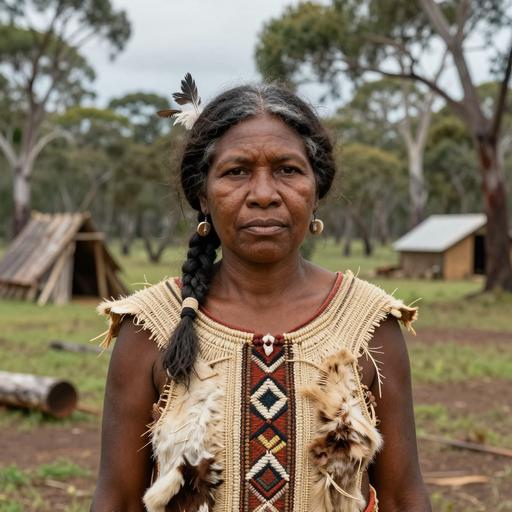
The Story
The journey of mtDNA haplogroup S2A
Origins and Evolution
mtDNA haplogroup S2A is a downstream branch of haplogroup S2, itself derived from the broader Oceanian haplogroup S. The parent clade S2 has deep roots in the Sahul region dating to the Late Pleistocene (the broader S lineage is typically placed around the Upper Pleistocene), and S2A likely formed locally within New Guinea or nearby Sahul populations in the Late Pleistocene to early Holocene (roughly the last ~16 thousand years). Its emergence reflects in situ diversification of maternal lineages after the initial settlement of Sahul by anatomically modern humans and the subsequent isolation, drift, and population structure that characterize Near Oceania.
Genetic processes important to the origin of S2A include founder effects from small, isolated groups, long-term population structure among Papuan and Aboriginal groups, and later limited inter-island dispersals that moved maternal lineages between New Guinea, nearby islands, and the Australian continent. Because S2A is nested within S2, its phylogenetic position helps resolve finer-scale maternal history within Sahul and the early Holocene demographic dynamics of Near Oceania.
Subclades
S2A is itself an intermediate clade within S2. Depending on the resolution of mitogenome surveys, S2A may contain further sub-branches that are geographically structured (for example, sublineages more common in particular New Guinea highland or coastal groups, or in specific Melanesian islands). High-resolution whole-mitogenome studies tend to reveal localized subclades reflecting village- or island-level founder events; however, S2A overall remains a Papuan/Melanesian-centered lineage rather than one associated with the Austronesian/Lapita maternal expansion.
Geographical Distribution
S2A is primarily a Near Oceanian lineage with its highest representation in populations descended from the original Sahul settlers. Observed patterns include:
- Presence across Papua New Guinea among both coastal and interior Papuan-speaking groups, often at moderate to locally high frequencies.
- Occasional detection among Aboriginal Australian groups, consistent with shared deep Sahul ancestry and ancient gene flow or retention of ancestral variation.
- Occurrence in Island Melanesia (e.g., Solomon Islands and neighboring islands), where localized founder events and coastal exchange networks have transmitted some Papuan maternal lineages.
- Low to moderate frequencies in Torres Strait Islander groups, reflecting their geographic bridging position between New Guinea and Australia.
- Very occasional findings in nearby parts of Island Southeast Asia (e.g., eastern Indonesia) that reflect either ancient coastal contact or later low-level dispersal.
The distribution reflects a pattern of deep regional continuity with limited long-distance spread; in many cases S2A is concentrated in areas with strong Papuan genetic continuity.
Historical and Cultural Significance
S2A documents the Pleistocene–Holocene continuity of maternal ancestry in Sahul and is therefore informative about the demographic history of Papuan and Aboriginal groups prior to and during the Holocene. Because S2A is not generally associated with the Austronesian/Lapita expansions that reshaped parts of Near Oceania around 3–3.5 kya, its presence often marks populations or subpopulations that retained substantial pre-Austronesian maternal ancestry.
In archaeological terms, S2A is best interpreted as part of the genetic signal of Pre-Lapita Sahul foragers and later Holocene Papuan communities rather than a marker of later farming expansions. When S2A appears alongside Austronesian-linked mtDNA haplogroups (e.g., B4a1a-derived lineages) in coastal or island populations, it indicates admixture between indigenous maternal lineages and incoming Austronesian groups during the late Holocene.
Conclusion
mtDNA haplogroup S2A is a regionally important maternal lineage in Near Oceania that preserves information about the deep settlement and local diversification of populations within Sahul. As genomic sampling and mitogenome resolution improve across New Guinea, Australia and neighboring islands, S2A and its subclades will continue to refine reconstructions of population structure, migration corridors, and the timing of demographic events in this geographically complex region.
Key Points
- Origins and Evolution
- Subclades
- Geographical Distribution
- Historical and Cultural Significance
- Conclusion