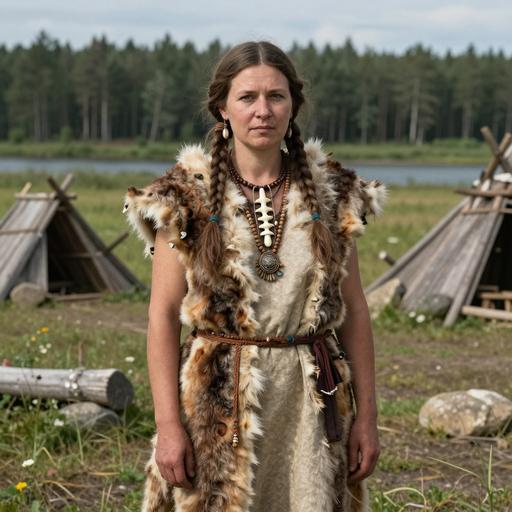
The Story
The journey of mtDNA haplogroup T2A1B
Origins and Evolution
mtDNA haplogroup T2A1B is a subclade of T2A1, itself part of the broader T2 branch within haplogroup T. The parent clade T2A1 is generally inferred to have arisen in the Near East / Anatolia during the early Holocene (around ~9 kya) and to have been carried into Europe by Neolithic farmer expansions. T2A1B likely represents a slightly later split within this lineage (estimated here at ~7 kya), consistent with diversification during the Neolithic and Chalcolithic periods as farming populations expanded and mixed across the Mediterranean and into Central and Eastern Europe.
Because T2A1B sits below T2A1 on the phylogenetic tree, its geographic and temporal patterns are expected to broadly mirror those of the parent clade but at lower frequency and often with a more localized distribution. The lineage's presence in both modern populations and a small number of ancient DNA samples supports a continuity from Neolithic-era demographic processes into later prehistoric and historic populations.
Subclades (if applicable)
T2A1B is itself a terminal or near-terminal subclade in many published trees (designation and depth depend on sampling). Where deeper branching exists, subordinate subclades are typically rare and geographically restricted; ongoing sequencing and complete mitogenome studies occasionally reveal additional internal structure. Because T2A1 has other sublineages (e.g., T2A1A and related branches), T2A1B should be considered alongside these sister clades for phylogeographic inference.
Geographical Distribution
Empirical and inferred distributions place T2A1B primarily in:
- Southern Europe (Italy, Greece, Iberia) at low to moderate frequencies, reflecting Mediterranean Neolithic settlement and later local continuity.
- Central Europe and the Balkans at low to moderate frequencies, often in contexts associated with Neolithic and post‑Neolithic populations.
- Eastern Europe and the Caucasus at lower frequencies, reflecting both Neolithic dispersals and subsequent regional movements.
- The Near East / Anatolia at low frequencies, consistent with a Near Eastern origin and persistence in source regions.
- North Africa and parts of Central Asia sporadically, typically at low frequency likely due to historical gene flow across the Mediterranean and via later contact routes.
Ancient DNA: T2A1 and some T2A1 subclades appear in Neolithic and later archaeological contexts; specifically, T2A1B is recorded in a small number (~5) of published ancient samples in some datasets, which supports its antiquity and links to Neolithic farmer-associated remains.
Historical and Cultural Significance
Because T2A1B is nested within a T2A1 lineage that expanded with early farmers, it is often interpreted as part of the maternal genetic package carried by Anatolian/Levantine-derived Neolithic farmers into Europe. In population-genetic studies T2 lineages (including T2A subclades) are considered markers of Near Eastern Neolithic ancestry when found in European contexts, although later movements and admixture events have redistributed these lineages.
In archaeological association terms, T2A1B is most plausibly connected to Neolithic farming cultures (e.g., Anatolian Neolithic expansions, Early European Neolithic groups such as LBK and Mediterranean Neolithic horizons). It can also appear in later contexts (Bronze Age and historic populations), reflecting continuity or secondary dispersals; localized presence in some modern populations may trace to these complex histories. Co-occurrence with paternal haplogroups typical of early farmers (for example, Y‑DNA G2a) and with other farmer-associated mtDNA haplogroups (H, J, K) is commonly observed in datasets sampling Neolithic-associated remains.
Conclusion
T2A1B is a low-frequency, regionally informative maternal lineage that likely arose in the Near East / Anatolia during the early to mid-Holocene and spread into Europe with Neolithic farmers. Its restricted and sparse modern and ancient occurrence makes it useful for fine-scale maternal lineage studies tied to the Neolithic dispersal and subsequent regional demographic processes, though broader sampling (complete mitogenomes and more ancient DNA) is needed to refine its internal structure and precise migration episodes.
Key Points
- Origins and Evolution
- Subclades (if applicable)
- Geographical Distribution
- Historical and Cultural Significance
- Conclusion