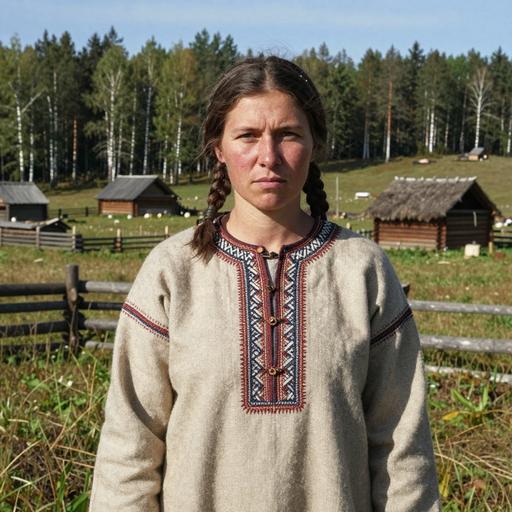
The Story
The journey of mtDNA haplogroup T2A1B1A1B1
Origins and Evolution
mtDNA haplogroup T2A1B1A1B1 is a terminal subclade nested within the broader T2 maternal lineage. The T2 clade is well known from population-genetic studies as a component that expanded with Neolithic and post‑Neolithic farmers from the Near East into Anatolia and southeastern Europe. Given its phylogenetic position beneath T2A1B1A1B and the archaeological contexts where it has been observed, T2A1B1A1B1 most plausibly arose in Anatolia or the adjacent Near Eastern corridor after the main Neolithic dispersals, during the Chalcolithic to Bronze Age interval (~4.0 kya). Its rarity and very limited branching suggest a local origin followed by persistence at low frequency rather than a major demographic expansion.
Subclades (if applicable)
At present, T2A1B1A1B1 is best treated as a terminal or nearly terminal subclade with no well‑documented downstream branches in published ancient‑DNA surveys. The scarcity of detections (currently represented by a very small number of ancient samples) means there is limited power to resolve internal structure. Future denser sampling of both ancient and modern mitogenomes from Anatolia and the Mediterranean could reveal further substructure or demonstrate that the lineage remained largely unbranched and regionally localized.
Geographical Distribution
Occurrences of T2A1B1A1B1 are geographically restricted and sparse. Ancient DNA finds point to localized occurrences in Anatolia, the southern Balkans, and Mediterranean coastal sites, consistent with a Near Eastern origin followed by limited spread along coastal and inland corridors. There are presently few (documented) modern detections at appreciable frequency; when present today, related T2 sublineages are typically found at low frequency in populations of Anatolia, the Aegean, southern Europe and adjoining Near Eastern regions. The pattern is consistent with a lineage that persisted through time in microregional populations, subject to genetic drift and founder effects rather than broad replacement events.
Historical and Cultural Significance
Because T2A1B1A1B1 appears in contexts associated with farming and later prehistoric coastal communities, it is most plausibly related to the demographic networks that linked Anatolian/Levantine farmer groups and their descendants in southeastern Europe. Its presence in Bronze Age and later coastal assemblages may reflect continued local continuity, episodic maritime contacts, or small-scale migrations rather than large-scale population turnover. The haplogroup therefore contributes to our understanding of maternal continuity in Anatolian and adjacent Mediterranean populations and highlights the fine-scale matrilineal diversity preserved in archaeological contexts.
Limitations and Research Needs
Interpretation is constrained by the very small number of observed instances in the ancient‑DNA record. Low-frequency lineages like T2A1B1A1B1 are susceptible to sampling bias: absence from many sites can reflect limited sampling rather than true absence. Targeted mitogenome sequencing of both archaeological remains across Anatolia, the Balkans and Mediterranean coastal sites and of under-sampled modern populations would improve age estimates, geographic resolution, and our understanding of whether this lineage persisted into the present or was lost in many regions.
Conclusion
T2A1B1A1B1 represents a narrowly distributed, low-frequency maternal lineage that likely originated in the Anatolia/Near East region in the Chalcolithic–Bronze Age timeframe and persisted in localized populations across the southern Balkans and Mediterranean shorelines. Its rarity makes it particularly informative for reconstructing microregional maternal continuity, patterns of drift, and localized demographic processes following the Neolithic expansions.
Key Points
- Origins and Evolution
- Subclades (if applicable)
- Geographical Distribution
- Historical and Cultural Significance
- Limitations and Research Needs