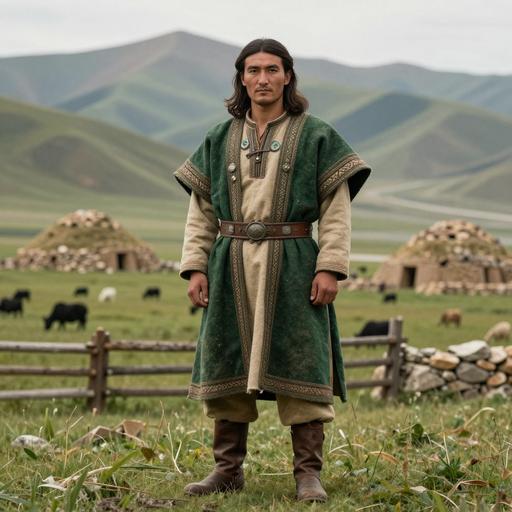
The Story
The journey of mtDNA haplogroup U2E1H1
Origins and Evolution
mtDNA haplogroup U2E1H1 is a downstream subclade of U2E1H, itself part of the broader U2 branch of haplogroup U. While the macro-haplogroup U has deep Upper Paleolithic roots across Eurasia, the U2E lineage and its H sublineages show a Holocene diversification centered on the South Asian subcontinent. Based on the position of U2E1H1 in the mitochondrial phylogeny and coalescence estimates for neighboring U2E subclades, a reasonable time depth for U2E1H1 is in the mid-Holocene (several thousand years ago), consistent with localized expansion and differentiation after the Last Glacial period.
Genetic drift, founder effects in small or endogamous communities, and localized demographic events in South Asia (including Neolithic to Bronze Age population structure) likely shaped the present-day distribution and internal diversity of U2E1H1.
Subclades (if applicable)
U2E1H1 is an intermediate terminal or near-terminal clade within the U2E1H branch. As an intermediate clade it may carry one or a few defining control-region and coding-region mutations that distinguish it from sibling lineages. Where fine-resolution sequencing (full mitogenomes) is available, U2E1H1 can be subdivided further into lower-level branches observed in specific populations or families; however, published datasets show that many detections remain sparsely sampled, and additional subclades will likely be resolved as more whole-mitochondrial genomes from South Asia and adjacent regions are generated.
Geographical Distribution
The highest frequencies and diversity of U2E1H1 are observed in the Indian subcontinent, particularly among both tribal (Adivasi) groups and many caste populations. Secondary concentrations appear in Pakistan (Punjabi, Sindhi, Pashtun and Baloch sampled groups) and in parts of Central Asia (Kazakh, Uzbek, Tajik and related groups), reflecting historical gene flow across the Iranian plateau and Central Asian corridors. There are sporadic, low-frequency detections in West Eurasia and North Africa, likely the result of rare long-distance maternal line transfers, historical mobility, or unsampled ancient connections. Ancient DNA reports occasionally retrieve U2E-related lineages from West Eurasian and South Asian archaeological contexts, but U2E1H1 itself is still mainly a modern South Asian-associated clade in available datasets.
It is important to stress that low-frequency detections outside South Asia do not imply a major demographic expansion from those regions; rather they reflect limited dispersal events, historical admixture, or sampling artifacts given the rarity of the clade outside its core range.
Historical and Cultural Significance
U2E1H1 likely formed and differentiated within the demographic landscape of Holocene South Asia. Its presence among a range of caste and tribal groups indicates it predates some later socio-cultural boundaries or has been maintained and transmitted through matrilineal continuity within communities. In broader terms, U2E1H1 exemplifies the pattern of regionally diversified maternal lineages in South Asia that persisted through the Neolithic and into the Bronze Age and later periods.
Where U2E1H1 is observed in Pakistan and Central Asia, its occurrence is consistent with historical and prehistoric contacts across the Iranian plateau, Silk Road corridors, and shared ancestry between populations on either side of these routes. Sparse detections in West Eurasia and North Africa may reflect isolated maternal gene flow from South Asia into those regions during historic trade, migration, or as a legacy of older prehistoric interactions.
Conclusion
mtDNA U2E1H1 is best understood as a South Asian Holocene maternal lineage whose distribution reflects localized origin, internal diversification, and occasional long-distance dispersal. Continued sampling and full mitogenome sequencing in South Asia, Pakistan, and adjacent regions will clarify its internal structure, refine its age estimate, and better document the historical pathways by which it reached peripheral regions of West Eurasia and North Africa.
Key Points
- Origins and Evolution
- Subclades (if applicable)
- Geographical Distribution
- Historical and Cultural Significance
- Conclusion