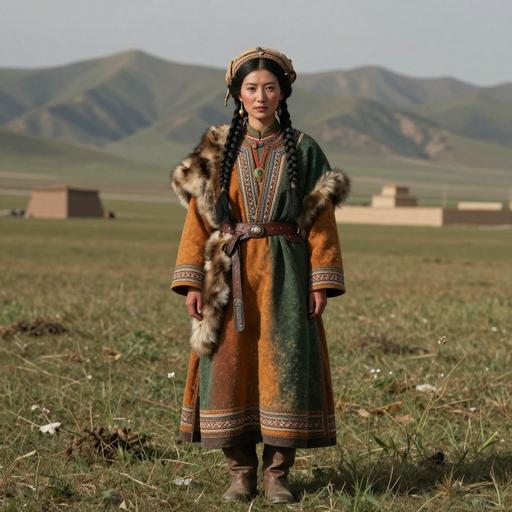
The Story
The journey of mtDNA haplogroup U3A1A1
Origins and Evolution
mtDNA haplogroup U3A1A1 is a downstream branch of U3A1A (itself a sublineage of U3), a West Eurasian maternal lineage. Based on phylogenetic position and the time depth estimated for the parent clade, U3A1A1 likely arose in the mid-Holocene (~5–6 kya) in the Near East or the Caucasus. Its emergence postdates the initial Neolithic farmer expansions into Europe and instead fits a pattern of more localized post-Neolithic demographic processes — including Chalcolithic and Bronze Age movements, trade-mediated gene flow, and regional population continuity in the Levant, Anatolia and adjacent regions.
Subclades (if applicable)
U3A1A1 is presently recorded as a relatively terminal and rare branch with few well-documented downstream subclades in published or public mitogenome databases. Where sub-branches have been reported they are typically geographically restricted and represented by small numbers of modern samples. The limited number of observed subclades and low frequency are consistent with a localized expansion followed by genetic drift rather than a large continent-spanning demographic event.
Geographical Distribution
Modern observations of U3A1A1 are concentrated in the Near East, the Caucasus and adjacent regions. Detectable but lower-frequency occurrences are reported in some North African (especially Berber-associated) groups and in parts of southern Europe (Italy, Greece, Iberia) where Near Eastern maternal lineages entered by prehistoric and historic contacts. Small numbers of occurrences in Jewish communities (both Sephardic and some Ashkenazi maternal lineages), South Asia and sporadic Central Asian reports indicate occasional long-distance dispersal, likely mediated by trade, migration and historical population movements. The lineage has been identified in at least one ancient DNA sample, supporting its presence in archaeological contexts and continuity in the region over millennia.
Historical and Cultural Significance
While U3A1A1 is not a major pan-regional haplogroup, its distribution carries useful signals about regional demographic processes in the mid- to late-Holocene. Its origin and spread align with periods of intensified inter-regional contacts across the Eastern Mediterranean, Anatolia and the southern Caucasus — including Chalcolithic and Bronze Age population dynamics, later Iron Age and historic-era trade (for example Phoenician and classical Mediterranean networks), and more recent medieval-era migrations that shaped Jewish and North African maternal pools. The presence of U3A1A1 in specific ethnic and cultural groups (e.g., some Levantine, Caucasus and Berber communities) suggests local persistence of maternal lineages alongside admixture from incoming groups.
Conclusion
U3A1A1 is a low-frequency, regionally focused mtDNA lineage whose phylogenetic placement and geographic pattern point to a Near Eastern/Caucasus origin in the mid-Holocene followed by localized expansions into the Levant, Anatolia, North Africa and parts of southern Europe. Its rarity and limited substructure make it more informative about local continuity and small-scale migrations than about large-scale population replacements. Continued mitogenome sequencing and ancient DNA sampling in the Eastern Mediterranean and Caucasus will improve resolution of its internal branching and historical movements.
Key Points
- Origins and Evolution
- Subclades (if applicable)
- Geographical Distribution
- Historical and Cultural Significance
- Conclusion