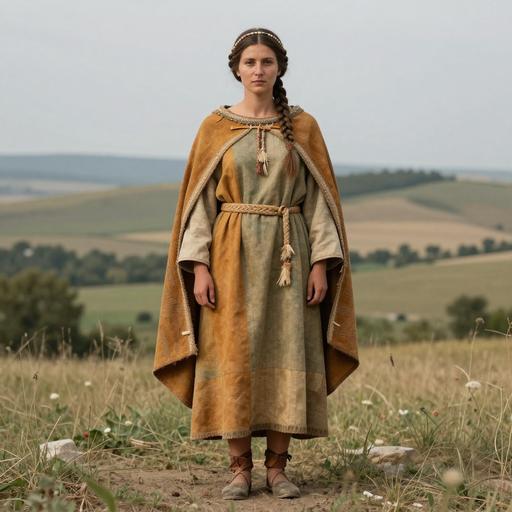
The Story
The journey of mtDNA haplogroup U5A1F1A
Origins and Evolution
mtDNA haplogroup U5A1F1A is a downstream branch of U5A1F1 (itself part of the broader U5a lineage). The U5 haplogroup is one of the earliest and most characteristic maternal lineages of post-glacial European hunter-gatherers; its diversification largely occurred during and after the Last Glacial Maximum. As a subclade of U5A1F1, U5A1F1A likely arose in Northern or Northeastern Europe in the early Holocene (on the order of ~9 thousand years ago), representing a localized differentiation of Mesolithic maternal lineages that persisted regionally into later periods.
Subclades
U5A1F1A is currently a relatively terminal and rare branch in published phylogenies and ancient DNA reports. It appears to have limited further deep subdivision in available modern and ancient datasets; many observations are singletons or small clusters consistent with a rare regional lineage. Because sampling is incomplete for many parts of northern Eurasia, additional very closely related subclades may be discovered as more whole mitogenomes are sampled.
Geographical Distribution
The distribution of U5A1F1A is concentrated in northern and eastern Europe with low-level presence beyond this core area. Observations come primarily from:
- Scandinavia (Norway, Sweden) and northern Fennoscandia
- Sámi and other northern indigenous groups (noting some unique maternal continuity in northernmost Scandinavia)
- Baltic populations (Estonia, Latvia, Lithuania)
- Eastern Europe (parts of Russia, Ukraine) at low to moderate frequencies in local samples
- Central Europe (Poland, Germany) at low frequency
- Caucasus and North Africa: very rare, likely due to later migration, drift, or sporadic gene flow
This haplogroup has been recorded in a small number of modern mitogenomes and is reported in at least one ancient DNA sample in current public databases, consistent with an ancient northern European presence.
Historical and Cultural Significance
Because U5A1F1A branches from a lineage strongly associated with Mesolithic hunter-gatherers, it is valuable for studies of regional population continuity in northern Europe. Its presence among modern Scandinavian and Baltic populations, and appearance in ancient samples, supports scenarios where some maternal lineages survived the Neolithic transition and later demographic events in northern Europe. While not specifically tied to large steppe expansions or pan-European farmer movements, U5A1F1A exemplifies the persistence of localized hunter-gatherer maternal ancestry through the Holocene.
Conclusion
U5A1F1A is a low-frequency, regionally informative mtDNA clade reflecting Mesolithic-derived maternal ancestry in Northern and Eastern Europe. It is most important for fine-scale studies of maternal continuity in Scandinavia and the Baltic and serves as a marker for tracing local demographic history; further mitogenome sequencing and ancient DNA sampling in northern Eurasia will improve resolution of its origin, age, and internal structure.
Key Points
- Origins and Evolution
- Subclades
- Geographical Distribution
- Historical and Cultural Significance
- Conclusion