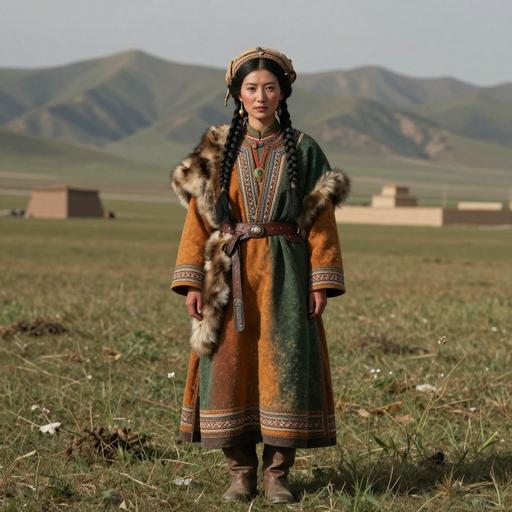
The Story
The journey of mtDNA haplogroup U8B1A1
Origins and Evolution
mtDNA haplogroup U8B1A1 is a downstream subclade of U8B1A, itself part of the broader U8 branch that has deep roots in Palaeolithic and Mesolithic Europe and adjacent regions. Based on phylogenetic branching and observed ancient DNA (aDNA) occurrences, U8B1A1 most likely formed in the western Mediterranean region (Iberia / southern Italy / Sardinia) during the early Holocene or the terminal Pleistocene, roughly ~11 kya. Its pattern — rare but persistent in some modern populations and present in multiple ancient samples — is consistent with survival of a local maternal lineage through post-glacial re-expansion and retention in relatively isolated coastal or island populations.
Subclades
U8B1A1 is a terminal or near-terminal subclade within the U8B1A lineage in published phylogenies and sample sets. Where deeper branching is observed, those sub-branches are extremely rare and often restricted geographically (e.g., Sardinia or specific Iberian localities). Compared with some other U-subclades (for example U5 or U4, which show broader Mesolithic distributions), U8B1A1 appears to have had limited radiations after its formation, producing a small number of closely related haplotypes detectable in both ancient and modern DNA.
Geographical Distribution
The distribution of U8B1A1 is concentrated in the western Mediterranean with sporadic occurrences elsewhere in southern Europe and the circum-Mediterranean. Modern and ancient detections show the following pattern:
- Iberian Peninsula (Spain and Portugal): the most consistent area of retention at low-to-moderate frequency in some regional samples, reflecting long-term regional continuity.
- Italy and Sardinia: Sardinia and parts of southern mainland Italy show low-to-moderate frequencies consistent with island persistence and refugial survival.
- Southern and Western Europe: rare detections in southern France and occasional low-frequency occurrences in parts of the Balkans.
- Near East / Anatolia, Caucasus, North Africa: sporadic or rare occurrences consistent with long-distance contact and Mediterranean mobility rather than primary centers of diversity.
A number of ancient DNA samples (on the order of a dozen-plus, noted here as 14 detections in curated aDNA datasets) include U8B1A1 or very closely related sequences, supporting continuity from Mesolithic/early Holocene contexts into later periods in localized regions.
Historical and Cultural Significance
U8B1A1's persistence in Iberia, Sardinia and nearby regions makes it an informative marker for studies of post-glacial recolonization, refugia, and long-term population continuity along the western Mediterranean rim. Its associations are most consistent with Paleolithic/Mesolithic hunter-gatherer ancestry, with limited incorporation into later farming expansions. In archaeological terms, U8B1A1 is most strongly tied to:
- Mesolithic and early Holocene contexts: presence in hunter-gatherer skeletal remains and early Holocene burials indicates deep antiquity.
- Neolithic and post-Neolithic presence at low frequency: occasional detection in Neolithic and later contexts (including coastal and island contexts) suggests assimilation into farming and maritime networks rather than large-scale demographic replacement.
Because it is rare and regionally concentrated, U8B1A1 can serve as a genetic signal of local continuity in population-genetic studies — for example, supporting models where parts of Iberia and Sardinia retained substantial Mesolithic maternal lineages through the Neolithic and later periods.
Conclusion
U8B1A1 is best interpreted as a regional, low-frequency remnant lineage of the western Mediterranean that traces back to the early Holocene or late Pleistocene. Its limited expansion relative to other European mtDNA clades, coupled with multiple aDNA detections, makes it valuable for reconstructing localized demographic histories, refugial survival, and the mosaic nature of post-glacial European maternal ancestry.
Key Points
- Origins and Evolution
- Subclades
- Geographical Distribution
- Historical and Cultural Significance
- Conclusion