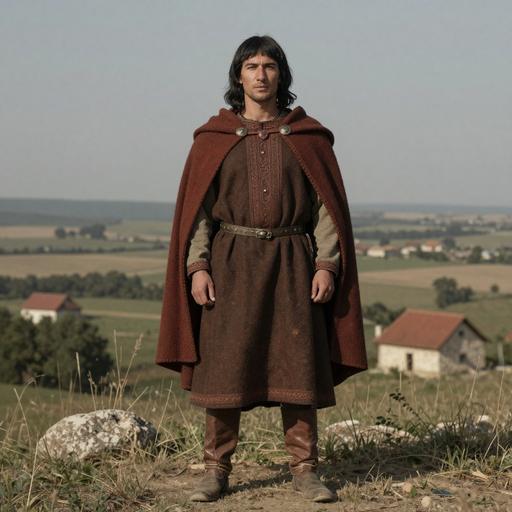
The Story
The journey of mtDNA haplogroup W1C
Origins and Evolution
mtDNA haplogroup W1C is a subclade of W1, itself nested within haplogroup W, which likely diversified in the Near East or the Caucasus after the Last Glacial Maximum. Based on its phylogenetic position under W1 and calibrated molecular clock estimates for W-lineages, W1C most plausibly arose in the early Holocene (around ~9 kya), during a period of expanding human populations, habitat shifts, and the early spread of farming communities from Anatolia and adjacent regions.
Genetically, W1C shows limited internal diversity relative to older mtDNA branches, consistent with a more recent origin and/or a history of localized demographic expansions and founder effects. Its derived mutations mark it as a distinct maternal lineage that can be tracked in modern populations and in some ancient DNA samples from the Neolithic and Bronze Age periods in western Eurasia.
Subclades (if applicable)
W1C is a terminal or near-terminal subclade within W1 in many published phylogenies; when defined further by high-resolution sequencing, W1C can split into small local lineages reflecting regional founder events. Because W1 overall has several shallow branches, W1C's own substructure is limited and often identified only with full mitochondrial genomes. Any deeper subclades of W1C tend to show geographically restricted distributions (for example, clusters concentrated in the Caucasus or northern Anatolia), indicating local expansion rather than broad continent-wide radiation.
Geographical Distribution
The contemporary distribution of W1C mirrors the broader W1 pattern but at lower frequencies. The highest relative concentrations are reported in the Caucasus and nearby Anatolia, with scattered occurrences across Eastern and Northern Europe, pockets in Central Asia, and detectable low-frequency presence in northwest South Asia (e.g., Pakistan, NW India). Small numbers of W1C have also been observed in western China and southwestern Siberia, likely reflecting long-distance movement and historic gene flow along trade and migration routes.
In ancient DNA studies, related W1 lineages appear in Neolithic farmer contexts in Anatolia and in Bronze Age individuals from the Caucasus and parts of Europe, supporting a model in which W1C was carried both by local postglacial populations and by later Neolithic/Chalcolithic demographic processes.
Historical and Cultural Significance
While W1C is not a high-frequency marker tied to any single large-scale prehistoric migration, it contributes to the maternal genetic signal of several important cultural horizons. Its presence in Neolithic Anatolia and the surrounding regions is consistent with female-mediated gene flow associated with the spread of early agriculture into Europe and adjacent areas. Later, small-scale movements during the Bronze Age and historic periods (including steppe-related expansions and trans-Caucasian interactions) likely redistributed W1C across broader portions of Eurasia.
Because W1C is relatively rare, its archaeological and historical significance is more informative at a regional level (for reconstructing local demographic events, founder effects, and matrilineal continuity) than as a marker of continent-wide transformations.
Conclusion
mtDNA haplogroup W1C is a geographically focused, low-to-moderate frequency maternal lineage that arose in the Near East/Caucasus region in the early Holocene and subsequently contributed—at modest levels—to the maternal gene pools of the Caucasus, Anatolia, parts of Europe, Central Asia, and northwest South Asia. It is most useful in population genetics as a marker of localized expansions and connections between Near Eastern, Caucasian, and neighboring Eurasian groups rather than as an indicator of a single large prehistoric migration.
Key Points
- Origins and Evolution
- Subclades (if applicable)
- Geographical Distribution
- Historical and Cultural Significance
- Conclusion