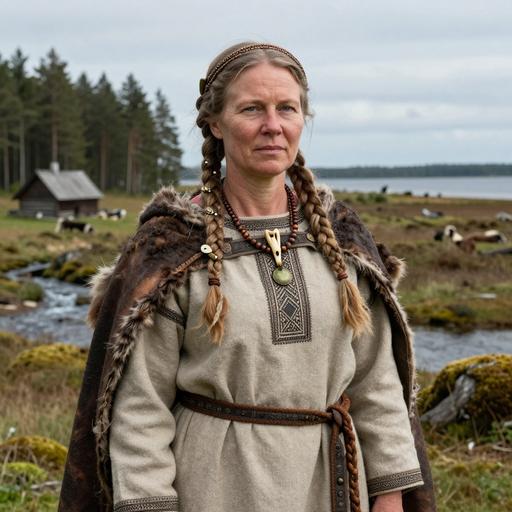
The Story
The journey of mtDNA haplogroup W3A1D
Origins and Evolution
W3A1D is a downstream subclade of mtDNA haplogroup W3A1, itself part of the broader West Eurasian haplogroup W. The parent clade W3A1 likely arose in the Near East / South Asia in the early Holocene (~8.5 kya) during a period of demographic growth and movement associated with post-glacial re-expansion and the spread of early farming. W3A1D likely formed later, during the mid-Holocene (estimated here around ~5 kya), as populations carrying W3A1 diversified and dispersed across adjacent regions.
Mutational differences that define W3A1D mark it as a useful micro-lineage for resolving maternal ancestry in archaeological and modern populations where W3A1 is present at low-to-moderate frequency. Because W-lineages are West Eurasian in origin, the emergence of W3A1D fits within the broader pattern of Near Eastern and South Asian maternal diversity that contributed to European, Caucasian and Central Asian gene pools through multiple waves of migration.
Subclades (if applicable)
As a named terminal subclade (W3A1D), it may have few or no widely sampled downstream lineages described in the literature; many W subclades are known from targeted sequencing of modern and ancient samples and from small clade-defining sets of control-region + coding-region mutations. Future mitogenome sequencing in under-sampled regions (South Asia, the Caucasus, Central Asia) may reveal further subdivisions within W3A1D or identify sister subclades that clarify its internal structure and more precise geographic origin.
Geographical Distribution
The geographic pattern for W3A1D is expected to mirror the patchy distribution of W3A1 but with reduced frequency and a more restricted footprint. Modern and ancient occurrences concentrate in:
- The Near East and adjacent South Asia where the parent lineage arose and diversified.
- The Caucasus and Central Asia, where long-distance contacts and population movements have introduced West Eurasian maternal lineages.
- Low-frequency occurrences in parts of Europe (Eastern, Northern and Western) that reflect downstream dispersals and later admixture.
Because W3A1D is rare, its detection in a particular population or archaeological sample is informative: it signals maternal links to West Eurasian/Near Eastern source populations and can help resolve fine-scale demographic events such as Neolithic farmer dispersals, Bronze Age movements, or historic-era migrations that involved gene flow between South Asia, the Near East and Europe.
Historical and Cultural Significance
Although not associated with any single high-frequency cultural complex, W3A1D fits into several broad demographic episodes:
- Neolithic expansions: The formation and early spread of W3A1 (parent clade) in the Near East and South Asia is contemporaneous with the Neolithic and post-glacial resettlement, suggesting that some W3A1-derived lineages (including W3A1D) may have moved with early farming or pastoral networks.
- Bronze Age transformations: Mid-Holocene and Bronze Age population movements (including steppe-related expansions and regional cultural interactions) provide plausible vectors for dispersing low-frequency maternal lineages from the Near East/South Asia into the Caucasus, Central Asia, and parts of Europe.
- Regional continuity and admixture: In South Asia and the Caucasus, W3A1D likely persists at low frequency due to local continuity and repeated admixture events between incoming West Eurasian lineages and indigenous maternal pools.
Ancient DNA hits (even if few) that include W3A1-derived lineages help anchor the clade in time and space and support its use as a marker for inter-regional maternal connections across the Holocene.
Conclusion
W3A1D is a low-frequency, regionally informative maternal lineage nested within W3A1. Its origins in the Near East / South Asia during the mid- to late-Holocene and its patchy presence across South Asia, the Caucasus, Central Asia and parts of Europe make it a useful marker for studying post-glacial, Neolithic and Bronze Age maternal interactions in West Eurasia. Broader mitogenome sampling and more ancient DNA discoveries will clarify its substructure, exact age, and specific migration pathways.
Key Points
- Origins and Evolution
- Subclades (if applicable)
- Geographical Distribution
- Historical and Cultural Significance
- Conclusion