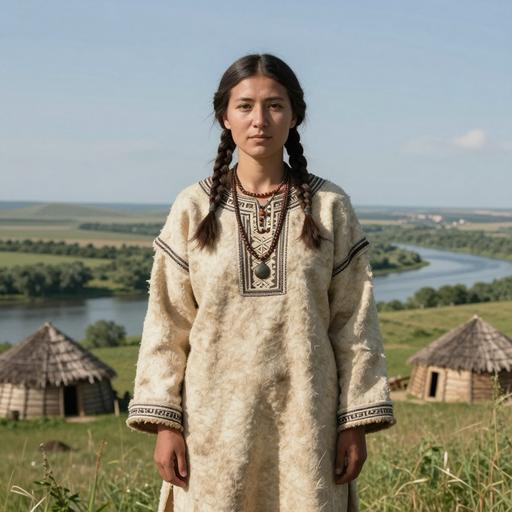
The Story
The journey of mtDNA haplogroup W6C
Origins and Evolution
mtDNA haplogroup W6C is a downstream subclade of W6, itself a branch of haplogroup W (within macro-haplogroup R). Based on the phylogenetic position of W6C beneath W6 and the geographic pattern of its occurrences, W6C likely split from other W6 lineages during the later Neolithic to Chalcolithic—into the Bronze Age period (roughly 4–5 kya). Its emergence postdates the initial expansion of haplogroup W out of Near Eastern/South Asian source areas, and its shallow time depth and patchy distribution are consistent with a localized origin followed by limited dispersal.
Subclades (if applicable)
Currently W6C is recognized as a distinct subclade beneath W6. Published datasets and public mtDNA phylogenies identify a small number of private and diagnostic mutations that define W6C; however, detailed internal branching and well-sampled named sub-subclades remain limited due to small sample sizes. As more full mitogenomes are sequenced in regions where W6C is detected, it is likely that additional internal structure will be resolved and that some geographically restricted sublineages will be identified.
Geographical Distribution
W6C is present at low to moderate frequencies across a broad but discontinuous area. Modern detections concentrate in South Asia (India, Pakistan) and the Caucasus / Iran / Near East with sporadic occurrences in Central Asia, parts of Eastern and Northern Europe, and rare detections in Western China / southern Siberia. The patchy distribution, occasional presence in archaeological samples, and localized clusters suggest founder effects, long-distance gene flow events, and maternal lineage persistence in refugia or culturally connected populations rather than a large-scale demographic expansion.
Historical and Cultural Significance
Because W6C is a relatively shallow subclade with limited frequency, it does not mark a major continent-scale migration by itself. Instead, its presence informs more subtle questions about regional maternal ancestry: links between South Asia and the Near East, post-Neolithic population interactions, and localized population movements in Chalcolithic and Bronze Age contexts. The occurrence of W6C in both South Asia and the Caucasus/Iran aligns with other maternal lineages that trace Neolithic farmer-derived gene flow and later Bronze Age exchanges across these regions. The single identified ancient DNA occurrence associated with this lineage supports continuity in at least one archaeological context, but the overall ancient record for W6C is sparse.
Conclusion
W6C is a small, regionally informative mtDNA lineage that illustrates how maternal subclades of broader West Eurasian haplogroups persisted and dispersed in complex, localized patterns after the initial Neolithic expansions. Continued dense mitogenome sequencing in South Asia, the Caucasus, the Near East, and Central Asia will clarify the internal structure, refine coalescence age estimates, and better tie W6C sublineages to specific archaeological horizons and migration events.
Notes on evidence and uncertainty: due to limited sample sizes and few ancient occurrences, estimates of age and distribution retain moderate uncertainty; improved mitogenome sampling and secure archaeological attributions are required to increase resolution.
Key Points
- Origins and Evolution
- Subclades (if applicable)
- Geographical Distribution
- Historical and Cultural Significance
- Conclusion