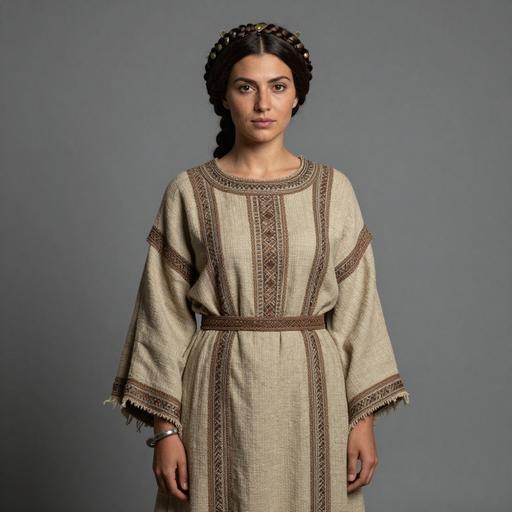
The Story
The journey of mtDNA haplogroup X2B5
Origins and Evolution
Haplogroup X2B5 is a subclade of mtDNA haplogroup X2B, itself part of the broader haplogroup X2, which has a deep Near Eastern and West Eurasian distribution. Given its phylogenetic position under X2B, X2B5 most likely emerged in the early Holocene (post-glacial) Near East, a period associated with population reorganizations and the spread of early agricultural communities. The estimated age for X2B5 (on the order of ~9 kya) is consistent with diversification during the Early to Middle Neolithic, when maternal lineages expanded from refugial and Near Eastern source regions into the Mediterranean, the Caucasus, and parts of Europe.
Subclades
As a named subclade of X2B, X2B5 may include further downstream branches in well-sampled datasets, but it is generally less frequent and less deeply branched than some other X2 subclades. Where present, X2B5 is defined by derived variants that place it within the X2B clade; however, because it is a relatively rare sublineage, the internal structure (further named subclades) is limited in frequency and sampling to date. Ongoing sequencing of modern and ancient mitogenomes may resolve additional downstream branches or refine the internal chronology of X2B5.
Geographical Distribution
X2B5 has a patchy but regionally coherent distribution: it is most consistently reported at low-to-moderate frequencies in southern Europe (Italy, Greece, the Balkans), the Near East (Anatolia and the Levant), and the Caucasus (Armenia, Georgia). It also appears at lower frequency in central and eastern Europe and sporadically in North Africa. The presence of X2B5 in ancient Neolithic contexts from Anatolia and in early farmer-associated remains in Europe supports a model of Near Eastern origin with subsequent dispersal into Europe during the Neolithic transition.
Historical and Cultural Significance
The pattern of X2B5—originating in the Near East and appearing in Neolithic archaeological samples—ties this haplogroup to the broader story of Neolithic demic diffusion: the movement of people who carried farming technologies and new maternal lineages into Europe and the Mediterranean. Its occurrence in some Jewish communities of eastern Mediterranean origin (Sephardic/Levantine-associated lineages) reflects the long-term regional continuity and mobility within eastern Mediterranean populations. Although not a dominant maternal lineage in any modern population, X2B5 serves as a useful marker of early Holocene Near Eastern ancestry in both modern and ancient DNA datasets.
Conclusion
mtDNA X2B5 is a regional, early-Holocene maternal lineage that exemplifies the post-glacial and Neolithic dispersal dynamics of Near Eastern maternal lineages into the Mediterranean, the Caucasus, and Europe. Because it is relatively uncommon, each observed modern or ancient occurrence of X2B5 helps refine the geographic and temporal picture of post-glacial population movements; future mitogenome sequencing will continue to clarify its internal branching and historical pathways.
Key Points
- Origins and Evolution
- Subclades
- Geographical Distribution
- Historical and Cultural Significance
- Conclusion