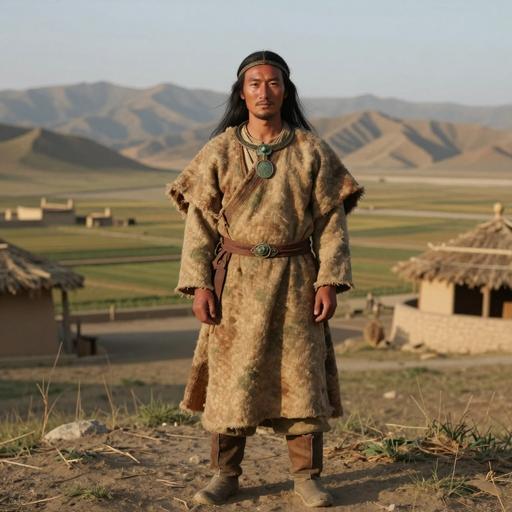
The Story
The journey of mtDNA haplogroup D4J3A
Origins and Evolution
Haplogroup D4J3A is a downstream branch of mtDNA haplogroup D4J3, itself a member of the East Asian D4 macro-haplogroup. Based on the phylogenetic position of D4J3A below D4J3 and on coalescent estimates for related D4 subclades, a reasonable estimate places the origin of D4J3A in the mid-Holocene (several thousand years after the initial formation of D4J3). Its emergence likely reflects local diversification of maternal lineages in Northeast/East Asia following late-glacial and early Holocene population re-expansions.
The mutation motif defining D4J3A is a set of coding- and control-region changes that mark it as a monophyletic group within D4J3; detailed diagnostic mutations depend on complete mitogenome sequencing and are used to place samples precisely on the phylogeny. The clade shows a pattern consistent with a regional founder event or limited expansion rather than continent-wide spread.
Subclades (if applicable)
D4J3A may itself contain further downstream branches identifiable only with whole mitogenome data; published and database samples often separate D4J3A into sublineages with local geographic clustering. As more complete genomes become available, substructure within D4J3A can be resolved to reveal microphylogeographic patterns (for example, sub-branches concentrated in coastal Primorye, Hokkaido/Japan, or particular Tungusic-speaking groups).
Geographical Distribution
The distribution of D4J3A is concentrated in Northeast Asia and adjacent Siberia, with low-frequency detections elsewhere in East Asia. Modern carriers are most often found among:
- Northeastern and northern Han Chinese (regional pockets)
- Korean populations (low frequency)
- Japanese samples (including occasional links to island/prehistoric contexts)
- Indigenous Siberian groups, particularly in the Russian Far East (Tungusic-speaking groups and scattered occurrences among other North Asian peoples)
- Low-frequency occurrences among Mongolic/Turkic-speaking groups in East-Central Asia
Ancient DNA has documented D4J3-type lineages in Holocene contexts of the Amur/Primorye region; a small number of ancient samples identified as D4J3-related lineages support continuity or recurrent presence of these maternal lineages in the Northeast Asian Holocene archaeological record.
Historical and Cultural Significance
D4J3A is informative for regional questions about small-scale maternal continuity and the demographic processes of the Holocene in Northeast Asia. Because the clade is not widespread at high frequency, it is particularly useful for:
- Tracking localized maternal ancestry and micro-migrations within the Amur-Primorye zone and the Japanese archipelago.
- Comparing hunter-gatherer and later Neolithic/horticulturalist maternal pools in the Russian Far East and northern Japan.
- Contributing to models of post-glacial north–south population structure and coastal versus inland dispersal routes in East Asia.
While not tied to a single major archaeological horizon across the entire region, D4J3A and related D4J3 lineages appear in contexts that reflect both Mesolithic/Neolithic-era forager populations and later population interactions during the Holocene.
Conclusion
D4J3A represents a regionally-focused maternal lineage within the broader D4 radiation of East Asia. Its mid-Holocene origin and patchy modern distribution make it a useful marker for studies of Northeast Asian microphylogeography, local continuity, and the fine-scale interaction between prehistoric populations of the Russian Far East, Korea, and Japan. Continued mitogenome sequencing and additional ancient DNA sampling are likely to clarify its internal substructure and refine its temporal and geographic history.
Key Points
- Origins and Evolution
- Subclades (if applicable)
- Geographical Distribution
- Historical and Cultural Significance
- Conclusion