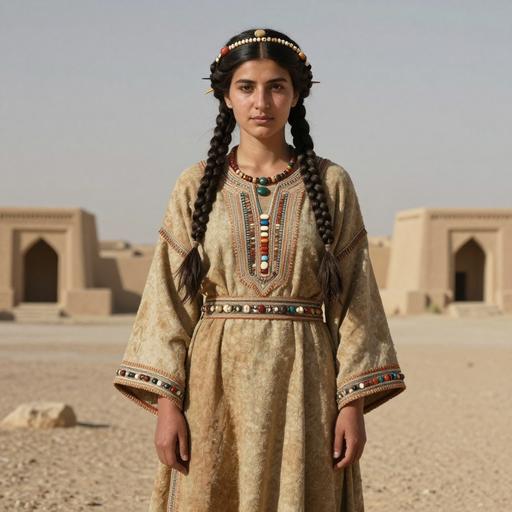
The Story
The journey of mtDNA haplogroup H6A1A26
Origins and Evolution
H6A1A26 is a low-frequency maternal lineage nested within the H6A1A2 branch of haplogroup H6. H6 as a whole has strong ties to Near Eastern and West Asian maternal diversity, with multiple subclades that spread into Europe during the Neolithic and subsequent post‑Neolithic periods. Given that its parent clade H6A1A2 is estimated to have arisen in the Near East/West Asia around the mid‑Holocene (~6 kya), H6A1A26 is plausibly a slightly younger offshoot that diversified locally in West Asia or adjacent regions during the Bronze Age to Iron Age timeframe (roughly 4–5 kya).
As with many rare downstream mtDNA branches, H6A1A26's phylogenetic placement indicates a regional differentiation event rather than a very deep or widely dispersed origin. Its rarity and the pattern of detection in modern and limited ancient samples suggest restricted demographic expansion and possible survival in pockets through drift, founder effects, or localized continuity in Near Eastern and neighbouring populations.
Subclades
H6A1A26 itself is a fine-scale terminal subclade beneath H6A1A2. There are currently no widely reported, deeply branching sub-lineages under H6A1A26 in public literature, which is consistent with its status as a relatively rare and recently recognized terminal lineage. Continued high‑resolution mtDNA sequencing and ancient DNA sampling could reveal additional downstream branches or clarify its internal diversity.
Geographical Distribution
H6A1A26 is reported only at low to very low frequencies where it does occur. The pattern of observation follows that of its parent clade, with focal detections in:
- Anatolia and the broader Near East / West Asia, where H6 diversity is high and where H6A1A2 originated.
- The Caucasus, reflecting regional sharing of maternal lineages between Anatolia and the southern Caucasus.
- Southern Europe and the Balkans, where low-level presence likely reflects Neolithic and post‑Neolithic gene flow from West Asia into Europe, plus later historical contacts.
- North Africa (Maghreb) and certain diasporic/Jewish communities have occasional low-frequency observations, consistent with historical population movements and trade connections across the Mediterranean.
The distribution is patchy and often detected in single individuals or very small numbers in modern datasets; this scarcity indicates either limited expansion or under-sampling in many regions.
Historical and Cultural Significance
Because H6A1A26 is a narrowly defined, low-frequency maternal lineage, its significance is primarily as a marker of localized maternal continuity and post‑Neolithic connectivity between West Asia, the Caucasus and adjacent parts of Europe and North Africa. Possible vectors and contexts that could explain its presence include:
- Post‑Neolithic population movements: expansions and trade networks in the Bronze Age and later periods that redistributed Near Eastern maternal lineages into the Aegean, the Balkans and southern Europe.
- Regional continuity in Anatolia and the Caucasus where certain maternal lineages persisted at low frequencies across millennia.
- Historical era mobility (e.g., classical, medieval, Ottoman periods) that produced additional low‑level gene flow across the Mediterranean and Near East.
Because the lineage is rare, it is less informative as a direct marker of large-scale migrations (unlike common haplogroups) but can be valuable in fine‑scale phylogeographic studies and in interpreting ancient DNA matches when present in archaeological individuals.
Conclusion
H6A1A26 represents a fine-scale, regionally concentrated maternal subclade deriving from H6A1A2 in the Near East / West Asia around the mid‑to‑late Holocene. Its low frequency and patchy distribution in Anatolia, the Caucasus, southern/eastern Europe and parts of North Africa point to limited demographic expansion and highlight the importance of additional sampling (modern and ancient) to clarify its full phylogeographic history. In population-genetic terms, H6A1A26 is best interpreted as a marker of localized maternal ancestry and post‑Neolithic connections between West Asia and adjacent regions.
Key Points
- Origins and Evolution
- Subclades
- Geographical Distribution
- Historical and Cultural Significance
- Conclusion