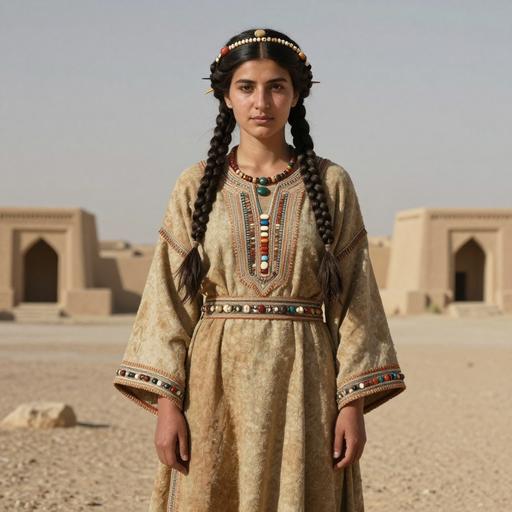
The Story
The journey of mtDNA haplogroup H79
Origins and Evolution
mtDNA haplogroup H79 is a downstream subclade of H7, itself a daughter lineage of the broadly distributed European/West Asian haplogroup H. Given the parentage (H7: origin estimated ~11 kya in the Near East/West Asia), H79 most likely arose in the Near East or adjacent regions during the early-to-mid Holocene (roughly ~7 kya) as local maternal lineages diversified after the Last Glacial Maximum and during the Neolithic transition. As with many H subclades, H79 is characterized by a small number of control-region and coding-region mutations that define it within the H7 branch.
Subclades
H79 appears to be a relatively deep but rare branch of H7 with few—or at present no widely recognized—further named subclades in published phylogenies; however, as more whole-mtDNA sequences are generated, additional internal structure (private or geographically restricted subclades) may be identified. Current data suggest H79 behaves as a low-frequency terminal clade within H7 rather than a diverse multi-branch lineage.
Geographical Distribution
The distribution of H79 follows the general footprint of H7 but at lower frequency. Modern and limited ancient DNA sampling indicate occurrences mainly in:
- Mediterranean Europe (Iberia, southern France, Italy)
- The Balkans and parts of Eastern Europe at low levels
- Near East / Anatolia and the Levant, where the parent H7 likely diversified
- The Caucasus and North Africa (Maghreb) in low-to-very-low frequencies
The pattern is consistent with a Near Eastern origin followed by dispersal into Europe during Neolithic farming expansions and subsequent regional demographic processes. H79 is uncommon in pan-European surveys and usually recorded only in small numbers of individuals, so frequency estimates remain low and geographically patchy.
Historical and Cultural Significance
Because H79 is rare, it does not define major prehistoric cultural expansions on its own, but it fits into broader models where maternal lineages from the Near East accompanied the spread of agriculture and later regional movements. It may be present at low frequencies in populations associated with Neolithic farmer-associated cultures (e.g., early LBK/Cardial-related expansions into Europe) and can also appear in later archaeological contexts through local continuity or gene flow. In population-genetic studies, rare H subclades like H79 are useful for tracing fine-scale maternal ancestry, local continuity, and micro-migrations rather than large-scale demographic replacements.
Conclusion
mtDNA H79 is best understood as a low-frequency, regionally scattered daughter clade of H7 with a Near Eastern origin in the Holocene and a distribution reflecting Neolithic dispersals and subsequent local population history across parts of Europe, the Caucasus and North Africa. Continued whole-mtDNA sequencing and ancient DNA sampling will clarify its internal structure, age, and precise geographic history.
Key Points
- Origins and Evolution
- Subclades
- Geographical Distribution
- Historical and Cultural Significance
- Conclusion