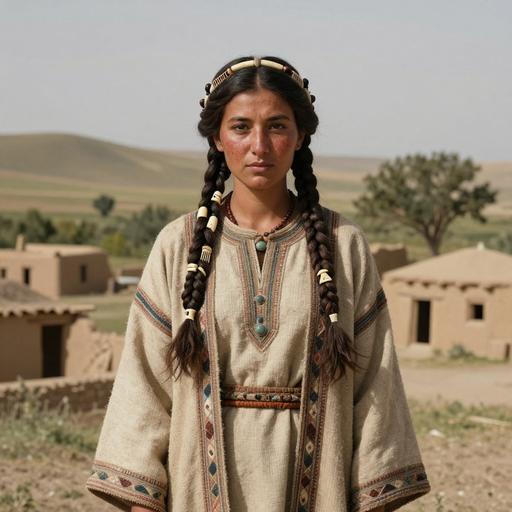
The Story
The journey of mtDNA haplogroup J1B1A3
Origins and Evolution
mtDNA haplogroup J1B1A3 is a subclade nested within J1B1A, itself a branch of haplogroup J1B1. Given its position in the phylogenetic tree, J1B1A3 most likely formed after the initial diversification of J1B1A in the early Holocene. The parent clade J1B1A has been associated with Near Eastern and Mediterranean Neolithic expansions; accordingly, J1B1A3 likely arose in the Near East (Anatolia/Levant) and expanded at low frequency into neighboring regions during subsequent Holocene demographic events. A conservative coalescence estimate for J1B1A3 is on the order of several thousand years (we use ~6 kya here as a plausible time depth based on its downstream position relative to J1B1A).
Subclades (if applicable)
As a specific downstream branch of J1B1A, J1B1A3 may contain further minor substructure that is detectable only with high-resolution full mitogenome sequencing. At present, J1B1A3 is best treated as a defined terminal or near‑terminal clade in many population datasets; localized subclades may be discovered as more complete mitochondrial genomes are sampled from under‑represented regions in the Near East and Mediterranean.
Geographical Distribution
J1B1A3 is observed at low to very low frequencies across a Mediterranean‑facing distribution consistent with its parent lineage. Modern occurrences are concentrated in:
- The Near East (Anatolia, Levant) where the lineage likely originated.
- Southern Europe along Mediterranean coasts (Iberia, Italy, Greece, Balkans) at sporadic, low frequencies, reflecting Neolithic and later maritime contacts.
- North Africa (coastal Maghreb) and the Caucasus at low frequencies, consistent with historical gene flow across the Mediterranean and Near East.
- Small, scattered occurrences in Central Asia, likely as a result of later long‑distance movements or low‑frequency drift.
In population samples, J1B1A3 is rare and usually represents a small fraction of J lineages. Where ancient DNA data permit, J1-derived lineages (including related subclades) appear in Neolithic and post‑Neolithic contexts around the Mediterranean, supporting a role in farmer expansions and regional admixture.
Historical and Cultural Significance
Because of its Near Eastern origin and Mediterranean presence, J1B1A3 is informative for studies of:
- Neolithic farmer dispersals from Anatolia into Europe and along Mediterranean coastal routes. J lineages in general are frequently interpreted as markers of early Holocene demographic movements tied to agriculture.
- Post‑glacial reoccupation and maritime exchanges that connected the Levant, Anatolia, southern Europe and North Africa; low‑frequency maternal lineages such as J1B1A3 can mark localized founder events or sustained low‑level gene flow.
- Historical diasporas and trade networks, including movements in the classical and medieval Mediterranean (e.g., Phoenician, Greek, Roman, later Islamic-era contacts) that can produce scattered occurrences of Near Eastern maternal lineages far from their origin.
J1B1A3 has also been detected at low frequency in some Jewish communities in which other J lineages are present, reflecting the complex maternal histories of diasporic populations; however, J1B1A3 is not a defining or high‑frequency marker for any single modern ethnoreligious grouping.
Conclusion
J1B1A3 is a low‑frequency, regionally informative maternal lineage that arose within the Near Eastern branch of haplogroup J and dispersed at modest levels into Mediterranean Europe, North Africa and adjacent regions during the Holocene. It is most useful in conjunction with other maternal and autosomal markers for reconstructing fine‑scale demographic events associated with the Neolithic and later Mediterranean connectivity. Increased mitogenome sampling, especially of ancient remains from Anatolia, the Levant and the Mediterranean rim, will clarify its precise age, internal structure and historical movements.
Key Points
- Origins and Evolution
- Subclades (if applicable)
- Geographical Distribution
- Historical and Cultural Significance
- Conclusion