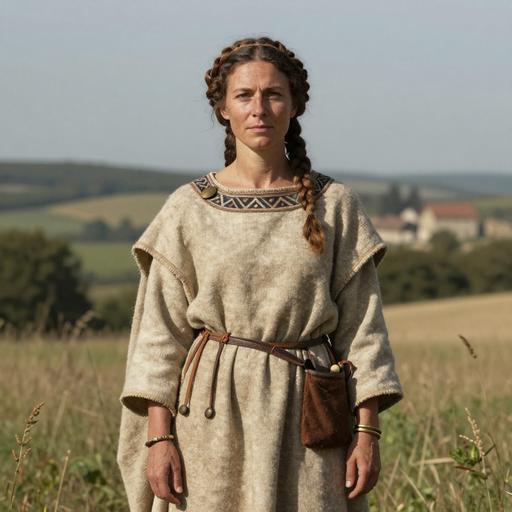
The Story
The journey of mtDNA haplogroup J1C2O
Origins and Evolution
mtDNA haplogroup J1C2O is a downstream branch of J1C2, itself a sublineage of haplogroup J1C. Given its phylogenetic position, J1C2O most plausibly arose in the Near East or the Caucasus during the early to mid‑Holocene (several thousand years after the initial diversification of J1C2). The parent clade J1C2 is associated with post‑glacial and early Neolithic movements from Anatolia/Caucasus into the Mediterranean, Europe and North Africa; J1C2O represents a more restricted and later‑branching maternal lineage that probably differentiated through local founder events or population substructure within those broader dispersals.
The defining mutations of J1C2O are private to this branch (relative to J1C2) and, because the clade is rare, have been observed only in a small number of modern samples and a handful of ancient contexts. That rarity suggests limited demographic expansion compared with some other J subclades, and a history shaped by localized migration, drift, and occasional long‑range movements (for example via coastal trade or diaspora communities).
Subclades
As a minor branch beneath J1C2, J1C2O may itself contain very few downstream lineages or private variants detected only in single individuals or small family groups. Current evidence indicates limited internal diversification (few named subclades), consistent with a young or bottlenecked sublineage. Future high‑coverage mitogenomes from targeted regions (Near East, Caucasus, Mediterranean) could reveal additional subbranches or help refine its internal structure.
Geographical Distribution
The modern geographic footprint of J1C2O is scattered and low in frequency. Based on its parentage and available observations, the clade is most likely to be found at low to moderate frequencies in:
- The Near East and Caucasus (the area of origin and early diversification).
- Southern and western Mediterranean Europe (reflecting Neolithic farmer and later maritime connections).
- North Africa (likely via Mediterranean contacts and historical movements).
- Pockets in Central Asia and along historical trade routes where Near Eastern lineages spread.
- Small representation within some Jewish diaspora communities, consistent with the broader presence of J1C2 lineages among Ashkenazi and Sephardi groups.
Because J1C2O is uncommon, its detection in a population often reflects either ancient local continuity or recent small‑scale migration rather than large, continent‑wide expansions.
Historical and Cultural Significance
Although J1C2O itself does not appear to have driven major demographic turnovers, its presence is informative for reconstructing finer‑scale maternal ancestry related to Neolithic farmer expansions from Anatolia and the Caucasus into the Mediterranean basin. The clade is consistent with scenarios in which small maternal lineages were carried by migrating farming communities, later persisting in coastal or upland refugia and occasionally being transmitted through historic trade networks or diasporas.
In archaeological contexts, J1C2O (like other J1C2 derivatives) can provide supplementary evidence for Near Eastern connections in ancient samples — for example, to test models of farmer colonization, maritime diffusion of peoples and goods around the Mediterranean, or gene flow between the Caucasus and neighboring regions during the Chalcolithic and Bronze Age. Where observed in Jewish populations, it may reflect assimilation of local maternal lineages or retention of Near Eastern maternal diversity through diasporic continuity.
Conclusion
J1C2O is a minor, regionally distributed maternal lineage that exemplifies how branching within larger haplogroups can document localized histories of migration, drift, and cultural interaction. It is most plausibly rooted in the Near East / Caucasus during the mid‑Holocene and persists at low frequency across Mediterranean and adjacent regions. Increased sampling and complete mitogenome sequencing in targeted regions will improve resolution of its age, internal structure, and past movements.
Key Points
- Origins and Evolution
- Subclades
- Geographical Distribution
- Historical and Cultural Significance
- Conclusion